
Every day, journalists, broadcasters, social accounts and AI assistants are shaping how people see your organisation. Media monitoring tracks that coverage across news, broadcast, podcasts, digital and social and turns it into signals you can act on.
Your story now reaches people through a newsroom, talkback segment, LinkedIn thread and an AI assistant summarising all of the above. Coverage moves faster, travels further and sticks around longer than ever before. If you're not watching, you're missing what's being said about you and could be missing your chance to control your brand’s narrative.
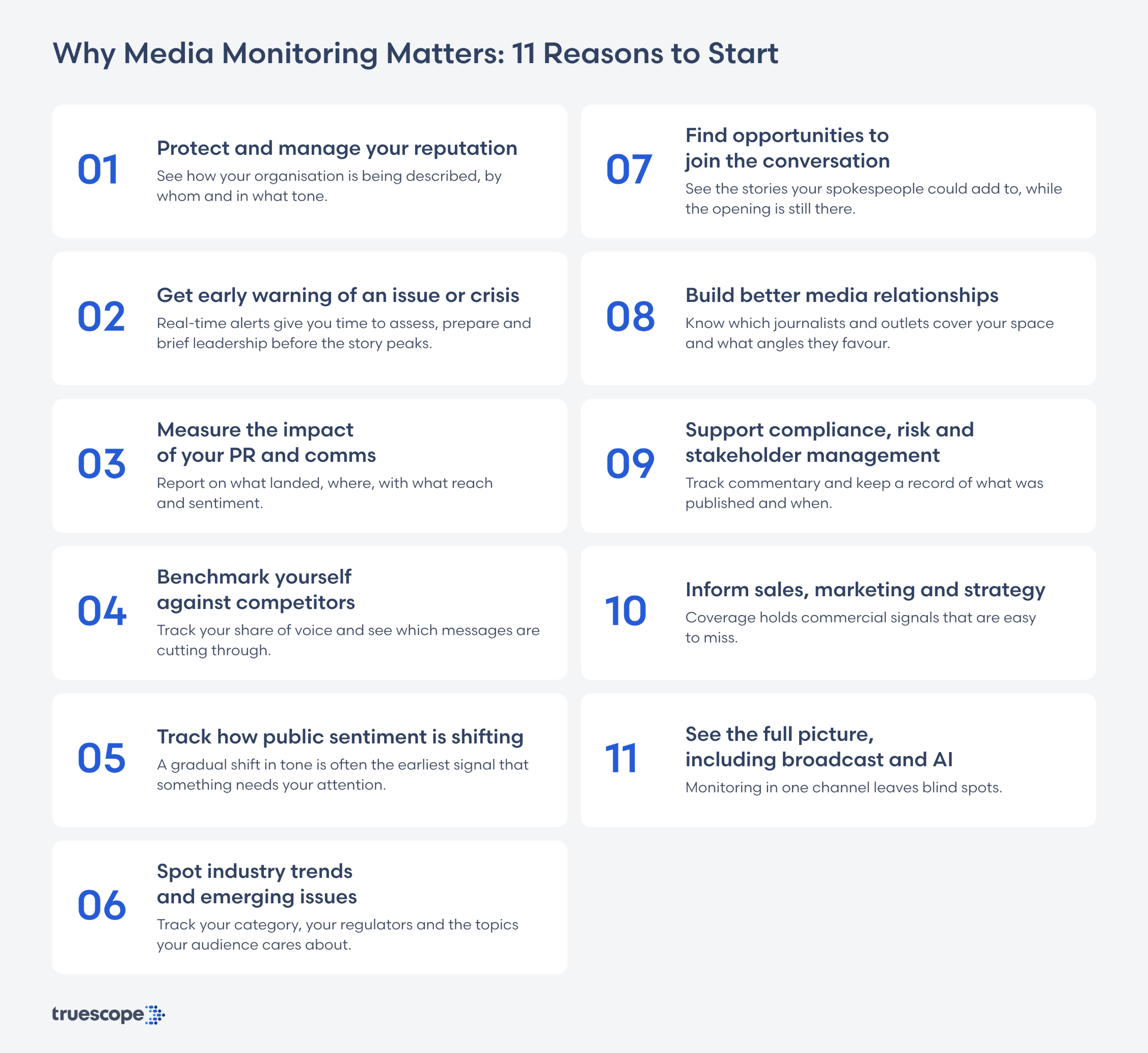
11 reasons your organization needs media monitoring
We’ve got 11 solid reasons why PR and communications teams need media intelligence and monitoring. Which of these are most relevant to you will depend on your organisation, your industry and where your team feels the gaps today. Let’s look at each.
1. Protect and manage your reputation
Media monitoring lets you track how your organisation is being described across news, broadcast and social, including who's saying it, where it's appearing and whether the tone is shifting.
That means you can catch an inaccurate story and request a correction before it gets syndicated, brief leadership on negative sentiment before they're blindsided, and reach out to the journalists shaping the conversation while the story is still developing.
Brand monitoring is ultimately what gives you something to point to when leadership asks "how are we perceived?" Instead of anecdotes, you can show them exactly how coverage sentiment, volume and share of voice have moved over a quarter, a campaign or a crisis.
2. Get early warning of an issue or crisis
Most crises don't arrive out of nowhere. They start as a regional story, a complaint gaining traction on social media, or a question at a press conference that catches someone off guard.
Real-time alerts give your team the window to assess the situation, align on a response and brief leadership before the story spreads. Without them, you're relying on someone stumbling across the coverage — and by then, journalists are already calling for comment.
If your team is building a crisis communications plan, monitoring is the early warning system it depends on.
3. Measure the impact of your PR and comms
When leadership asks what your comms work achieved, you need more than a list of clippings. Media monitoring gives you the data to answer with specifics:
- Where you appeared. Which outlets, broadcasts and social platforms picked up the story and whether they were the ones you were targeting.
- Who you reached. The audience size and potential impressions behind each piece of coverage, so you can show scale beyond just a headline count.
- How you were described. Whether the tone was positive, negative or neutral, and whether your key messages actually came through in the coverage.
- How you compare. Your share of voice against competitors, so leadership can see your coverage in context rather than in isolation.
- How it's trending. Whether sentiment, volume and reach are moving in the right direction over time.
The real value, though, comes when you connect these outputs to outcomes. Frameworks like AMEC's Integrated Evaluation Framework help structure that analysis, and monitoring is the data layer underneath it.
For example, Methodist Health System uses Truescope to build monthly reports with month-over-month and year-over-year comparisons across four hospitals and 30+ clinics, giving their comms team the evidence to show leadership exactly what PR delivered.
4. Benchmark yourself against competitors
Your coverage means more when you can see it next to your competitors'. Monitoring lets you track share of voice, which tells you how much of the conversation in your category belongs to you versus everyone else. It also shows you where competitors are getting coverage that you're not, including which outlets feature them, which journalists are on their beat, and what messages are resonating for them.
It also surfaces what competitors are actually doing. Product launches, executive moves, partnerships, pricing changes, and the issues they're being asked about? That’s all competitive intelligence that could otherwise take weeks of manual research or an expensive consultant engagement.
Forvis Mazars uses Truescope's AI research tools to benchmark their media presence against industry peers, turning share-of-voice data into evidence that helps their comms team demonstrate impact and justify continued investment to leadership.
5. Track how public sentiment is shifting
Sentiment analysis shows you the balance of positive, negative, and neutral coverage over time, and flags when that balance starts to move.
A gradual shift in tone around a product, an executive, or a policy position is often the earliest signal that something needs your attention, well before it becomes a headline. Use it to brief leadership on emerging reputational risk, adjust messaging that isn't landing, or confirm that a campaign actually moved perception in the direction you intended.
Truescope’s sentiment analysis, for example, scores every piece of coverage at the article, sentence, and entity level as it enters the platform. That means you can see not just whether an article was positive or negative overall, but how the specific brand, person, or topic you’re tracking was described within it.
When New Zealand Rugby announced a new All Blacks head coach, Truescope showed that positive sentiment hit 51% within 48 hours, well above their usual 33% baseline. That gave the comms team concrete evidence to take to the board rather than relying on gut feel.
6. Spot industry trends and emerging issues
Monitoring shouldn't stop at your own name. Tracking your category, your regulators, and the topics your audience cares about shows you where the conversation is heading. That way, you can prepare a position on a policy change before you're asked for one, contribute to a debate while it's still forming, or identify a story your organisation is well placed to comment on.
For example, a healthcare comms team tracking "staffing shortages" or "nurse burnout" across news and social would see the narrative building weeks before it reaches their CEO's inbox. That early visibility is the difference between having a response ready and being caught flat-footed.
7. Find opportunities to join the conversation
Every day, journalists write stories your spokespeople could have added to, such as a trend piece on your sector or a breaking story where you have expertise.
Reactive commentary is one of the most efficient ways to build a media profile, but it depends entirely on timing. Set alerts for the topics and beats that matter to your organisation, and you'll start catching opportunities your competitors miss because they're still reading yesterday's coverage.
8. Build better media relationships
Good media relationships start with knowing a journalist's work. Monitoring shows you which reporters, producers, and influencers cover your space, what angles they favour, and how they've written about you before.
That makes your outreach sharper. Instead of a cold pitch to a generic media list, you can reference a journalist's recent piece, understand their angle, and offer something that fits what they're already covering. It's hard to build rapport with a reporter whose work you haven't read.
9. Support compliance, risk and stakeholder management
In regulated sectors like financial services, healthcare, energy, and government, a single story about a product, a leader, or a compliance issue can prompt calls from investors, regulators, or the press. Risk, legal, and investor relations teams need to track that commentary as it appears and keep a time-stamped record of what was published and when.
Say a pharmaceutical company's drug trial results are reported inaccurately by a major outlet. Within hours, the story is syndicated across health news sites, picked up on social media, and generating questions from investors.
With monitoring in place, the comms team sees the original story the moment it publishes, flags the inaccuracy to legal, and coordinates a correction request before the narrative sets. Without it, they're finding out from their board.
10. Inform sales, marketing and strategy
Media coverage holds commercial signals that most teams outside comms never see. Think a prospect announcing expansion, a customer facing a public challenge, a competitor losing a key executive, a new regulation reshaping a market.
These are all published, and they're all actionable if the right people see them in time.
As the role of media intelligence expands beyond the comms team, organisations that share monitoring insights with sales, marketing, and strategy are finding it sharpens account planning, improves campaign timing, and surfaces opportunities that would otherwise require expensive market research.
11. See the full picture, including broadcast and AI
Audiences don't consume media in one channel, so monitoring in one channel leaves blind spots. Free tools like Google Alerts cover a fraction of the web and miss broadcast, podcasts, and most social entirely.
Most teams underestimate how much they're missing. Commercial radio reached 12.4 million Australians a week in GfK's last survey of 2025, and broadcast TV and BVOD together reached 87.2% of Australians each month in the second half of 2025 (OzTAM VOZ). If your monitoring only covers online, you're not seeing where a large part of your audience actually encounters your story.
And now, AI assistants write up summaries about your organisation for anyone who asks, drawing on what's already been published. This makes media monitoring more valuable in a world of generative AI precisely because the coverage you earn today shapes how AI describes you tomorrow. Monitoring that published record shows you what those answers are likely to say, and whether the narrative they're drawing from is one you'd want repeated.
What to look for in a media monitoring service
Not every platform delivers on every reason above, so it's worth knowing what separates a tool that collects clips from one that actually drives decisions. When you're evaluating options, these are the things worth testing:
- Coverage breadth. Print, online, broadcast, podcasts, and social, with broadcast treated as a core capability rather than an add-on. Ask for a source list and verify that the specific outlets you care about are included.
- Relevant results. Boolean search and smart filtering that separate the stories that matter from syndicated duplicates and background noise. Volume without relevance just creates more work.
- Speed. Real-time alerts that reach you before the story peaks. Test how alerts are configured and how quickly they actually land.
- Analysis you can explain. Sentiment, share of voice, and trend tracking that you can trust enough to put in front of leadership. If you can't explain how the numbers were calculated, they won't hold up in a board meeting.
- Reporting built for stakeholders. Dashboards and reports designed for the people who have to answer for the brand, not just the people running the searches. Ask whether reports can be customised, branded, and scheduled for different audiences.
- AI that goes beyond summarisation. Ask whether the AI can only summarise individual articles, or whether it can analyse across your full coverage, identifying patterns, profiling journalists, and breaking a question into multiple research threads. And when it delivers an answer, does it cite its sources so you can verify before sharing?
- Support from people who understand media intelligence. Find out who your account manager will be, whether they have comms industry experience, and whether support is available in your time zone.
Media monitoring is more important than ever
The media landscape is faster, more fragmented, and more consequential than it was even a few years ago. A story can move from a regional outlet to national news to an AI-generated summary in hours. Your stakeholders, your competitors, and your board are all watching. The platform you use to monitor and act on that coverage needs to keep up.
Truescope was built from the ground up on modern architecture, with data enrichment at its core:
- AI that analyses, not just summarises. Assistant, Analyst, and Search AI work directly with structured, enriched media data, so your team can go from a plain-language question to a source-cited analysis in minutes.
- Sentiment at the article, sentence, and entity level. See how your specific brand, person, or topic was described within a piece of coverage, not just the overall tone of the article.
- Customisable, automated reporting. Build branded reports for different stakeholder groups, with AI-generated summaries, and schedule delivery via email, Slack, Microsoft Teams, or WhatsApp.
- No caps. Unlimited searches, results, and report templates.
- Flexible contracts. No long-term lock-ins or auto-renewal clauses.
- Dedicated account managers. Fast, personalised support from a team with real media intelligence experience.
Ready to get started? Book a demo to see how Truescope fits your team.
Frequently asked questions
What is media monitoring?
Media monitoring is how organisations keep track of their coverage across news, broadcast, podcasts, and social media. A monitoring service pulls that coverage together, filters out the noise, and turns it into alerts and reports that help comms teams spot issues early, measure impact, and keep stakeholders informed.
Why is media monitoring important?
Media monitoring is critical because Ccoverage shapes how journalists, stakeholders and AI assistants describe your organisation, which influences how potential customers perceive your products and brand.
Media monitoring shows you that coverage early enough to respond, and gives you the evidence to show leadership what your comms work achieved.
What are the main reasons to invest in media monitoring?
Most organisations start with two or three reasons and expand from there. The most common are:
- Protecting and managing brand reputation
- Getting early warning of issues before they escalate
- Measuring the impact of PR and comms work
- Benchmarking coverage against competitors
- Keeping leadership and the board informed
- Tracking sentiment shifts over time
- Spotting opportunities for reactive commentary
Which reasons come first depends on your organisation, your industry, and where your team feels the pressure most.
Can Google Alerts replace a media monitoring service?
No. Google Alerts is free and useful for tracking a few keywords on the open web, but it doesn't cover radio, TV, podcasts, or most social platforms. It also has no sentiment analysis, share of voice, or reporting capabilities, so it can't produce the kind of coverage reports most comms teams are expected to deliver.
See how you can get more signals and insights from your media intelligence platform



See how you can get more signals and insights from your media intelligence platform
See how you can get more signals and insights from your media intelligence platform