
Media intelligence is the discipline of collecting, analyzing, and interpreting media coverage across every channel, including traditional and social media (press, broadcast, online, and social), to produce actionable intelligence that drives decisions. It’s what separates communications teams that know what’s being said about their brand from those that know what to do about it.
Most organizations have some form of media monitoring, far fewer have media intelligence, and the gap between the two is exactly where reputation is built or lost.
What is media intelligence?
Media intelligence is the systematic process of tracking, analyzing, and making sense of media coverage to inform communications strategy. It covers every channel where your brand, competitors, or industry appear (i.e. newspapers and trade publications, television and radio broadcasts, online news, podcasts, social media platforms (LinkedIn, X, TikTok, Reddit), and increasingly, the AI-generated answers that synthesize all of the above).
The term is often used interchangeably with media monitoring, but the distinction matters. Media monitoring is the collection layer, alerts, clip counts, a feed of media mentions. Media intelligence is the analytical layer on top of it, often utilizing natural language processing, machine learning, and advanced data analysis for trend analysis to process vast datasets. Monitoring tells you your brand appeared 47 times this week. Intelligence tells you sentiment shifted negative on Thursday, a single trade outlet drove 60% of that coverage, and a competitor’s product launch triggered the narrative change. Monitoring is data, intelligence is the context that makes data useful.
Media intelligence sits at the center of modern communications function because it connects the channel PR teams build coverage in, earned media, to the decisions that leadership teams need to make. Brand reputation, crisis response, competitive positioning, campaign measurement, and issues monitoring all depend on it.
A strong media intelligence program powered by a robust media intelligence platform monitors every relevant channel continuously, analyzes what the coverage means for brand reputation and competitive position, and delivers that analysis through customizable dashboards in a form leadership can act on.
What does media intelligence cover?
Media intelligence spans every channel where narrative about your brand, competitors and industry forms. Communications teams that monitor some of these and miss others are working with an incomplete picture.
- Print and online news. Print media is the traditional heartland of PR measurement, national newspapers, trade publications, regional outlets, newswires, and digital-native news sites. For most B2B brands, the trade outlets their buyers read carry more weight than any headline publication. Online news matters doubly, it generates backlinks that compound in search rankings long after the publication date, and it feeds the AI systems now assembling answers for your customers.
- Broadcast media. Television and radio are the most commonly under-tracked channels in earned media measurement. A segment on a national current affairs program or a morning radio interview can reach audiences that no press release will, and the sentiment those audiences form tend to be durable. Broadcast monitoring captures transcripts and clips so coverage doesn’t disappear between morning and evening teams.
- Social media. Social media is where narrative forms fastest and escalates furthest. A customer complaint, an employee post, a creator recommendation, or a viral moment can shift public perception in hours. Social media intelligence means moving beyond basic social media monitoring to employ social listening to track not just brand mentions but the themes, sentiment, influencers, and audience dynamic driving each conversation, including those happening in threads that never tag your brand directly.
- Podcasts and video. An industry podcast with 10,000 listeners of senior buyers is earned media that most clip-count dashboards never see. Podcast monitoring tracks brand and keyword mentions across episodes, giving communications teams visibility into conversations that are influential precisely because they’re specialist and trusted.
- Newsletters and niche publications. B2B buying decisions are increasingly influenced by independent writers and vertical-specific newsletters with small, expert audiences. These carry authority out of proportion to their circulation numbers, and standard monitoring tools often miss them entirely.
- AI generated content. The newest and fastest-growing category. When a customer asks an AI assistant a question about your market, the answer is assembled from sources the model treats as credible, predominantly earned media coverage. What AI says about your brand is now a media intelligence problem, not just a search engine optimization one.
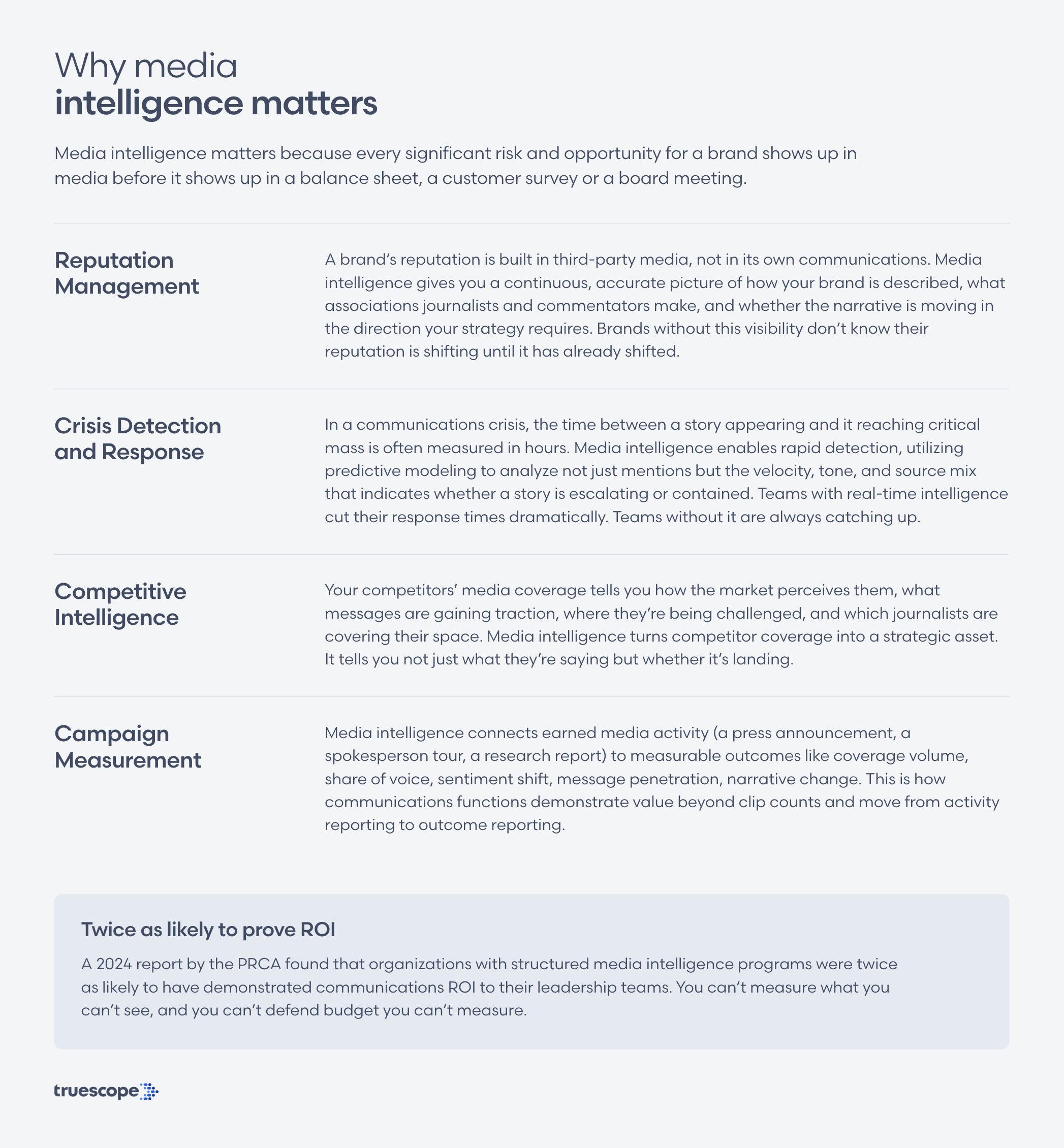
Why media intelligence matters
Media intelligence matters because every significant risk and opportunity for a brand shows up in media before it shows up in a balance sheet, a customer survey or a board meeting.
Media intelligence in the age of AI
Media intelligence now has a second mandate that didn’t exist a few years ago, understanding how AI systems describe your brand.
Truescope co-founder and CEO John Croll describes the industry as five distinct pillars:
- Media Monitoring, the foundation, knowing in real time what’s being said about you, your competitors, and your industry.
- Social Media Listening, the least controlled and fastest-moving of the five, where a comment section can turn a beautiful piece of content into a reputational problem within hours.
- The Media Database, how PR teams reach the right journalist, on the right beat, at the right time.
- Media Distribution, sending releases through trusted channels at scale, which matters more than ever as a marker of legitimacy in a fake-news era.
- Media Insights, where the enormous investment in collecting media data finally answers the “so what?“ question through sentiment, share of voice, and connection to business outcomes.
Most organizations buy these pillars from separate vendors, but Croll argues the real opportunity is a connected workflow where each pillar feeds the next and insights loop back into strategy. That connected, forward-looking view of the media landscape is exactly what the AI era now demands, because a whole new class of channels has emerged that no single pillar was built to see.
Google’s AI Overviews, ChatGPT, Perplexity, Claude, and Gemini are now answering a material share of the questions your customers and stakeholders used to resolve with a search results page. These systems synthesize answers from sources they evaluate as credible. Third-party media coverage, earned media, is weighted heavily. What your brand’s owned channels say about itself is weighted far less.
This creates a new layer of media intelligence work. Communications teams need to know not just what journalists are writing but what AI systems are surfacing when asked about their brand, category, and the problems their products solve. The answers AI gives today are built from the media coverage that existed when those models were trained. The coverage you earn in the next twelve months shapes how AI described your brand in the years after that.
Industry analysts are unambiguous about the direction. The channels that most heavily influence what AI thinks about a brand are the ones companies don’t control, YouTube, Reddit, Substack, specialist forums, and independent media. That’s a media intelligence problem at its core, you need to see the full media landscape of third-party conversation to understand what the machines are learning about you.
For communications leaders, this shifts the strategic calculus. Earned media was always valuable because audiences trust it. Now it’s also the raw material for AI-generated search, which means every piece of coverage you earn, every expert endorsement you secure, every category narrative you shift has a second life in how AI models describe your market. Media intelligence is how you track that process and manage it deliberately rather than by accident.
How to use media intelligence
Getting value from media intelligence requires more than a monitoring subscription or basic media intelligence solutions. Here’s how high-performing communications teams structure the discipline.
Share of Voice
Share of voice, your brand's proportion of coverage within a defined competitive set and topic area, is the metric that most immediately connects media intelligence to strategic positioning. It benchmarks where you stand, reveals where competitors are gaining ground, and gives leadership a number they can track over time. It's almost always the first question a CCO or CMO asks.
Sentiment Analysis
Binary sentiment classification is the floor, not the ceiling. Effective media intelligence analyzes the themes driving sentiment changes, the sources carrying negative versus positive coverage, and the direction of travel. A brand improving from 40 percent positive to 60 percent positive coverage over a quarter has a story to tell. A brand holding steady at 70 percent positive but seeing its largest-circulation outlet turn critical has a story to worry about.
Message Pull-Through
If your communications strategy is built on three key messages, market leadership, innovation, customer outcomes, media intelligence tells you what percentage of your coverage actually reflects those messages. Message pull-through is one of the most useful metrics for connecting PR strategy to execution, and one of the most neglected.
Monitoring Spokespeople
Coverage of your CEO, CTO or chief communications officer is brand coverage. Media intelligence tracks spokesperson coverage separately, volume, sentiment, outlets, topic association, so you can understand how your executives' public presence is contributing to or complicating the brand narrative.
Coverage to Business Signals
The measurement discipline that elevates media intelligence from a communications tool to a business intelligence tool is linking coverage to business outcomes, branded search volume, direct website traffic, inbound lead volume, demo requests and sales pipeline in the weeks following major coverage. Attribution is imperfect and always will be. Directional evidence, trended over quarters and connected to specific campaigns or announcements, is sufficient to hold budget conversations at the executive table.
Retire AVE
Advertising value equivalency, multiplying coverage area by advertising rates, has been formally displaced by AMEC's Integrated Evaluation Framework and should not appear in any current media intelligence report. It measures the wrong thing (what you would have paid for equivalent ad space) rather than the right thing (the impact the coverage actually had). AMEC's framework connects activity to outputs, outcomes and organizational impact instead.
Real-Time Cadences
Effective media intelligence operates at two speeds simultaneously. Real-time alerts for crisis detection, breaking news and competitor announcements. Weekly and monthly reporting for narrative tracking, share of voice trends and campaign measurement. Quarterly strategic reviews for executive reporting and budget justification. Different tools, different cadences, different audiences, one connected picture.
Frequently asked questions about media intelligence
What is Media Intelligence in Simple Terms?
Media intelligence is the process of tracking everything the media says about your brand, competitors and industry, across news, broadcast, social media and podcasts, and turning that data into insight that shapes communications decisions. It goes beyond monitoring alerts to understanding what coverage means and what to do about it.
What is the Difference between Media Monitoring and Media Intelligence?
Media monitoring is the collection layer, alerts, clip feeds and coverage archives. Media intelligence is the analytical layer on top, sentiment analysis, share of voice, narrative tracking, competitive benchmarking and strategic reporting. Monitoring tells you what was said. Intelligence tells you what it means.
What Channels does Media Intelligence Cover?
A comprehensive media intelligence program covers print and online news, broadcast (television and radio), social media platforms, podcasts and video, newsletters and niche publications, and, increasingly, the AI-generated answers that synthesize third-party media content. Teams that monitor some channels but miss others are working with an incomplete view of their brand's reputation.
How is Media Intelligence used in PR and Communications?
PR and communications teams use media intelligence for reputation management, crisis detection and response, competitive intelligence, campaign measurement, issues and regulatory monitoring, and board-level reporting. It connects earned media activity to outcomes that leadership can evaluate, share of voice, sentiment shift, message penetration, and business signals like branded search and inbound leads.
What Metrics does Media Intelligence Produce?
The core metrics are share of voice, sentiment, coverage volume, reach, message pull-through and spokesperson coverage. These are most useful when trended over time, benchmarked against competitors and connected to business outcomes. AMEC's Integrated Evaluation Framework provides the industry-standard structure for moving beyond volume metrics to outcome reporting.
Is Media Intelligence the same as Competitive Intelligence?
They overlap but aren't the same. Competitive intelligence is a broader discipline covering market dynamics, product positioning and business strategy. Media intelligence is the specific practice of analyzing media coverage, which contributes one data stream to competitive intelligence. Most organizations use media intelligence as the foundation for their competitive media analysis: tracking competitor share of voice, narrative and journalist relationships.
Why is Media Intelligence Important for AI Search?
AI search engines like Google's AI Overviews, ChatGPT and Perplexity build their answers from sources they evaluate as credible, with independent third-party media coverage weighted highly. What AI says about your brand is shaped by what media has historically said about it. Media intelligence helps communications teams understand what AI is saying about their brand and competitors, track the third-party sources that influence those answers, and manage their earned media strategy with AI visibility in mind.
Intelligence your communications teams can’t operate without
Media monitoring tells you what was said. Media intelligence tells you what it means, who's driving it, where it's heading, and what to do. In an environment where reputation forms in channels you don't control and AI search engines are trained on the coverage your PR team earns, the distance between those two things has never mattered more.
Every significant reputation risk, competitive shift and communications opportunity shows up in media before it shows up anywhere else. The question is whether your team is equipped to see it clearly enough, early enough, to act.
If your communications function is working from alerts and clip counts rather than genuine intelligence, that's the gap to close. See how Truescope works for PR and communications teams, book a demo.
See how you can get more signals and insights from your media intelligence platform




See how you can get more signals and insights from your media intelligence platform


.svg)