
When a comms leader asks me how to get their brand cited inside ChatGPT, Perplexity or Gemini, they usually want a clean answer. There isn't one. At least not the kind that fits on a slide.
The honest answer is that brand visibility in ChatGPT and other AI assistants sits on reputation, and reputation takes time to build. That's the part most people don't want to hear. Generative Engine Optimisation, or GEO, sometimes called Answer Engine Optimisation or AEO, isn't SEO with a new acronym. You can't pay your way to position one. The large language models decide which sources have authority, and they decide it slowly, based on patterns of trust and recurrence that take many months to shift.
That's why I think AI search optimisation is fundamentally a communications problem, not a marketing one.
Why comms, not SEO
Reputation has always been the comms team's job. They build the foundation of trust that everything else, marketing, sales, growth, gets to stand on. The structure of GEO mirrors that. Citing brands in AI answers comes down to whether the sources that talk about you carry weight with the model, whether your content is structured in a way a machine can read first and a human second, and whether the message stays consistent enough that the LLM treats you as a recognised authority on the topic.
That's reputation work. That's authenticity work. That's earned media work. None of it lives inside an SEO team.
Marketing now has two distinct jobs: market for humans, and market for machines and those might end up being two different teams. I think that's right. And in any organisation that takes reputation seriously, the team marketing to machines should sit inside comms.
The four foundations of GEO PR
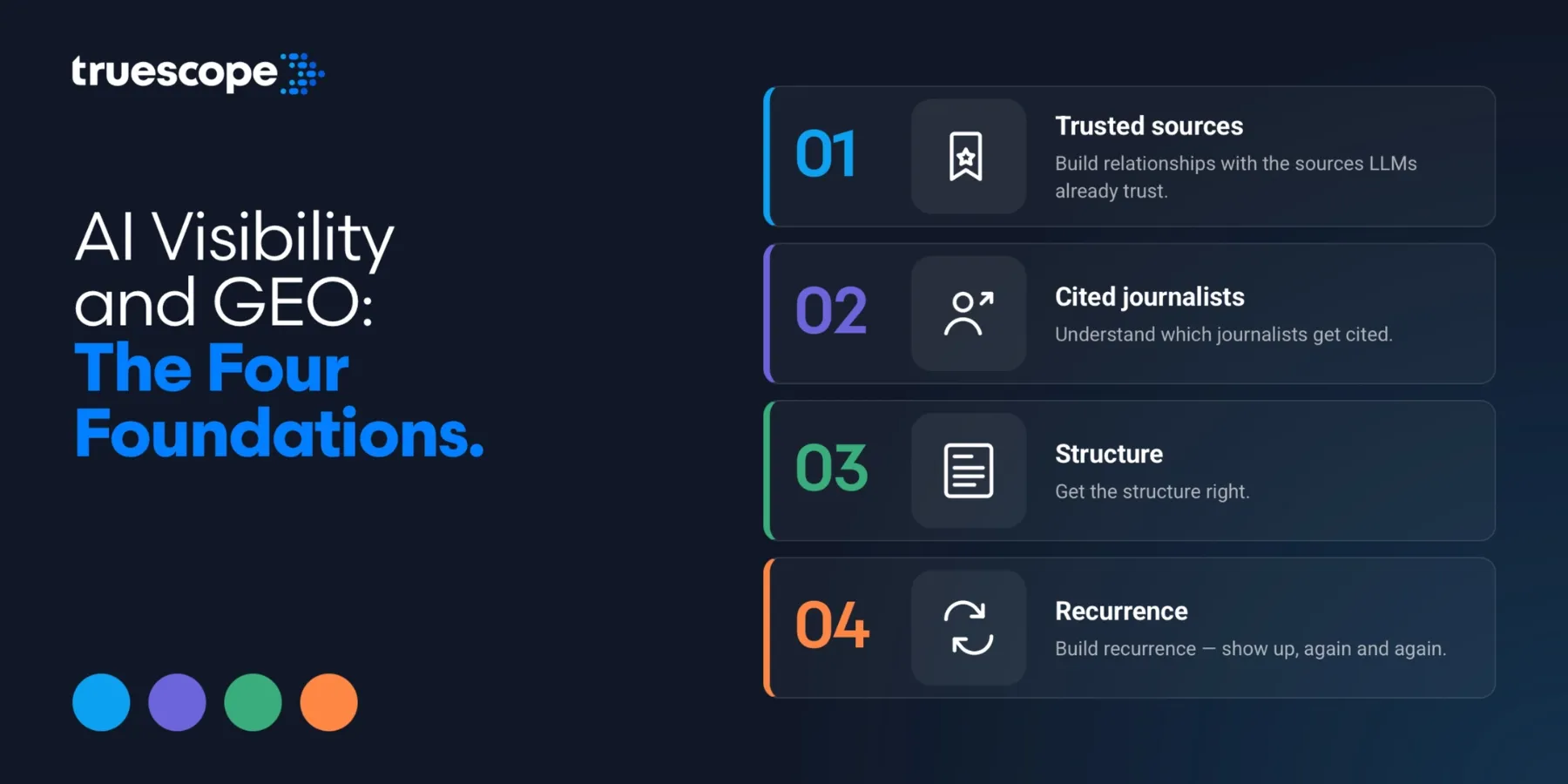
When I'm asked where to start, this is what I tell people. There are four foundations for GEO PR, and they are not optional.
- Build relationships with the sources LLMs already trust. LLMs pull disproportionately from a smaller set of authoritative outlets. Know who they are, in your market and your vertical.
- Understand which journalists get cited. The journalist is the product. Reaching the right one, on the right beat, with something they actually care about is how earned coverage gets created, and earned coverage is what the models are reading.
- Get the structure right. Your first audience is a machine. If a model can't parse it, it doesn't matter how well a human reads it. Headings, claims, attribution, schema, this is the new craft.
- Build recurrence. One mention is noise. A pattern of mentions, across credible sources, on a consistent message, is what builds your position inside the model. The LLM looks at the recurrence and decides this is the source I should be looking at.
None of it is mysterious. It is also not free, and it is not fast.
Chance for comms team to own GEO
There's a real conversation happening inside organisations right now about who owns the AI visibility budget, marketing or comms. In a lot of cases, marketing has already won that argument, because marketing turns up to those discussions with data, with spend, with return on investment, with clear cause and effect. Comms has historically turned up with vanity metrics, and that has cost the function dearly.
GEO PR changes the maths. Industry research suggests earned media accounts for around 82% of all citations inside LLM responses (source: Muck Rack's What is AI Reading? study). That is a comms data point. If a comms team can show which earned coverage is actually driving large language model results, which articles, which outlets, which messages, which journalists, they can finally walk into the boardroom with the kind of impact reporting marketing has been bringing for a decade.
In some markets, the Chief Communications Officer is already a trusted advisor to the CEO. In others, comms still reports up through marketing. Either way, the rule is the same. You earn the seat at the table when you turn up with numbers that connect to strategy. If you can't link your work to a business decision, the function gets commoditised. GEO PR is one of the cleanest opportunities I've seen for comms to get on the right side of that line.
What winning looks like in 2027
If you ask me what the scoreboard looks like a few years from now, when half of audience discovery happens inside an AI assistant, I think it comes down to three measures.
- Quality. Volume of clippings won't matter. A handful of strong, well-positioned mentions in high-citation sources will beat a thousand weak ones.
- Authority. The LLM will consistently surface a small number of brands as the authoritative voice in any given vertical or issue. Being one of them is the prize.
- Reputation. The walled garden is real. Audiences will get the answer they need without clicking through. The brand the model trusts is the brand the buyer trusts.
That's a different game from the one most teams are measured on today. It is also a fairer one. Quality, authority and reputation have always been what comms was actually built to deliver. The AI era finally gives us a way to measure it.
The teams that figure this out first will own the citation. And in a world of AI-mediated discovery, the citation is the brand.
New: AMEC releasing their industry-led GEO principles
One last thing worth flagging. AMEC has just released its GEO Principles, a framework setting out seven measurement principles and three evidence domains: upstream information and reputation, search and content readiness, and downstream AI output tracking. It is a clear signal that our industry is moving from anecdote to standard, and it gives comms teams a credible scaffold to build a GEO PR programme on. If you're serious about measuring AI visibility this year, this is worth a read.
See how you can get more signals and insights from your media intelligence platform




See how you can get more signals and insights from your media intelligence platform


.svg)