
Earned media monitoring is the practice of tracking and analysing the coverage your organisation earns rather than pays for: news articles, broadcast segments, podcasts, blogs, and social posts where someone else talks about you. Done well, it tells you what the world is saying about your brand in close to real time, and it gives you the evidence to prove your public relations work is landing. Done badly, or not at all, you are guessing.
This guide is for in-house comms managers and PR leaders who need a reliable way to capture earned media across every channel, measure it with numbers that mean something, and report it to people who control the budget. We will cover what earned media monitoring is, why it matters more in 2026 than it did five years ago, the channels it has to reach, a step-by-step method for tracking coverage, the metrics worth measuring, and how to turn all of it into a board-ready story.
What is earned media monitoring?
Earned media is any coverage a third party gives you without being paid for it. A journalist quotes your spokesperson, a podcast discusses your product, a customer posts a glowing review. It carries weight because the audience reads it as independent, not as an advertisement. Audiences trust word of mouth and peer recommendations more than traditional ads.
Earned media monitoring is the process of finding, capturing, and analysing that coverage wherever it appears. It sits next to two other categories in the PESO model. Owned media is what you control, such as your website and newsletters. Paid media is what you buy, such as advertising and sponsored posts. Earned media is what others choose to say, which is why it is both the most credible and the hardest to track.
The reason teams invest in monitoring is simple. You cannot manage what you cannot see. Earned media moves fast, it spreads across broadcast, print, online and social at once, and a single story can shift public opinion before lunch. Monitoring gives you a live view of that coverage so you can act on it, measure it, and report it.
Why earned media monitoring matters now
Two things have changed the stakes. The first is speed. News breaks and travels in minutes, and a negative story you spot early can be managed, while one you find a day late has already set the narrative, especially when negative reviews and complaints spread quickly on social media. Monitoring earned media is your early warning system for reputation and the front line of crisis communications. Because crisis management is resource-intensive and demands time and expertise, delayed detection usually drives up the cost.
The second change is artificial intelligence search. When people ask ChatGPT, Perplexity or Google's AI Overview a question, the answers are built largely from earned coverage. The Bliss Group reports that 89 to 94 per cent of citations in AI-generated search summaries come from earned media (Bliss, citing analysis by Britopian). That figure does not translate directly into traffic or leads, but it does mean the coverage you earn now shapes what audiences are told about you by machines as much as by people. If you are not monitoring that coverage, you have no idea what the answer engines are repeating about your brand.
For comms leaders, there is a third reason. Budgets are scrutinised every cycle, and you need to show how trust affects business results: 71% of customers buy less from companies they distrust, while 93% are more loyal to trusted companies. Earned media monitoring is how you replace anecdote with evidence for the business.
What channels earned media monitoring has to cover
A lot of monitoring tools quietly narrow earned media down to online news and social posts, because those are the cheapest channels to crawl. That leaves a hole. To monitor earned media properly, you need coverage across every channel where your audience actually pays attention.
Broadcast and television
Broadcast is the channel most tools treat as an afterthought, and it is the one comms leaders most often need. A two-minute segment on the evening news or a mention on drive-time radio can reach more of your target audience than a week of online articles, yet it is invisible to a platform that only scans the web. That matters even more at scale, with Truescope monitoring over 2,500 international TV and radio channels. The gap is wider in any market where much of the coverage that shapes opinion still runs on television and radio that web-first tools barely index. Proper earned media monitoring captures television and radio as searchable transcripts and clips, and lets teams refine alerts by media types so broadcast is logged the same way an online article is. This is the ground Truescope was built on, and it is where we monitor the broadcast coverage that other tools miss. For the detail on how this works in practice, see our piece on tracking broadcast and radio coverage.
Online news, print and podcasts
Online news is the high-volume channel, and it needs de-duplication and syndication tracking so one wire story picked up by forty outlets does not read as forty separate wins across earned media coverage in different media channels. Licensed print coverage still matters for many sectors, and podcasts have become a serious earned media channel that text-only monitoring ignores. Some platforms, such as Critical Mention, offer customizable alerts by media type for tighter monitoring workflows.
Social and creator content
Social posts, influencer content, social media mentions and customer reviews round out the picture. Positive reviews on digital platforms can significantly influence purchasing decisions. The point is not to monitor every channel for its own sake. It is to make sure that when you report on your earned media, the number reflects the whole of your coverage across news outlets, review sites and social media platforms, not the slice that happened to be easy to collect.
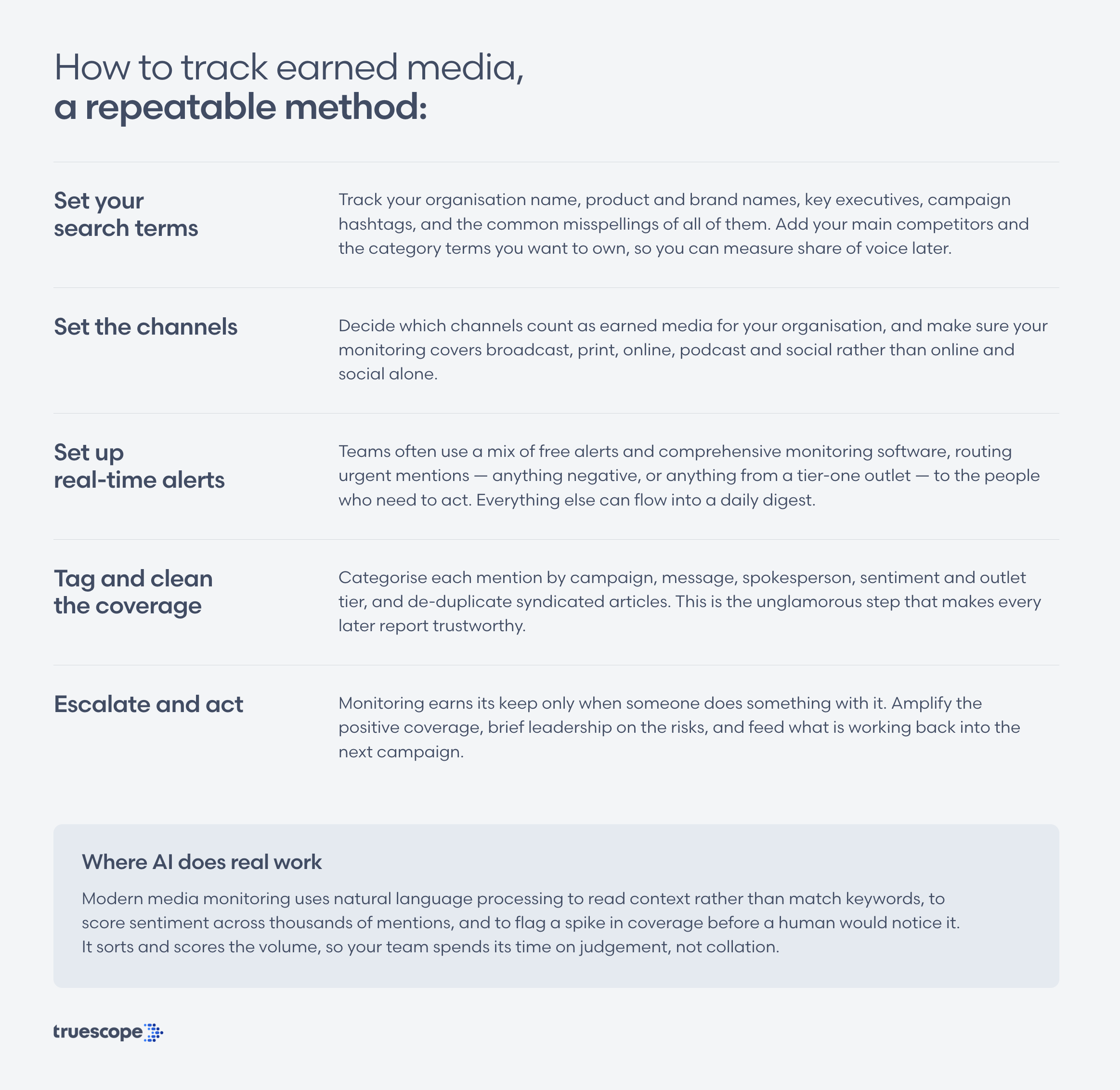
How to track earned media: a step-by-step method
You do not need a complicated programme to start. You need a repeatable method.
What to measure: sentiment analysis and the metrics that matter
Volume tells you how much coverage you earned. It does not tell you the actual impact. The metrics that matter measure quality and outcome, not just quantity.
- Reach and prominence: how many people could have seen the coverage, and whether your brand was the headline or a passing mention.
- Sentiment: whether coverage was positive, negative or neutral, scored consistently so you can track the trend over time.
- Share of voice: how much of the category conversation you own compared with your competitors, and benchmarking competitors can help identify growth opportunities. Share of voice is one of the few earned media metrics that maps cleanly to a commercial goal.
- Message pull-through: whether the coverage carried the messages you actually wanted, not just your name.
- Backlinks and referral traffic: when an article links to your site, you can measure the visitors it sent, which is one of the most concrete ways to tie earned media to ROI.
A word on what not to measure. Advertising value equivalent (AVE) has been displaced as a credibility metric and the industry has moved on from it. Some teams still quantify earned media value by estimating what equivalent advertising cost would have been for the same reach, but AMEC, the global body for communications measurement, formally rejected AVE because it puts a fictional advertising price on editorial coverage and tells you nothing about impact. Use AMEC's Integrated Evaluation Framework instead: it links your activity to outputs, to outcomes, to organisational results, which is the chain a board actually cares about. If a tool still leads with AVE, a metric the industry has moved on from, treat that as a sign it has not kept up.
How to report earned media to your board
The reporting is where most of the value is either captured or lost. Leadership does not want a list of clippings. They want to know whether the communications function moved a number that matters to business results.
Frame every report around the outcome, then use the metrics as evidence. Lead with share of voice against competitors, the sentiment trend, and the two or three stories that carried your key message to the right audience. Tie referral traffic and any measurable lift to the coverage that drove it, which is how earned media enters the ROI conversation alongside the channels finance already trusts. Keep impressions in the appendix, because on their own they are a vanity metric that inflates the picture without proving anything. When you compare performance to the market, show how coverage affected brand visibility. Report separately on brand exposure so executives can see how reach shifted over time.
The goal is a short, honest narrative the C-suite can repeat: here is the coverage we earned, here is how it compares to the market, here is what it did for the organisation and the actual impact on the business. Consistent earned media monitoring is what lets you tell that story the same way every quarter, which is how PR earns the trust of the people who set the budget.
Frequently asked questions
What is earned media monitoring?
Earned media monitoring is the process of tracking and analysing unpaid coverage of your organisation across broadcast, print, online, podcast and social channels. It captures what third party sources say about your brand, including organic mentions, so you can measure reputation, prove the value of public relations, and respond to issues early.
How do you track earned media?
Set your search terms (brand, products, executives, competitors and category terms), choose the channels that count as earned media, select the media types and relevant media channels to track, set up real-time alerts for urgent mentions, tag and de-duplicate the coverage, then act on what you find. A media monitoring tool with a media database automates the collection and organization so your team can focus on analysis.
What is the difference between earned, owned and paid media?
Earned media is coverage others give you for free, such as press articles and reviews, while shared media refers to brand content distributed on social platforms and then shared by audiences. Owned media is what you control, such as your website and newsletters. Paid media is what you buy, such as advertising. Earned media is the most credible because the audience sees it as independent.
What metrics measure earned media?
The useful ones are reach and prominence, sentiment, share of voice, message pull-through, and the backlinks or referral traffic that connect media coverage and media mentions to ROI. Avoid advertising value equivalent (AVE), which AMEC has rejected as a measure of impact. Anchor your measurement to AMEC's Integrated Evaluation Framework instead.
Why does earned media monitoring matter for AI search?
Most citations in AI-generated answers come from earned media, so the coverage you earn now shapes what tools like ChatGPT and Google's AI Overview tell people about your brand. Monitoring earned media is how you see what those answer engines are repeating about you.
Where to go from here
Earned media monitoring only works when it covers every channel, measures quality rather than volume, and produces a report the board trusts. Most PR teams have the third channel, social, well covered and the first, broadcast, barely at all. That gap is the difference between a complete picture and a partial one.
See how Truescope monitors earned media across broadcast, online, print and social in one place, built for PR professionals and communications teams who need to measure and prove the value of their public relations efforts and PR efforts. See how Truescope works for PR teams.
See how you can get more signals and insights from your media intelligence platform




See how you can get more signals and insights from your media intelligence platform


.svg)