
Reputation management monitoring is the practice of tracking what is said about your brand across every channel that shapes how people see you, then acting on it. That means news, broadcast, radio, podcasts and social media, not just review sites and X mentions. For a comms team, it is the early-warning system and the evidence base in one, it tells you when perception is shifting, why, and what to do before a small problem becomes a public one.
Most guides on this topic are written for local businesses watching their Google and Yelp reviews. This one is written for communications and PR teams who have to answer to a CEO or a board when a story breaks. If that is you, here is what to monitor across your brand's media coverage, how to read it without fooling yourself, and how to report reputation in a way leadership trusts.
What is reputation management monitoring?
Reputation monitoring is the ongoing process of finding, tracking and analysing every mention of your brand across media and online conversation. Reputation management, or online reputation management, is the wider discipline of shaping that perception over time. Put the two together and reputation management monitoring is the layer that feeds the management. You cannot manage what you cannot see.
In practice, that means watching coverage and conversation across earned media (news articles and journalist coverage), broadcast and radio, podcasts, social media, online forums, review platforms, online and social media mentions. A good media monitoring setup pulls all of that into one place, uses AI to classify what it finds, flags what matters with real-time alerts, lets you measure brand sentiment and share of voice rather than just counting mentions, helping you gauge public perception and protect your online reputation.
The reason this has moved up the agenda is simple. Trust is now a buying factor. In Edelman's 2025 Trust Barometer, most customers said brand reputation and trust matter as much as price and quality. Reputation is no longer a soft metric,t moves revenue, and does so faster than it used to.
Reputation monitoring vs reputation management: what is the difference?
The two terms get used interchangeably, but they are not the same job.
Reputation monitoring is the listening half. It answers "what is being said, where, by whom, and in what tone." It is continuous, and it is largely a data problem, collecting mentions across channels, removing noise, classifying sentiment, and surfacing the items a human needs to see.
Reputation management is the acting half. It answers "what do we do about it." Responding to a journalist, correcting a false claim, briefing an executive, amplifying a positive story, or standing up a crisis response. Management decisions are only as good as the monitoring underneath them.
For communications teams the distinction matters because a sound reputation management strategy depends on monitoring online reputation before teams can act. Teams respond well once they know. They get caught out when they don’t know in time, because the signal was on a channel they were not watching, a breakfast radio segment or a podcast rather than a tweet. That distinction is what makes reputation work a proactive strategy rather than a reactive scramble.
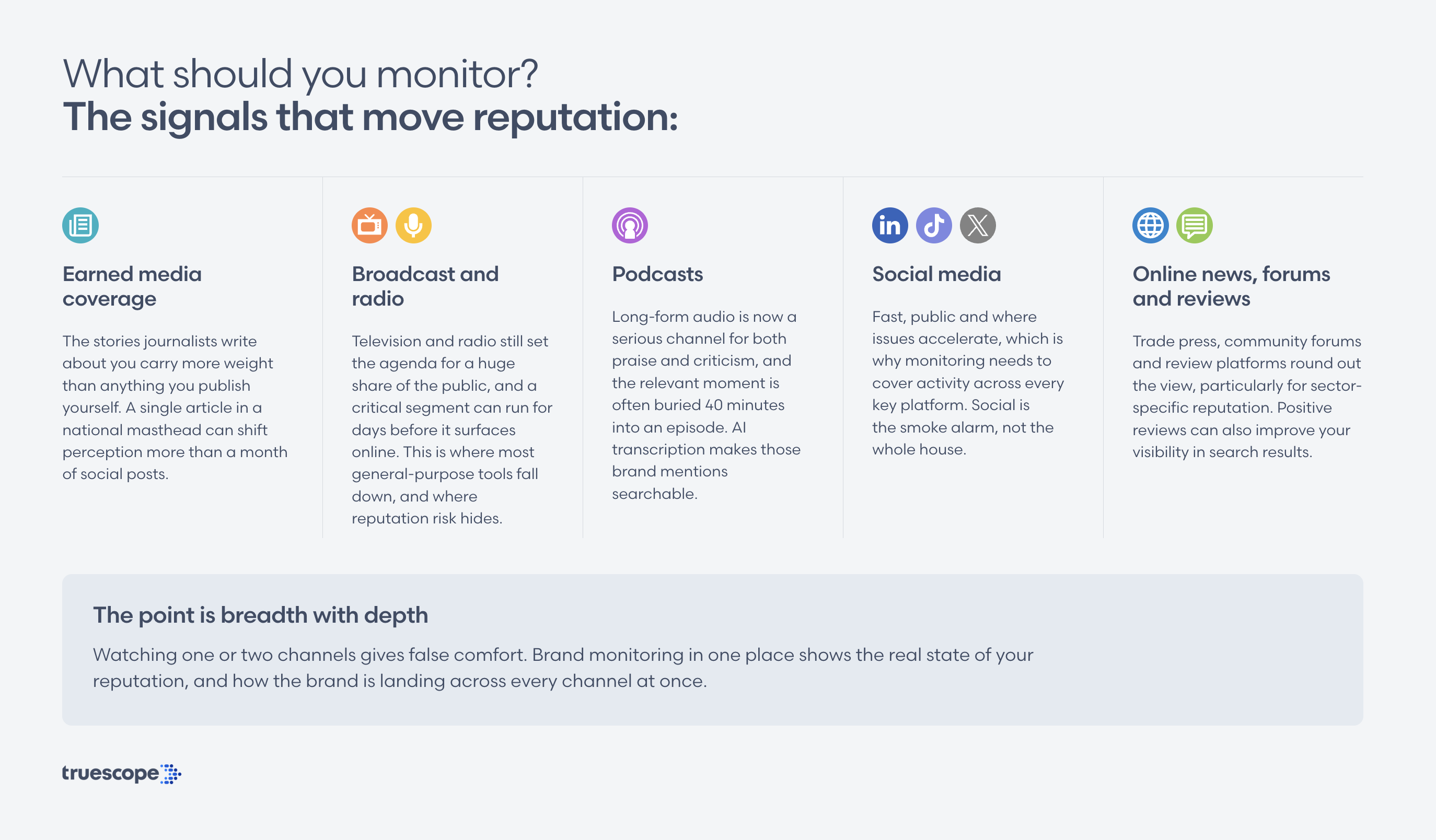
What should you monitor? The signals that move reputation
Reviews and social mentions are part of the picture, not the whole of it, especially for enterprise, government and public-sector brands. The signals that move reputation sit across several channels at once.
Reading sentiment and share of voice without fooling yourself
Two metrics do most of the heavy lifting in reputation monitoring: sentiment and share of voice.
Sentiment analysis, usually AI-driven, classifies each brand mention as positive, neutral, or negative, so you can see the tone of the conversation and not just its volume. It is useful, but with a caveat. Automated sentiment struggles with sarcasm, industry jargon and context, so the score is a guide, not gospel. Use it to spot shifts and triage what needs a human read, then check the items that matter yourself.
Share of voice tells you how much of the conversation in your category is about you versus your competitors, and whether those shifts reflect changes in brand perception rather than mention volume alone. A reputation can be quietly healthy and still losing share of voice, which is its own kind of risk.
No metric is perfect. The value is in the trend: watching sentiment and share of voice move over weeks and months, against real events, is what turns monitoring into actionable insights and helps teams identify trends in brand perception.
Catching a crisis early
The strongest argument for reputation monitoring is crisis management. Almost every reputational crisis has a window, often hours, between the first signal and the moment it goes wide. Monitoring buys you that window.
A spike in negative feedback, negative reviews, wider customer concerns, an unusual cluster of coverage, or a critical broadcast segment are the early signals. Real-time alerts that fire when volume surges or sentiment drops let teams respond quickly and address negative feedback proactively while they can still shape the response, rather than reading about it once it has run. The brands that come through a crisis well are usually the ones that knew first. During that window, assigning a dedicated crisis management team is crucial so ownership, approvals, and actions are clear from the outset.
Good monitoring gives the communications team the facts (what was said, where, by whom, how far it has spread) so the response is calm and evidence-led instead of reactive. If negative reviews are part of the issue, the monitoring data tells you that too.. For more on turning signals into a plan, see our guide to navigating a PR crisis with confidence.
How to measure brand reputation (and report it to the board)
At some point you have to tell leadership how the brand is doing, in language they trust, and reporting should be built around clear key performance indicators rather than vanity numbers or advertising value equivalency (AVE), a discredited measure the industry has moved on from. We do not use AVE, and neither should your board reporting.
The credible alternative is AMEC's Integrated Evaluation Framework, which ties media activity to outcomes that matter, reach into the right audiences, quality and tone of coverage, share of voice against competitors, movement on the perceptions you are trying to shift, and outcomes leadership may care about, such as customer satisfaction and trust. The framework gives you a defensible way to show brand reputation as a trend tied to business goals, rather than a pile of clippings. Competitive benchmarking is part of this as share of voice shows not just how you’re tracking but how you compare.
For the board, reporting that lands is short and consistent entailing how sentiment and share of voice are trending, what drove the movement, and what the team did about it, with a clear link to business growth. Done well, reputation reporting turns the communications function from a cost into a source of intelligence the C-suite relies on. Our piece on how PR analytics proves value goes deeper on building that case.
What to look for in a reputation monitoring tool
If you are assessing reputation management tools, the buyer's checklist for a communications or PR team looks different from the one a local business uses. Five things matter most.
Channel coverage. Does it monitor broadcast, radio and podcasts, or only text and social? Strong online reputation management tools use the right monitoring tools to cover channels beyond text and social. This is the question that separates tools built for communications and PR teams from tools built for review management.
Real-time alerts you can tune. You want a clear signal when a mention spikes or sentiment drops, set to the brands, topics and people you care about, not a firehose.
Sentiment and share of voice you can trust. Look for transparency about how sentiment is scored and the ability to correct it, plus competitor benchmarking so you can see how your brand sits against rivals for effective reputation management.
Reporting that suits executives. The platform should produce board-ready output, not just dashboards, with key features such as reporting, alerts and analysis, so the work of turning data into a story does not fall on you every week.
Service and local depth. For brands in Australia and the wider APAC region, local media, local broadcast and local context matter. A tool with global reach but no Australian depth will miss the coverage that actually affects you.
The right tool enables businesses to maintain a positive online presence and gain a competitive advantage..
Truescope was built for exactly this: comprehensive media monitoring across news, broadcast, radio, podcasts and social, with AI that transcribes and analyses coverage so communications teams see what matters and can prove it. For the wider view, see our take on modern media monitoring and on transforming PR with integrated monitoring and insights.
Frequently asked questions
What is reputation management monitoring in simple terms?
It is tracking what is said about your brand across news, broadcast, social and review channels—often called online reputation monitoring—then using that information to protect and improve how people see you. Monitoring is the listening; management is the acting on it to help maintain a positive online image and a positive image over time.
Is reputation monitoring just about online reviews?
No. Reviews are one signal, but online brand reputation monitoring still needs to capture customer feedback from review sources. In app marketplaces, 77% of users won't download apps rated below 3 stars. One negative review can drop ratings by 0.4 stars in 48 hours. For most organisations, news coverage, broadcast and radio segments, podcasts and social conversation move reputation far more than review-site ratings, so monitoring needs to cover all of them. Engaging with positive reviews can strengthen brand loyalty.
How do you measure brand reputation?
Track sentiment (the tone of coverage), share of voice (your presence versus competitors), and the quality and reach of coverage, because measuring reputation means keeping track of the right metrics over time, then read them as trends over time to help maintain a positive public image. AMEC's Integrated Evaluation Framework is the recognised way to tie those measures to business outcomes. AVE is outdated and no longer used by serious comms teams.
What is the difference between reputation monitoring and social listening?
Social listening watches social channels. Reputation monitoring is broader: it covers online reputation and brand image concerns across social, earned media, broadcast, radio, podcasts, reviews, as well as social media engagement and wider customer engagement signals, every channel that shapes a brand's reputation.
How quickly can monitoring help in a crisis?
The value is speed, because proactive reputation management depends on seeing issues early. Real-time alerts can surface a negative spike or a critical broadcast segment within minutes, giving the comms team the hours-long window it needs to respond before the issue spreads and helping protect customer relationships.
Where to start
Reputation management monitoring is only as good as the channels it watches and the framework it reports against. Start by mapping where your brand's reputation actually lives, which is almost always wider than reviews and social. Then make sure your monitoring reaches all of it, and reports in language your board trusts.
See how Truescope helps maintain brand consistency across news, broadcast and social worldwide, supporting a stronger positive public image. Book a demo.
See how you can get more signals and insights from your media intelligence platform




See how you can get more signals and insights from your media intelligence platform


.svg)