
Most people in our industry still say "media monitoring" when they talk about what we do. And fair enough. For decades, that's what it was. Someone would clip a newspaper article, stick it in a folder, and hand it to the comms team. Job done.
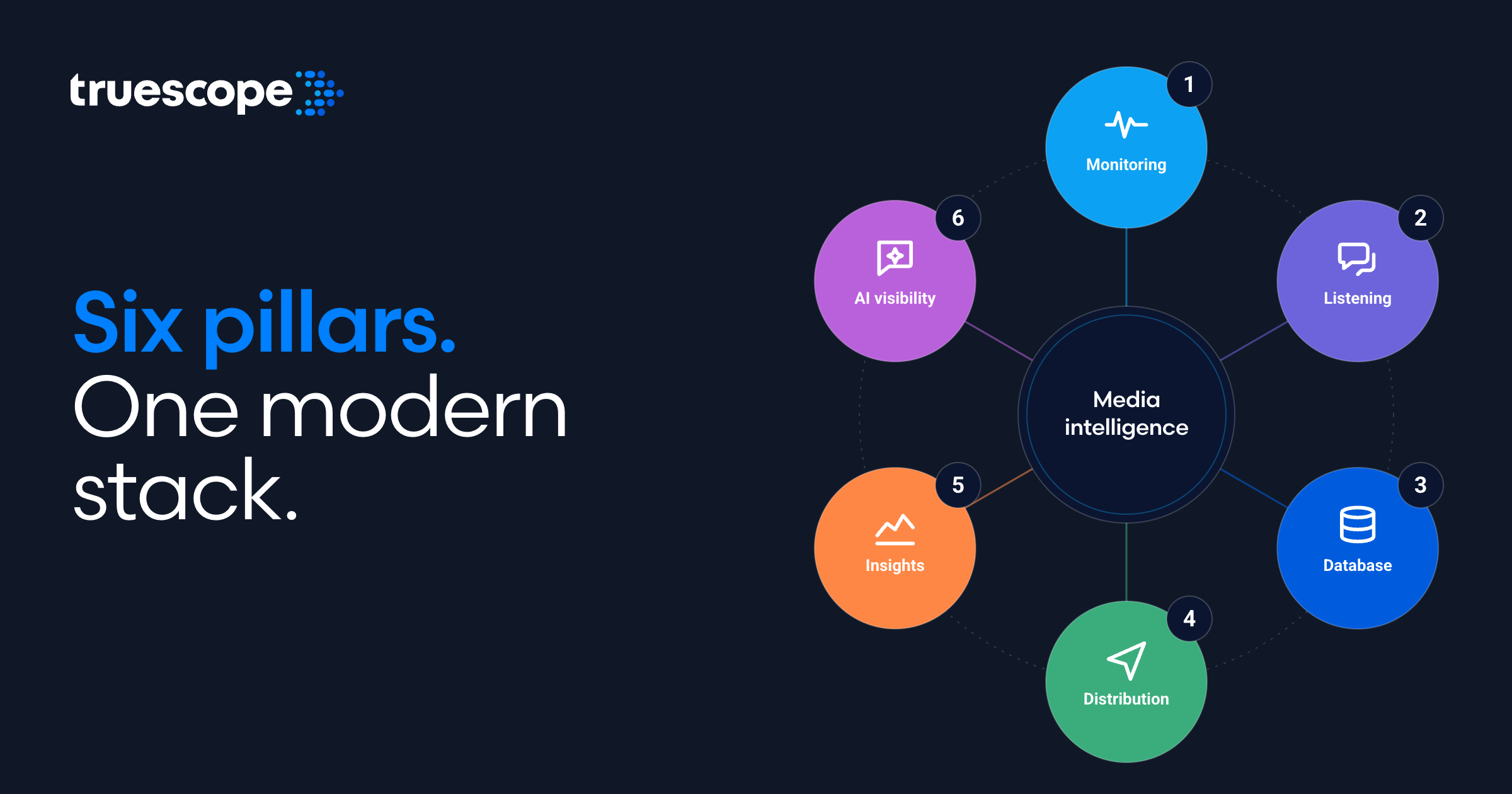
But the job has changed. New channels, new media types, new audience behaviours, and a speed of information that would have been unthinkable even 5 years ago. The industry has quietly grown into something far bigger than clipping articles. I think of it as six distinct pillars, each with its own complexity, and each with its own value to a communications professional.
1. Media monitoring
This is where it all started. Press first, then TV and radio, then online. In most markets around the world, monitoring is still what organisations buy first. It's the foundation. You need to know what's being said about you, your competitors, and your industry before you can do anything else. The difference now is the volume and the speed. Real-time coverage across thousands of sources is table stakes.
2. Social media listening
If monitoring tells you what the media is saying, social listening tells you what the public is saying. And the public doesn't play by the same rules. Different platforms, different formats, different audiences, all moving in real time. It's probably one of the most complex pillars because it's the least controlled. A brand can put out a beautiful piece of content and have the comment section turn it into a reputational problem within hours. You can't manage what you don't see, and social listening is how you see it.
3. Media database
This one has been around for 40 years and it's still a core part of the workflow. The media database is how PR and comms teams find the right journalist, on the right beat, at the right time. Every journalist I've spoken to says the same thing: stop sending me stuff I don't care about. The database, used well, is how you build trust with the people who tell your story. The journalist is the product. Reaching them with the right message, at the right time, in the right way, is what a good database enables.
4. Media distribution
Distribution has been part of the workflow for a long time. The ability to send a media release to the right people, at the right time, at scale. In some markets, particularly those with stock exchange or regulatory requirements, there's a compliance reason for using a distribution channel. But distribution has also become more relevant in the last few years because of the fake news problem. Sending information through a well-known, trusted channel gives the recipient confidence that what they're reading is legitimate. Trust in the source matters more than ever.
5. Media insights
This is where the data becomes really useful. Organisations have made enormous investments in collecting media data, but the question that keeps coming up is: so what? Where are the insights? How do I make better decisions based on what I'm seeing? Linking media insights back to communication strategy has become one of the most important parts of what this industry provides. It's moved well beyond counting clips. The expectation now is sophistication: sentiment, themes, audience reach, share of voice, and how all of that connects to business outcomes.
6. AI visibility (GEO/AEO)
This is the newest pillar, and it’s the one changing fastest. Large language models have become a place people go to learn about your organisation, your products, and your reputation, and they answer using earned and owned media citations with no clicks It used to be about paying to sit at the top of a search results page with an SEO campaign. Now it’s about building trust and authority so the models recognise you and reach for your content when they build an answer. You’re no longer buying the top slot. You’re earning the citation.
It’s more complex than anything else on this list. Multiple models, multiple jurisdictions, and the public asking the same question a hundred different ways through prompts. That’s why it’s a pillar and not a feature. The early signs are that this will be as influential as search was 20 years ago. If you thought search mattered to your reputation, this matters just as much.
The holy grail: a connected workflow
Here's what I think about a lot. Each of these six pillars exists in its own right. You can buy monitoring from one vendor, a database from another, distribution from a third. Most people do. But if you can build a workflow that connects all six, where you use your database to reach the right content creators, distribute through the right channels, monitor the results, and then generate insights that feed back into strategy, that's a different proposition entirely.
Think of it as a Bloomberg for public relations. One connected system where the workflow across all six pillars actually talks to each other.
Nobody does this well yet. Some vendors cover all six, but they tend to have a pedigree in one area and stretch into the others without the same depth. The technology exists. The integration doesn't. Not properly.
Where this is heading
What I get most excited about is the predictive side. Right now, most of what our industry delivers is confirmatory. Something happened, here's the coverage, here's how it performed. That's useful, but it's backwards-looking.
Where I think this goes next is predictive intelligence. When someone puts a media release into our system, we should be able to tell them: here's who's most likely to pick it up, here's the sentiment they'll probably write with, here's whether you'll get earned coverage, and here's what the next 48 hours are likely to look like.
We're not there yet. But when you have years of metadata across every piece of content on a platform, all organised by industry vertical, you start to see patterns. You can see how audiences have reacted to similar events in the past. Financial events, product launches, crises. The reactions are more consistent than people think.
See how you can get more signals and insights from your media intelligence platform




See how you can get more signals and insights from your media intelligence platform


.svg)