



These days, social media is where opinions about your brand form first. According to Forbes, there are now 5.79 billion active social media user identities worldwide, and the typical online adult uses 6.5 different platforms each month. That's a lot of conversation happening about your brand, your competitors and your industry, most of it without you in the room.
Social media listening is how communications, PR, and marketing teams get into that room with your buyers in it. Done well, it tells you what people think, why they think it, and what's likely to happen next. Done poorly, it's a dashboard full of mentions nobody acts on.
This guide covers everything you need to build a social listening strategy and broader social media strategy that informs decisions, asking what it is, why it matters, where to listen, how to set it up step by step, which metrics to track, and how to choose the right tool.
Key takeaways
- Social listening goes beyond monitoring. Monitoring tells you what was said, flagging direct brand mentions across channels. Listening tells you what it means and what to do about it.
- Every team benefits. PR, marketing, product, customer experience and leadership all draw different value from the same conversation data.
- Setup determines success. Clear objectives and well-built queries matter more than the volume of data collection you perform.
- Context beats counts. Sentiment, share of voice and narrative tracking are more useful than raw mention numbers.
- Social is one piece of the picture. The most complete view comes from listening across social, news, broadcast and online media together.
What is social media listening?
Social media listening is the practice of tracking online conversations about your brand, competitors, people, products and industry, then analysing them to understand sentiment, spot emerging trends and guide strategy.
It includes direct mentions and tags, but the real value sits in the conversations that don't tag you, a customer venting in a Reddit thread, a TikTok trend touching your category, or an industry debate gaining momentum on LinkedIn.
Social listening vs social media monitoring
The two terms are often used interchangeably, but they describe different levels of work. Monitoring is the foundation. Listening is what you build on top of it.
Comms and PR professionals need both. Monitoring keeps you responsive in the moment to drive effective customer engagement. Listening makes sure what you learn shapes your next decision.
Why social media listening matters
Social listening turns public conversation into an early-warning system for your brand reputation and a research tool at the same time. Here's where it delivers the most value.
Protect your reputation and catch issues early
Most crises don't start with a front-page headline. They start with a handful of posts that pick up speed. Listening helps you spot unusual spikes in volume or negative sentiment while there's still time to respond, and gives you the context to decide whether an issue needs action or will fade on its own.
Understand your customers in their own words
Surveys tell you what customers say when you ask, but social listening provides unfiltered customer feedback and audience insights when you don't. Use it to uncover pain points, feature requests, unmet needs and the language your audience actually uses, which is valuable input for your content strategy, messaging, and product decisions.
Benchmark against competitors
Track how often competitors are discussed, perform competitive analysis on how people feel about them, and see which campaigns land. Share of voice and comparative sentiment show where you lead, where you lag and where there's a gap in the market to own.
Sharpen your content and marketing campaigns
Listening reveals which topics, formats and creators resonate with your audience. It also lets you measure campaign impact beyond likes and shares, by tracking changes in conversation volume, sentiment and themes before and after launch.
Identify advocates, creators and influential voices
Not every voice carries the same weight. Listening helps you find the creators, journalists, analysts and loyal customers who shape conversations in your space, so you can build relationships with the people who matter most.
Inform leadership with evidence
Executives want to know how overall brand health is perceived and what's changing. Social listening provides that evidence, and when combined with news and broadcast coverage, gives leadership a complete picture of reputation.
How different teams use social listening
Where to listen: channels and sources
Your audience is spread across multiple social media platforms, and each one plays a different role in the conversation. Prioritise the channels where your stakeholders are most active, rather than trying to listen everywhere equally.
Don't listen to social in isolation
Social conversation rarely stays on social. Think of your own conversations with your group of friends or colleagues. A viral post becomes a news story, a news story gets picked up on talkback radio, and the radio segment gets clipped and shared back to social. If you only listen to one channel, you'll only see part of the story.
That's why leading communications teams combine social listening with news, broadcast, podcasts and online media monitoring. It shows how narratives move between channels, which outlets and voices amplify them, and where to focus your response.
How to build a social media listening program in 7 steps
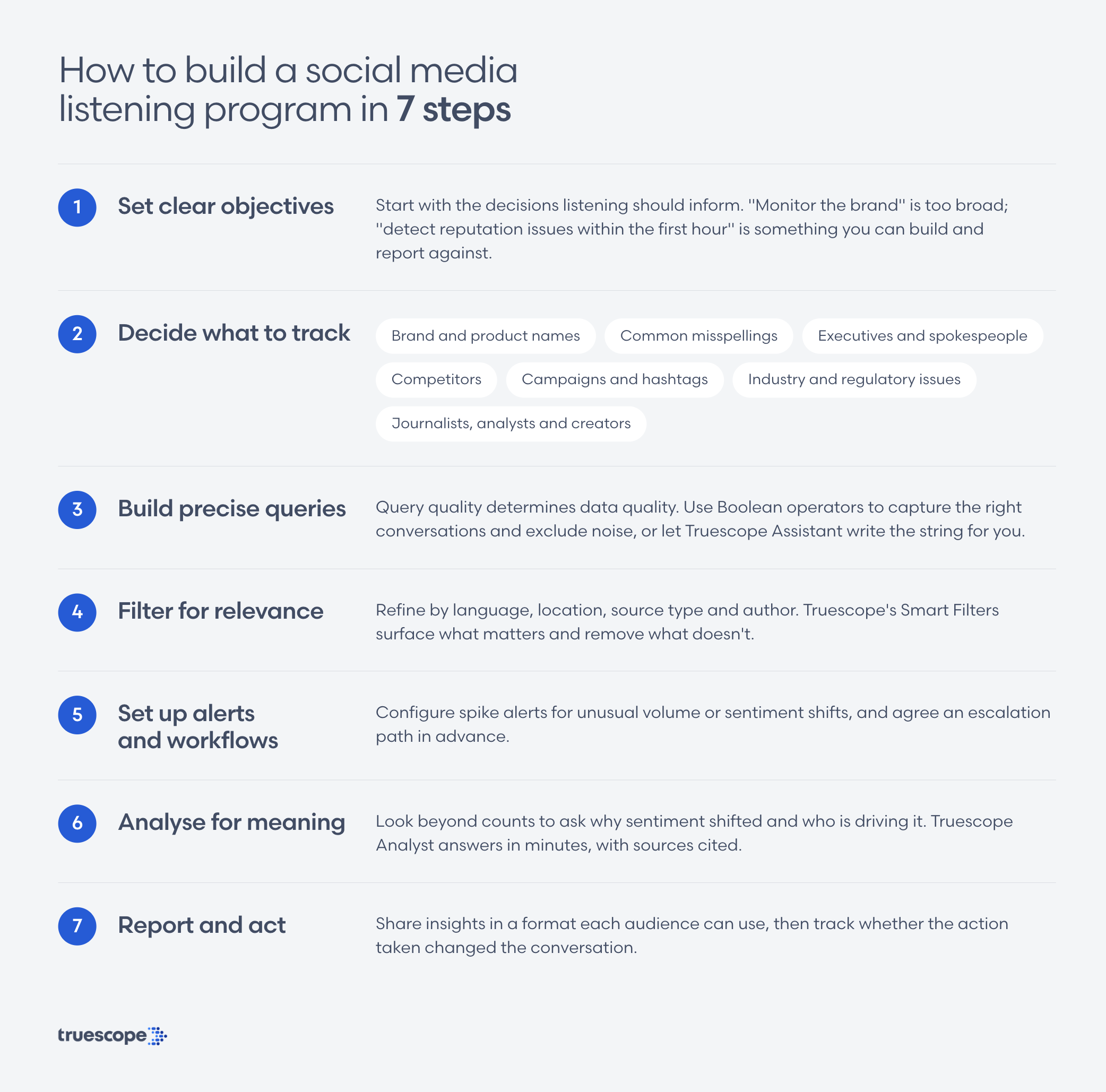
1. Set clear objectives
Start with the decisions you want listening to inform. "Monitor the brand" is too broad. "Detect emerging reputation issues within the first hour" or "Measure share of voice against our top three competitors each quarter" gives you something to build around and report against.
2. Decide what to track
Map out the topics that matter to your objectives:
- Brand names, product names and common misspellings
- Executives and spokespeople
- Competitors and their products
- Campaign names and branded hashtags
- Industry topics, issues and regulatory terms
- Key stakeholders, such as journalists, analysts and creators
3. Build precise queries
Query quality determines data quality. Use Boolean operators (AND, OR, NOT) and proximity searches to capture the right conversations and exclude noise. For example, a brand that shares its name with a common word needs exclusions to filter out irrelevant mentions.
If Boolean isn't your strength, Truescope Assistant can convert a plain English description into a Boolean search string for you.
4. Filter for relevance
Even well-built queries pull in some noise. Use filters for language, location, source type and author to refine results. Truescope's Smart Filters help surface the coverage that matters and remove what doesn't, so your team spends time on analysis rather than sorting.
5. Set up alerts and workflows
Decide what needs immediate attention and who gets told. Configure spike alerts for unusual volume or sentiment shifts, and agree on an escalation path in advance so the right people can act quickly when something breaks.
6. Analyse for meaning
This is where monitoring becomes listening. Look beyond counts to ask why sentiment shifted, which narratives are gaining traction, who is driving them and how they compare to last month. Truescope Analyst can turn a question like "What's driving negative sentiment about our brand this week?" into a structured, source-cited analysis in minutes.
7. Report and act
Share insights in a format each audience can use, whether that's a daily summary for the comms team, a campaign wrap-up for marketing or a monthly reputation report for leadership. Then close the loop: track what action was taken and whether it changed the conversation.
Social listening metrics that matter
The right metrics depend on your objectives, but these are the ones most communications and marketing teams rely on.
A note on sentiment
Sentiment is one of the most valuable listening metrics, and one of the easiest to get wrong. Sarcasm, slang and mixed opinions trip up basic keyword-based scoring. A post that praises your product but criticises your competitor shouldn't be scored the same way for both brands.
Look for tools that read context and score customer sentiment at the entity level, so you know how people feel about each brand or person mentioned, not just the post as a whole. Truescope's AI-powered sentiment analysis does exactly this.
How to choose a social media listening tool
The market is crowded, and most social listening tools can collect mentions. The difference lies in how well a social listening platform turns those mentions into actionable insights. Look for:
- Coverage across channels. Social alone isn't enough. Choose a platform that brings social, news, broadcast and online media into one view.
- Accurate, flexible queries. Full Boolean support and help building queries, so you capture what matters without drowning in noise.
- Relevance filtering. Tools that remove irrelevant results automatically save hours every week.
- Context-aware sentiment. Entity-level sentiment that understands nuance, not simple keyword matching.
- Real-time alerts. Spike detection that flags issues as they emerge, with summaries that explain what's happening.
- AI-assisted analysis. The ability to ask questions of your data and get structured, source-cited answers quickly.
- Reporting that fits your audience. Customisable dashboards and automated reports for everyone from your team to the board.
- Local expertise and support. A partner who understands your market and can help you get the most from the platform.
Common social listening mistakes to avoid
- Listening without a purpose. Collecting data with no clear objective leads to dashboards nobody uses.
- Tracking only your brand name. You'll miss competitor activity, industry trends and conversations that don't mention you by name.
- Setting and forgetting queries. Products, campaigns and language change. Review and refine your queries regularly.
- Over-relying on volume. A spike in mentions isn't automatically good or bad. Always look at sentiment and context.
- Ignoring other media channels. Social conversations are shaped by news and broadcast coverage, and vice versa.
- Not acting on insights. Listening only creates value when it changes what you do next.
Frequently asked questions
What is the difference between social listening and social monitoring?
Social monitoring tracks and responds to individual mentions in real time. Social listening analyses those mentions over time to find patterns, sentiment shifts and insights that inform strategy.
How often should I review social listening data?
Set real-time alerts for urgent issues, review key metrics daily or weekly, and run a deeper analysis monthly or quarterly to spot longer-term trends.
Can social listening help in a crisis?
Yes. Listening plays a key role in crisis management and reputation management by helping you detect a potential issue early, understand how it's spreading and who's driving it, and measure whether your response is changing the conversation.
Do I need Boolean search skills to set up social listening?
It helps, but it's no longer essential. Tools like Truescope Assistant can turn a plain English description into a Boolean query for you.
Is social listening only for large organisations?
No. Any organisation with a public reputation to manage can benefit, from government agencies and not-for-profits to fast-growing brands.
Turn social conversation into strategic advantage
Social media listening gives you a direct line to what your audience, customers and stakeholders really think. With clear objectives, well-built queries and the right metrics, it becomes one of the most valuable sources of insight your organisation has.
Truescope brings social listening together with news, broadcast and online media monitoring in one platform, with AI teammates that help you find, understand and report on what matters, faster.
Ready to see what your audience is saying? Book a demo with Truescope today.
See how you can get more signals and insights from your media intelligence platform



See how you can get more signals and insights from your media intelligence platform


