
Brand monitoring is the practice of tracking every mention of your brand across the channels that shape how people see you through news, broadcast, podcasts, social platforms, review sites, forums, SEO, and search, and then turning what you find into decisions. Done well, it tells you what your reputation is worth today, where it is under pressure, and what to do next.
Most teams already sense this. The harder question is how to do it in a way that produces signal rather than noise, and evidence rather than anecdote. This guide walks through what brand monitoring and brand tracking actually cover, how to read the metrics honestly, how to catch a problem before it becomes a crisis, and what to look for when you choose a tool.
What is brand monitoring?
At its simplest, brand monitoring is listening at scale. Your brand is being discussed in places you will never see manually, a journalist's article at 6am, a podcast segment, a Reddit thread or Quora answer, a one-star review, a competitor's launch that pulls coverage away from you. Brand monitoring is the system that captures those mentions as they happen, organises them, and makes them searchable and measurable so that the people responsible for your brand can respond in time.
It sits at the centre of the wider practice of media monitoring, social media management, brand management, and reputation management, but with a specific lens. Media monitoring asks "what is being published?" Brand monitoring asks "what is being said about us, by whom, in what tone, and what does it mean for how we are perceived?" The output is an evidence base for communications, marketing, brand awareness, product, customer experience, and leadership.
The reason this matters more than it used to is that trust now lives with brands. The 2025 Edelman Trust Barometer found that 80% of people trust the brands they use, more than they trust business in general, media, government or NGOs. Trust has become as much a purchase driver as quality and price. When a single asset that valuable is being discussed continuously in public, not watching is a decision in itself.
Brand monitoring vs social listening: what is the difference?
These two terms get used interchangeably, and the overlap is real, but they are not the same thing.
Social listening is focused on social platforms like X, LinkedIn, Instagram, TikTok, Facebook, YouTube, alongside hashtag tracking and the social media posts and conversations happening there. It is excellent for reading audience mood, spotting emerging themes, and understanding how people talk when they are not talking to you directly.
Brand monitoring is broader. It includes social, but it also covers earned media, the news articles, broadcast segments, trade press and podcasts that carry far more authority with buyers, regulators and boards than a single post does. A story in a national outlet reaches a different audience, carries valuable backlinks, and lands with different weight than viral social mentions surfaced through basic social media monitoring. If you only rely on social listening tools to listen socially, you miss half the reputation picture, and usually the more consequential half.
The practical takeaway is that you want both, in one place. The value comes from seeing a story break in the press and watching how it travels through social in the same view because that is how modern reputation events actually unfold.
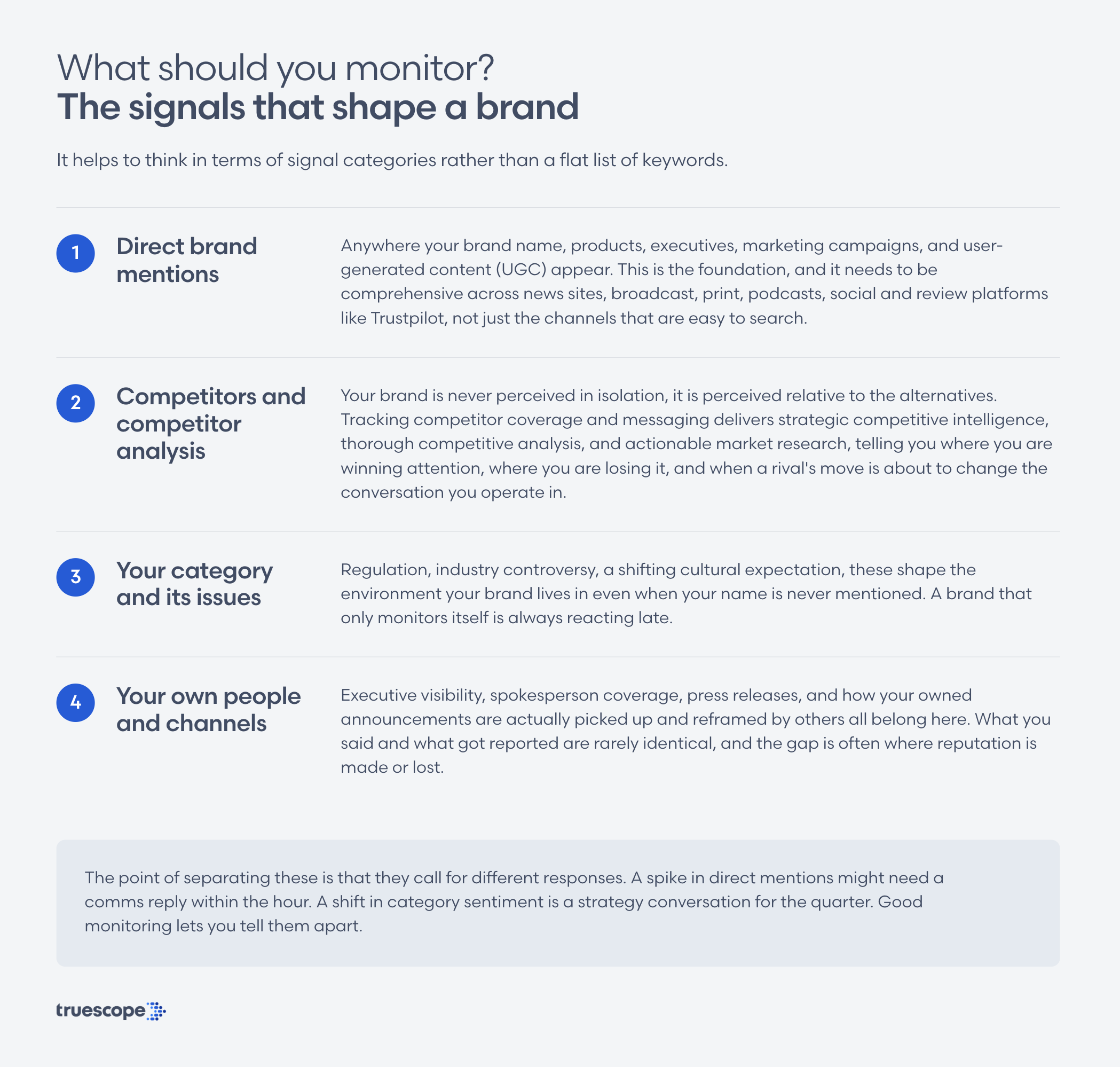
What should you monitor? The signals that shape a brand
Reading sentiment and share of voice without fooling yourself
Two metrics dominate brand reporting, and both are easy to misuse.
Sentiment, the tone of coverage, positive, negative or neutral, is genuinely useful, but only if you treat it as directional rather than precise. Automated sentiment struggles with sarcasm, industry context and mixed messages, so the number on any single mention should never be taken as gospel. Where it earns its keep is in trend and in aggregate. A steady surge in negative sentiment across hundreds of mentions is a real signal, and it is one you would never catch by reading a handful of articles by hand. Read brand sentiment as a movement over time, and always be willing to click into the coverage behind a sudden swing before you act on it. Sentiment monitoring is a lens, not a verdict.
Share of voice, your presence in the conversation relative to competitors, is the other workhorse. It answers "are we being heard?" But raw share of voice flatters you if it counts a crisis as a win. A thousand mentions of a product recall is a large share of voice and a terrible outcome. The fix is to read share of voice alongside sentiment and alongside the quality of the outlets carrying you, never on its own. Volume without tone and without reach is a number that looks like insight and isn't.
The discipline in both cases is the same, the story is in how they move together, not just the single metric.
Catching problems before they become a crisis
Most reputation crises do not arrive without warning. They build. A handful of complaints in one channel, a critical piece in a trade outlet, a question a journalist starts asking more than once. These are the early tremors, and the entire value of real-time monitoring is that it surfaces them while you still have room to act.
What separates teams that manage this well is not speed of typing but speed of knowing. If you learn about a breaking story from a Google Alert the next morning, or worse from your CEO, you have already lost the window in which a measured response is possible. Real-time alerting on the mentions that matter, tuned so that it flags the meaningful and stays quiet on the routine, is what turns monitoring from a reporting function into an early-warning system.
The goal is not to react to everything. It is to notice the one thing that is about to matter while it is still small. That is a monitoring problem before it becomes a broader crisis management issue, and solving it early is far cheaper than solving it late.
How to measure brand health, and report it to the board
Eventually someone will ask what all of this is worth, and "we got a lot of coverage" is not an answer a board accepts. The organisations that get taken seriously connect their monitoring to a consistent framework rather than a rotating set of favourable numbers.
The industry standard here is AMEC's Integrated Evaluation Framework, which insists on tying communications activity through to outputs, outcomes and impact rather than stopping at reach. In practice that means reporting a small, stable set of measures over time, sentiment trend, share of voice against named competitors, the quality and reach of the outlets carrying you, and how coverage maps to the messages you are actually trying to land, and reporting the same measures every quarter so movement is visible.
The mistake to avoid is the highlight reel by cherry-picking whichever metric looked good this month. Boards trust a number that is reported consistently even when it moves the wrong way far more than they trust one that only ever appears when it flatters. Consistency is what makes brand health a measure leadership can plan around, and it is the difference between comms being seen as a cost and being seen as intelligence.
What to look for in a brand monitoring tool
Once you decide to do this properly, choosing the right brand monitoring software matters, and the differences between platforms are real.
Start with coverage. A monitoring tool is only as good as the sources it can actually see. Broad, deep access across news, broadcast, print, podcasts, social, app stores, and visual media via image recognition is the single most important thing, because a mention you never captured cannot be measured or acted on. Ask any prospective platform exactly what it covers and where the gaps are.
Then look at accuracy and noise. The point of monitoring is to reduce the amount of irrelevant material a human has to wade through. A tool that floods you with false matches on a common brand name is worse than useless; it trains your team to ignore alerts. Precision in matching, and control over what triggers a notification, is what keeps the system trusted.
Look at speed. Real-time or near-real-time capture is what makes early warning possible; a platform that reports yesterday's news tomorrow cannot protect you from a fast-moving story.
Look at analysis and reporting. You want sentiment, share of voice and message tracking built in, and you want to get a clean, credible report in front of a stakeholder without rebuilding it by hand every month.
And look at the people behind your online brand monitoring strategy. Reputation questions are rarely purely technical, and access to a support team that understands media intelligence, rather than a ticket queue, is worth more than a long feature list. This is where Truescope is built to help, comprehensive coverage across traditional and social media, real-time alerting, sentiment and share-of-voice analysis, and reporting designed for the people who have to answer for the brand.
Frequently asked questions
Is brand monitoring the same as media monitoring? Not quite. Media monitoring is the broader practice of tracking what is published across all media. Brand monitoring is the applied lens that focuses that capability on your brand, competitors and category, and interprets it in terms of reputation.
How is brand monitoring different from Google Alerts? Google Alerts covers a fraction of the web, misses broadcast, podcasts and most social, arrives late, and offers no sentiment, share of voice or reporting. It is a starting point for the smallest brands, not a monitoring system.
How often should I be monitoring? Continuously. Reputation events do not respect business hours, and the value of monitoring is in catching things as they happen. Reporting can be weekly or monthly but the listening itself should never stop.
Can sentiment analysis be trusted? As a trend, yes, as a verdict on a single mention, treat it with care. Automated sentiment is directional and improves in aggregate. Use it to spot movement, then read the coverage behind any sharp change before acting.
What should a small team monitor first? Direct mentions of your brand and executives, then your two or three closest competitors. That alone gives you an early-warning system and a share-of-voice baseline without overwhelming a lean team.
How do I show the value of brand monitoring to leadership? Report a consistent set of measures, sentiment trend, share of voice, outlet quality and message pull-through, against a recognised framework such as AMEC's, every quarter. Consistency over time is what earns credibility.
Does brand monitoring help in a crisis? It is often what prevents one. The earlier you see a story building, the more room you have to respond calmly and on your own terms. Monitoring turns a crisis you discover too late into a signal you caught early.
Where to start
You do not need to monitor everything on day one. Start with the mentions that matter most, your brand, your leaders, your closest competitors, get real-time alerting in place so nothing meaningful reaches you late, and settle on a small set of measures you will report consistently. From there, widen the aperture to your category and the issues shaping it as your confidence grows.
The brands that protect their reputation are not the ones that react fastest. They are the ones that see clearly and early, and build the habit of acting on what they see. That is what brand monitoring is for.
See how Truescope helps you track, measure and protect your brand across every channel that matters. Book a demo.
See how you can get more signals and insights from your media intelligence platform



See how you can get more signals and insights from your media intelligence platform


.svg)