


As a vital component of broader crisis management and business continuity, crisis communications is the practice of managing what your organisation says, and how the world hears it, when a situation threatens your brand’s reputation, your operations, or the trust people place in you.
Every organisation has a version of this moment. A product recall, a data breach, natural disasters, global disruptions like the COVID-19 pandemic, a statement that lands the wrong way, an executive departure, or a supplier failure that becomes your problem the instant a journalist connects the dots. What separates the organisations that come through intact from the ones that don't is rarely the severity of the event itself. It's how quickly and how credibly they communicate about it.
The crucial word is communications. A crisis is an operational and legal problem, but it becomes a reputational one the moment it enters the public conversation, and the public conversation is the part where you can actually control the narrative. Crisis communications is the discipline of shaping it, deciding what to say, to whom, in what order, and how fast, while the facts are still moving.
What makes a situation a crisis?
Not every bad day is a crisis, and treating routine complaints as five-alarm fires is its own kind of failure. Three things tend to turn a problem into a genuine crisis.
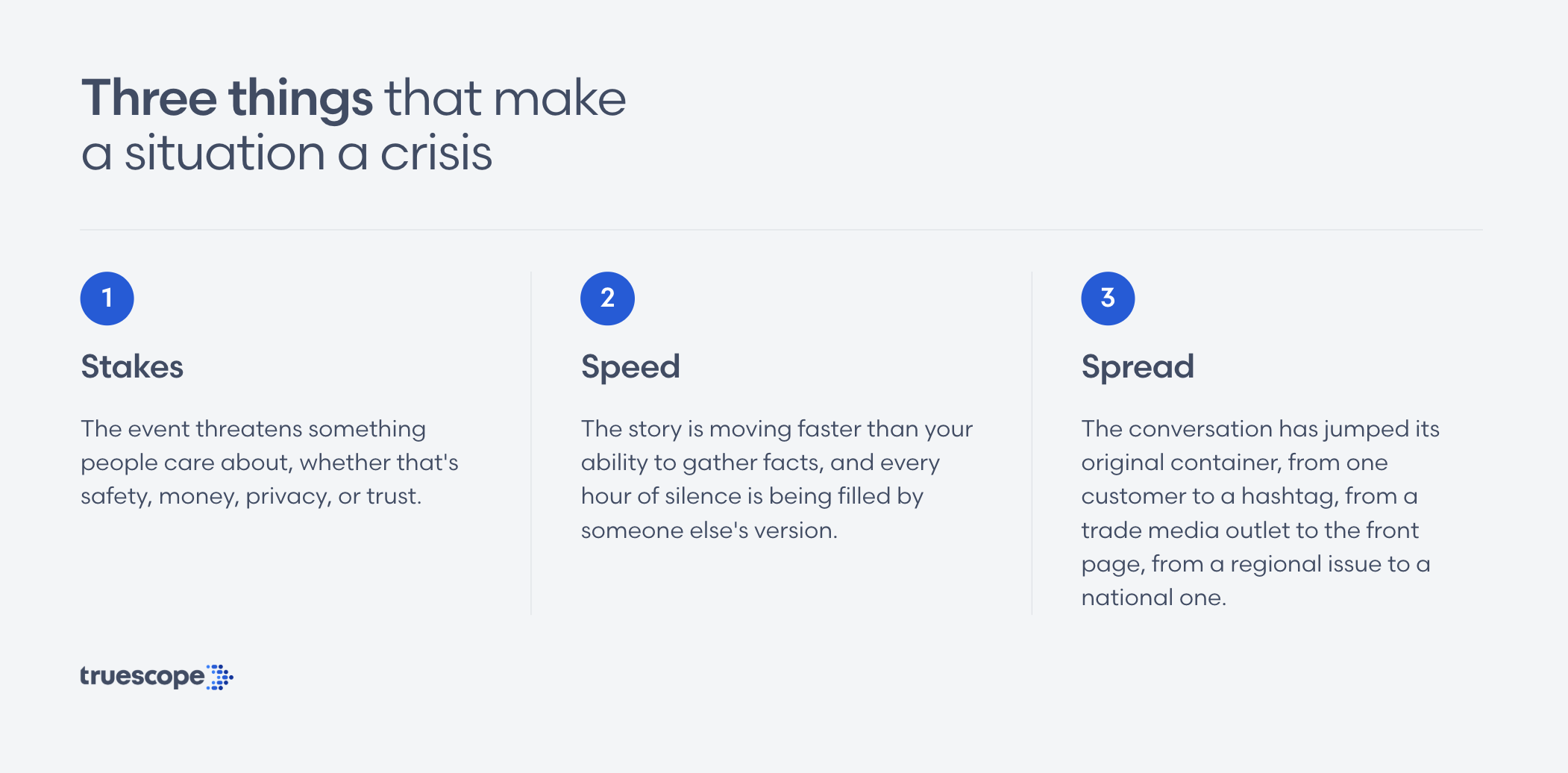
The first is stakes. The event threatens something people care about, whether that's safety, money, privacy, or trust.
The second is speed. The story is moving faster than your ability to gather facts, and every hour of silence is being filled by someone else's version.
The third is spread. The conversation has jumped its original container, from one customer to a hashtag, from a trade media outlet to the front page, from a regional issue to a national one.
When all three are present, you are in a crisis whether you've declared one or not. The organisations that respond well are usually the ones that recognised it early, often because they were watching the signals before the situation reached full boil.
Crisis communications vs reputation management
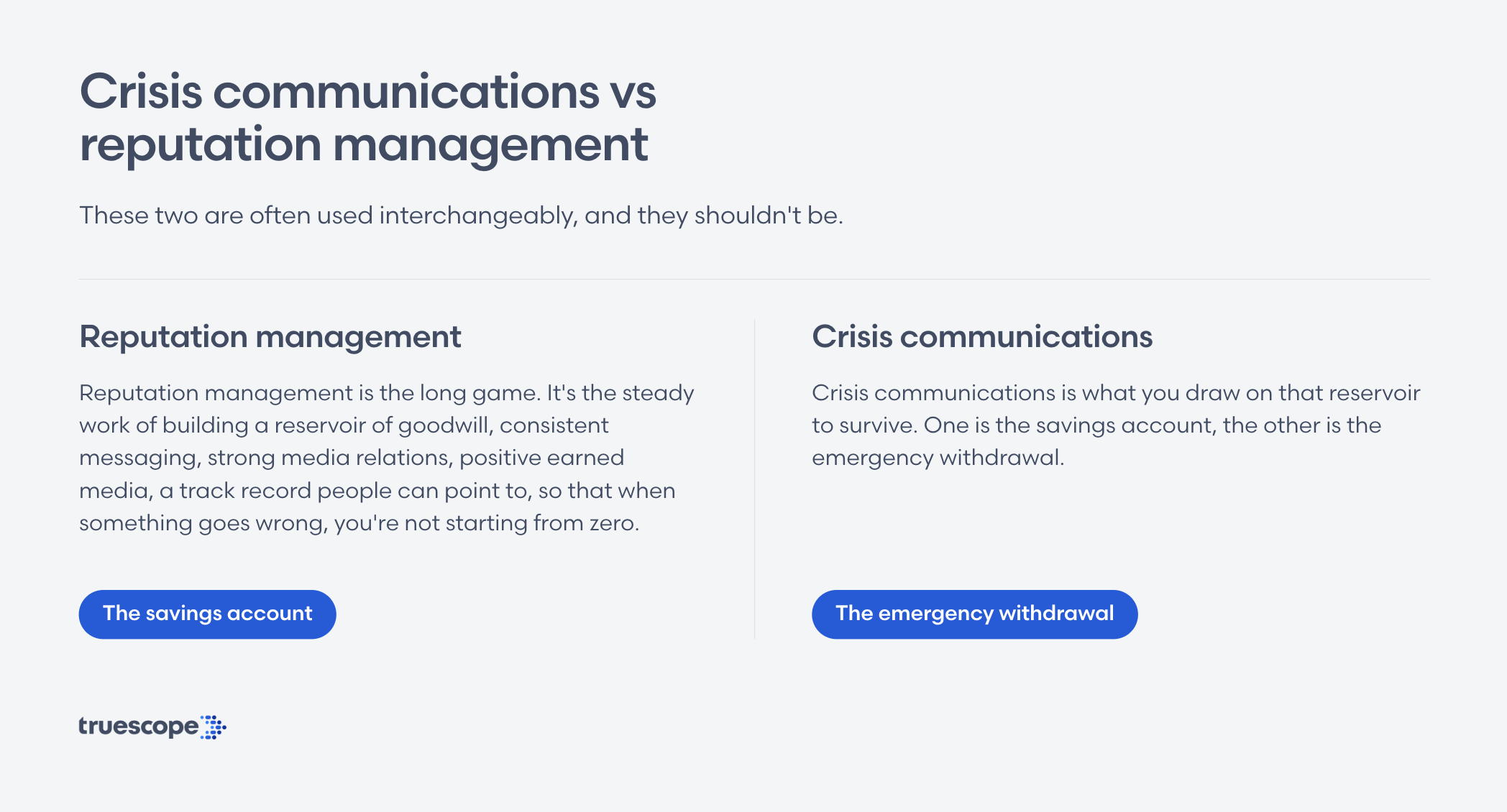
These two are often used interchangeably, and they shouldn't be.
Reputation management is the long game. It's the steady work of building a reservoir of goodwill, consistent messaging, strong media relations, positive earned media, a track record people can point to, so that when something goes wrong, you're not starting from zero. Crisis communications is what you draw on that reservoir to survive. One is the savings account, the other is the emergency withdrawal.
The relationship runs in both directions. A strong reputation buys you the benefit of the doubt in the first critical hours, when facts are scarce and audiences are deciding whether to extend you patience or pile on. And a crisis handled with honesty and speed can, counterintuitively, deposit trust back into that account. The way you behave under pressure tells people more about who you are than any campaign ever will.
What good crisis communications includes
Effective crisis communication strategies, communication protocols, and response plans are built long before the crisis occurs. The teams who handle these moments well have almost always done four things in advance.
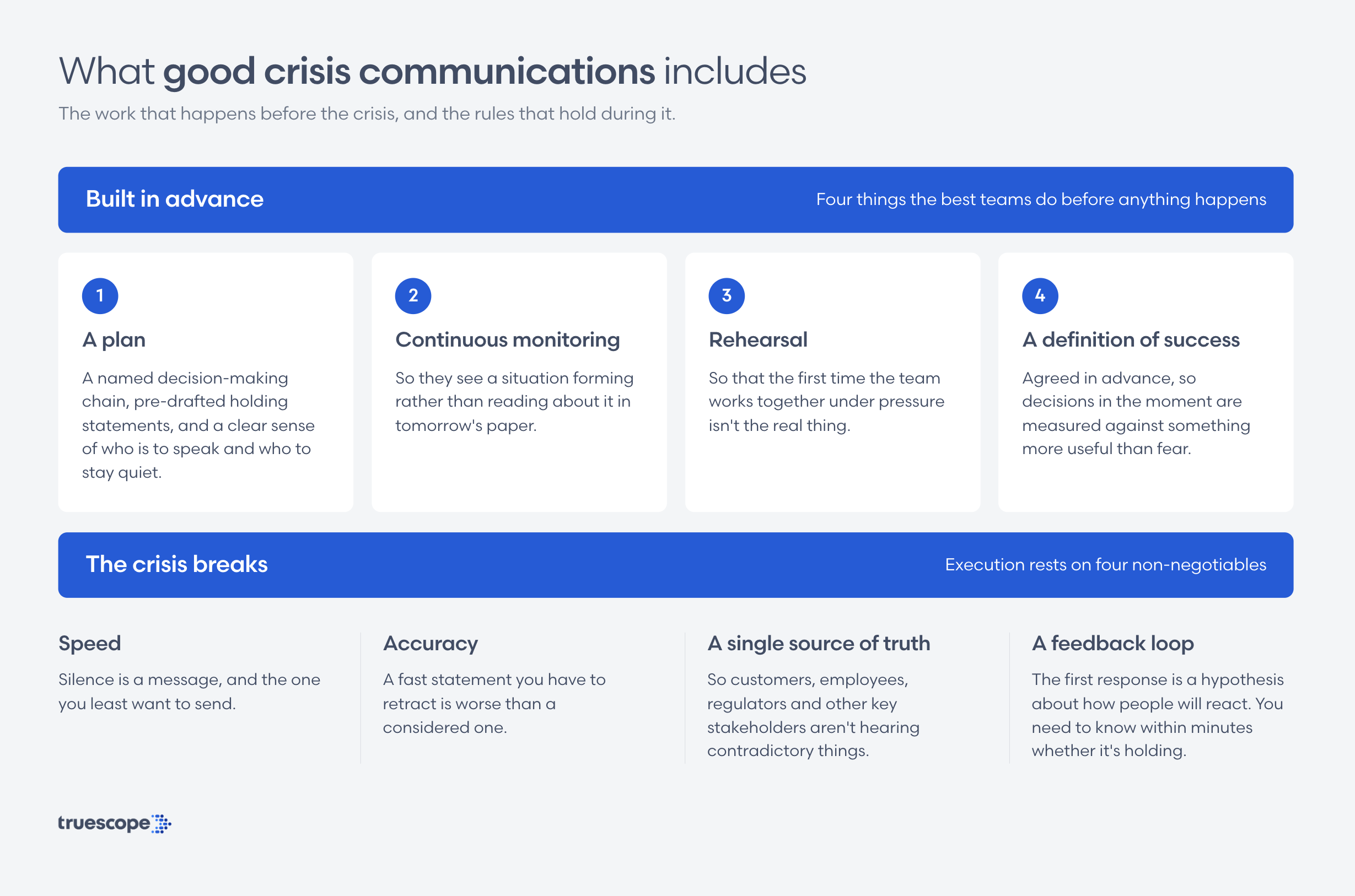
They've prepared a comprehensive crisis communication plan, a named decision-making chain, pre-drafted holding statements, materials for press conferences, and press releases, and have a clear sense of who is to speak and who to stay quiet. They've listened to the continuous media monitoring of news and social channels so they see a situation forming rather than reading about it in tomorrow's paper. They've rehearsed and run various crisis scenarios and crisis simulations, so that the first time the team works together under pressure isn't the real thing. And they've defined success, mapped potential vulnerabilities, and agreed in advance what a good outcome looks like, so decisions in the moment are measured against something more useful than fear.
When the moment arrives, the execution rests on a few non-negotiables. Speed, because silence is a message and the one you least want to send. Accuracy, because a fast statement you have to retract is worse than a considered one. A single source of truth, so that customers, employees, regulators, and other key stakeholders aren't hearing contradictory things. And a feedback loop, because the first response is a hypothesis about how people will react, and you need to know within minutes whether it's holding.
Why crisis communications matters
The cost of getting this wrong isn't abstract. Reputational damage compounds. A mishandled crisis costs you more than the moment, it reshapes the story that gets told about you for years, resurfacing every time your name appears next to a similar event.
But the deeper reason crisis communications matters is that a crisis is one of the few times an organisation's entire audience is paying attention at once. Customers, employees, investors, regulators, and journalists are all watching the same event and forming the same judgment: can we trust these people when it counts? Handled well with clear key messages, a crisis is a chance to answer that question in your favour in front of everyone who matters. Handled badly, it answers it for you.
Crisis communications in the age of AI
The window for response has never been shorter. A single post can outrun a corporate approvals process before the legal team has finished reading it. Coverage is generated, summarised, and amplified by algorithms in minutes, and increasingly by AI systems that will describe your crisis to anyone who asks, drawing on whatever version of events is loudest, not necessarily the most accurate.
That changes the job in two ways. First, monitoring has to be real-time and comprehensive, spanning news, broadcast, and social media, because you can no longer afford to learn about a story hours after it's set. Second, the way AI tools summarise your situation, or inadvertently spread misinformation, is now part of the reputational record. If the accurate version of events isn't clearly and quickly available, the summary that circulates will be built from something else.
The upside is that the same technology that accelerates a crisis can help you stay ahead of it. The ability to detect an emerging issue, measure how public sentiment is shifting, and see which outlets and voices are driving the conversation, all in near real time, turns crisis response from a reaction into something closer to navigation.
Common mistakes to avoid
The most common failure is silence, hoping a story will pass if you don't feed it. It rarely does. It just leaves the narrative to everyone else. Close behind is over-legalising, statements so carefully worded to admit nothing that they communicate no humanity either. Audiences forgive mistakes far more readily than they forgive evasion.
Other recurring errors. Responding on the wrong communication channels or to the wrong audience first, so employees learn about a crisis from the news. Declaring victory too early, before you can see whether the response actually landed. And, most avoidable of all, flying blind, making decisions about a fast-moving story without a live, accurate picture of what's being said and how it's changing.
Frequently asked questions about crisis communications
What is crisis communications in simple terms?
It's how an organisation communicates during a serious problem, what it says, to whom, and how quickly, to protect public trust and its reputation while the situation is still unfolding.
What is the difference between crisis communications and PR?
Public relations is the ongoing work of shaping how an organisation is perceived. Crisis communications is a specialised, high-pressure subset of that work, focused on the moments when reputation is under acute threat and the response is measured in minutes.
What are the first steps in a crisis?
Confirm the facts, conduct an immediate risk assessment to see how far and fast the story is spreading, activate your crisis communications team, and get an accurate holding statement out quickly, one that acknowledges the situation honestly even if you don't yet have every answer.
How do you measure whether a crisis response worked?
By watching what happens to the conversation during post-crisis communication. Whether the volume of media coverage stabilises, whether sentiment recovers, whether your message is the one being repeated, and whether the story fades rather than resurfacing. These are things you track, not things you guess at.
Can you prepare for a crisis you can't predict?
Yes. You can't predict the specific event, but you can prepare the muscles. A plan, a designated spokesperson, holding statements and messaging templates, and continuous monitoring that lets you see trouble early. Preparedness is general even when crises are specific.
Turn a crisis into a conversation you're part of
In corporate communications, a crisis is where reputation stops being something you build at your own pace and becomes something you defend in real time, in front of everyone at once. The organisations that do it well aren't the ones who never face a crisis. They're the ones who saw it early, understood the conversation as it moved, and responded before the story hardened without them.
That starts with knowing what's being said the moment it's said. See how Truescope helps communications teams monitor media and social in real time, track sentiment as it shifts, and understand exactly how a story is spreading, so that when a crisis hits, you're navigating it rather than reacting to it. Book a demo.
See how you can get more signals and insights from your media intelligence platform





See how you can get more signals and insights from your media intelligence platform


