
Most comms teams I work with are confident they are crisis ready. Few actually are.
The gap shows up the moment a crisis hits. The CEO calls. The board asks for an update. And the comms team scrambles to produce something that does not answer the question being asked.
The reality is that crisis readiness is not about how fast you can pull a report once the news breaks. It is about the work you put in months earlier, when nothing is on fire.
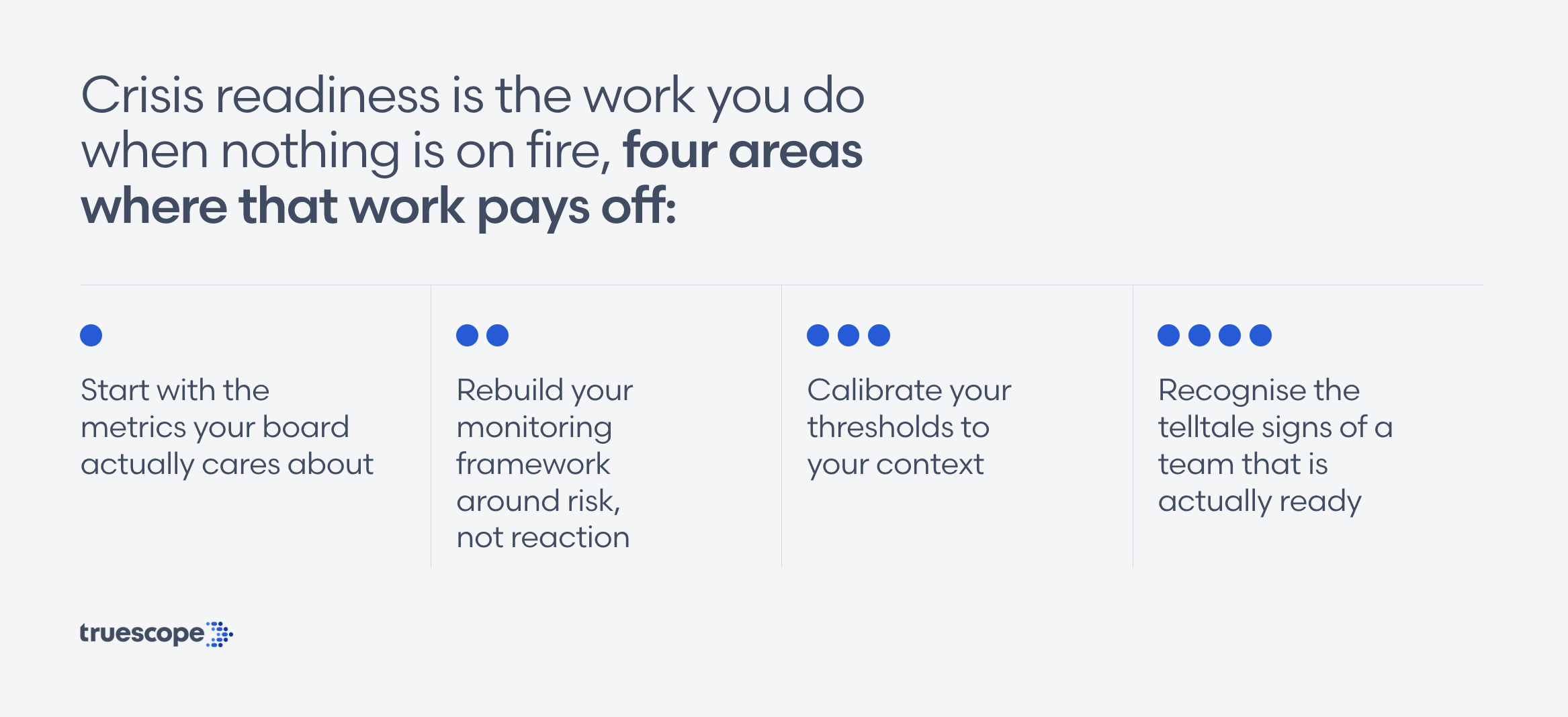
Start with what the board actually cares about
When a crisis hits, your CEO and your board are not asking how many media articles picked up the story. They are asking about commercial impact, share price, regulatory exposure, and what to say to major stakeholders by end of day.
Most comms teams report on engagement numbers, sentiment scores, and coverage volume. These metrics matter on a normal Tuesday. They are close to useless in a crisis if they are not connected to the questions a board actually asks.
This is the misalignment I see most often. The comms team optimises for one set of metrics. The decision makers care about a different set. And no one closes the gap until a crisis exposes it.
Part of this is structural. Some comms leaders do not come from a commercial background, and they are not always in the room when the top level commercial conversations happen. So they default to reporting what they know, not what their CEO is asking.
The fix is to have the conversation in peacetime. Sit down with your CEO, your CFO, your General Counsel, and your board chair if you can get the time. Ask them directly. When a crisis happens, what do you actually want from us? What format do you want the brief in? What threshold should trigger an escalation to you?
Then design your drawer plans backwards from those answers.
Rebuild your monitoring framework around risk, not reaction
Most clients structure their media monitoring the same way. Brand mentions. CEO mentions. Top three competitors. Industry keywords. It looks complete. It is not.
Boards do not care about most of that during a crisis. They care about risk mitigation and opportunity navigation. They care about whether a narrative is accelerating past the point where it can be contained. They care about which stakeholder voices are amplifying an issue.
If your monitoring framework is not structured around these questions, your team will spend the first six hours of a crisis pulling reactive data that does not help anyone make a decision.
What this means is that the monitoring setup should be reverse engineered from your drawer plans. If your board has flagged a coordinated regulatory response as a top three risk, you need a listening framework that detects regulatory signals early. If reputational damage in a specific stakeholder community is a top concern, you need to be tracking that community directly, not hoping it shows up in your general feed.
Few clients do this work. The ones that do are the ones who handle crises well.
Calibrate your thresholds to your context
Here is a question I get asked constantly. What counts as high volume? What number of mentions should trigger an alert?
There is no universal answer. A small company might run at 100 mentions a day. A crisis for them might look like 300. A large multinational might have 30,000 mentions a day. A crisis there starts at 60,000.
Thresholds are relative. They are calibrated to your baseline, your sector, and your audience. A good monitoring partner should sit down with you every six to twelve months to review what counts as normal, what counts as elevated, and what counts as viral for your specific context.
The signs of a team that is actually ready
After enough years in this work, the difference becomes obvious. A team that is crisis ready does not sound like one that thinks it is.
The ones that are ready have already briefed their media intelligence partner. They have set the rules. When I activate you at noon, I want a first cut report one hour later. Three to five hours after that, once the conversation has festered, I want a full report. Use my template, because that is what I send to the board.
They have also thought through the next 24, 48, and 72 hours. They know a crisis does not end when the first wave of coverage settles. They have agreed in advance how the lens of reporting will shift as the issue evolves. They review their drawer plans every six to twelve months against best practice and against learnings from any real incidents in their sector.
The teams that are not ready usually find out the hard way. We get the call. The CEO has just seen a story break in a WhatsApp group. The comms director is asking what we can do in the next two hours. We have never set up their keywords. We have no template for them. Sometimes we can still help. Sometimes we cannot, because the setup work was never done.
A peacetime checklist for the Chief Communications Officer
Before you finish this quarter, run through this. If you cannot answer yes to most of it, you know where the work is.
- Have you sat down with your CEO and board to confirm what they want from comms during a crisis, in what format, and at what frequency?
- Are your monitoring keywords structured around board level risks, or only around reactive brand and competitor mentions?
- Do you have a calibrated definition of high, medium, and low volume that reflects your specific context, not a generic benchmark?
- Have you briefed your monitoring partner on your activation timeline, your report template, and your escalation procedure?
- Have you mapped how your reporting lens needs to shift at the 1 hour, 24 hour, 48 hour, and 72 hour marks?
- Have you reviewed your drawer plans in the last twelve months against learnings from actual crises in your sector?
Overall, crisis readiness is not an annual budget line. It is a series of rather unglamorous conversations you have when nothing is wrong. That is what separates the teams that handle crises well from the ones that do not.
See how you can get more signals and insights from your media intelligence platform



See how you can get more signals and insights from your media intelligence platform


.svg)