
There's no such thing as "alternative media" anymore
A PR and comms leader asked me a question last week: should her team be focusing on alternative media?
She'd been pitching podcasts, Substacks, YouTube shows and Reddit for a while, and was surprised how few of her peers bothered. Most of them, she said, told her they didn't really focus on it.
I think it's the wrong question to ask.
Alternative media is the catch-all label for channels that sit outside traditional mainstream outlets: podcasts, newsletters like Substack, YouTube shows, Reddit threads and creator content. That's the textbook definition. The problem is the label itself.
The moment you call something "alternative media," you've already lost the plot. You're sorting channels into "real" and "other" based on a hierarchy your buyers stopped recognising years ago. Good comms doesn't start with the medium or the outlet category. It starts with the audience: where those people go, who they trust, and how they consume information.
What does "alternative media" even mean now?
Alternative to what?
In the US, 58% of Americans aged 12 and over now listen to a podcast every month. That's around 165 million people, and an all-time high (Edison Research, Infinite Dial 2026). Worldwide, the monthly podcast audience has grown past 600 million, up from roughly 546 million two years earlier (Statista). Substack passed 100,000 publications earning money in April 2026, roughly double the number a year before (Backlinko).
When a majority of your buyers have a podcast in their week, and a serious chunk of them get their industry thinking from a newsletter, "alternative" is not a description. It's a confession that your mental model of media is about a decade out of date.
These aren't fringe channels. They're equally important ones.
The audience moved. The outlet list didn't.
There is now no universal channel list. New platforms and new channels keep popping up.
Tech and finance audiences moved to these platforms years ago. Traditional corporate and luxury brands still find mainstream coverage carries weight. Both are true at the same time. An "as seen in the New York Times" logo still does real work for some brands. For others it pushes nothing, while a 40-minute podcast with the right host quietly moves a sales cycle.
In much of APAC the shift has gone further again. Audiences haven't just moved to social platforms, they buy there too. Social commerce has grown from under 5% of Southeast Asian e-commerce to 20 to 25% in under four years, and more than 60% of online shoppers in the region have bought something directly through a social platform in the past year. When the platform is also the checkout, treating it as an "alternative" makes even less sense.
This is part of a bigger reframing of the category, which we set out in the pillars of media intelligence. The outlet list is no longer the unit that matters.
So the planning question was never "should we do alternative media." It's "where does this specific buyer go for information, who do they trust when they get there, and what changes if we show up." Answer that, and the channel list writes itself. Sometimes it's the New York Times. Sometimes it's a subreddit with 80,000 engaged members. Often it's both. We made the same argument about wider channel coverage in media monitoring in 2026.
If you start from the outlet category, you optimise for the wrong thing. You chase the placement that looks impressive in a board deck instead of the one that reaches the person you're trying to influence.
Why alternative media matters more now: AI is reading all of it
There's a second shift happening that makes the "alternative" framing actively risky.
Your buyers aren't just consuming these channels. So are the AI tools they now ask their questions to.
Reddit is the single most-cited source across every major AI engine, appearing in roughly 40% of citations and turning up in nearly 93% of AI search results (5WPR AI Platform Citation Source Index 2026). ChatGPT, Perplexity and Google's AI Overviews are all pulling from Reddit threads, Substack posts and podcast transcripts to assemble the answers your buyers read long before they speak to sales.
None of this means tier-one coverage stopped mattering. It still carries genuine authority, with audiences and increasingly with the AI engines themselves, which give more weight to established, trusted outlets when they assemble an answer. The risk isn't tier-one placement. It's treating it as the whole strategy. If your earned-media plan stops there, you're absent from the other places buyers now form their first opinion, and that's bad news for how your brand shows up inside AI. This is also why media monitoring still matters in the age of LLMs: the answers are being assembled from tier-one outlets and from sources you used to file under "alternative", side by side.
Why do some leaders still focus only on tier-one media?
Because it's hard to measure, and we've trained ourselves to value what's easy to count.
A Forbes hit gives you a clean link and a logo. A mention on a niche B2B podcast gives you a warm audience and a lift in branded search that's harder to screenshot. One of those fits neatly in a monthly report. The other one actually works.
This is the part of my job I care about most. "Hard to measure" has never meant "not valuable." It means the measurement has to get better, not that the channel should be ignored, and the way AI is reshaping PR analytics is closing that gap fast. At Truescope we track broadcast, podcasts, social and creator content for exactly this reason: the conversations that move buyers stopped being confined to the outlets that are easy to clip.
Where I'd start
Forget the outlet categories. Start with three questions about the actual human you're trying to reach.
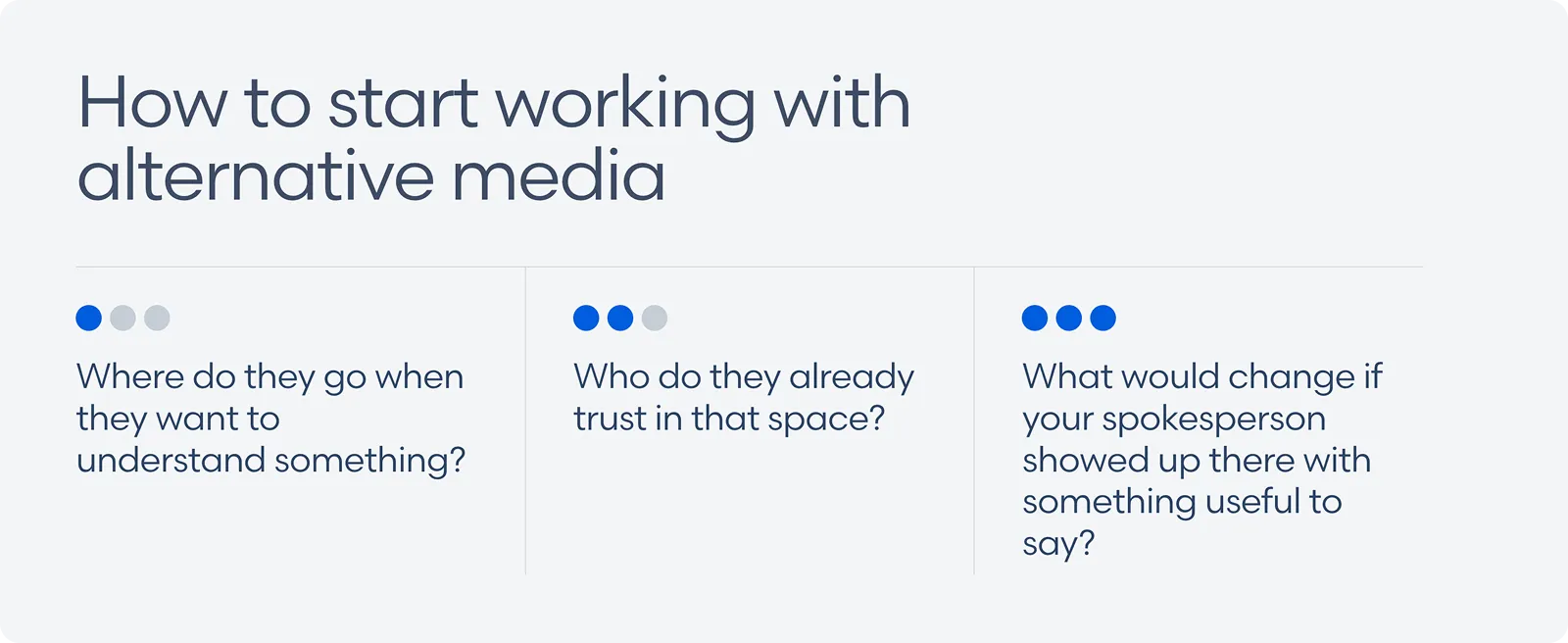
Build the content from the answer, then adapt it per channel. The same idea becomes a podcast conversation, a LinkedIn long-form post, a Reddit AMA, a note to a Substack writer who covers your space. Think of it as a matrix: your core content on one axis, channels on the other. Fill the intersections that matter and skip the ones that don't.
The firms that win the next few years won't be the ones with the longest list of tier-one logos. They'll be the ones who stopped dividing media into "real" and "alternative," and started dividing it by who's actually listening.
Frequently asked questions
What is alternative media?
Alternative media is the catch-all term for channels outside traditional mainstream outlets, including podcasts, newsletters, YouTube, Reddit and other creator content. In practice the line between "alternative" and "mainstream" has blurred, because the audiences and the trust have already moved.
Is alternative media worth it for PR and comms?
It depends on where your specific buyer goes for information and who they trust there. For tech and finance audiences, these channels often carry more weight than a tier-one placement. For some corporate and luxury brands, mainstream coverage still does real work. Both can be true at once.
Why does alternative media matter for AI search?
Because answer engines read it. Reddit is the most-cited source across major AI engines, appearing in roughly 40% of citations and turning up in nearly 93% of AI search results (5WPR AI Platform Citation Source Index 2026). If your earned media is all tier-one placements, you can be invisible in the place buyers now form their first opinion.
How do you measure alternative media coverage?
You track it the same way you track any channel: monitor where the conversation happens across broadcast, podcasts, social and creator content, then tie that coverage to outcomes like branded search and pipeline. The measurement has to get better, not narrower.
One last thing
If you made it this far down, have a think: what was the last "alternative" channel that outperformed your tier-one coverage?
At Truescope, we monitor the full picture, not just the easy-to-clip outlets. See how Truescope tracks broadcast, podcasts, social and creator content so your team can plan around where buyers actually are.
See how you can get more signals and insights from your media intelligence platform




See how you can get more signals and insights from your media intelligence platform