


Media monitoring is the practice of tracking what is said about your organisation, your people, your competitors and your industry across news, broadcast, digital media, podcasts and social media. Done well, it turns a constant stream of coverage into signals you can act on.
Most organisations know they should be doing it. Fewer can name their reasons to do media monitoring. That matters, because the reason you monitor shapes what you track, who sees it and what they do next. A communications team watching for an emerging issue needs something very different from a sales team looking for buying signals or a board that wants to understand brand reputation risk.
The case for monitoring has also shifted. Audiences now encounter your story through a newsroom, a talkback segment, a LinkedIn thread and an AI assistant summarising all three. Coverage moves faster, travels further and sticks around longer. If you are not watching, someone else is defining the narrative for you.
Below are the 12 reasons to do media monitoring that we see most often, starting with the comms team and moving out to the wider business.
12 reasons to do media monitoring
1. Protect and manage your reputation
Reputation is built in the coverage you earn and eroded in the coverage you miss. Monitoring shows you how your organisation is being described, by whom and in what tone. It lets you correct inaccuracies quickly, thank the journalists who got it right, and spot patterns before they harden into public perception.
It also keeps you honest. Leadership teams often assume they know how the organisation is seen. Coverage tells you how it actually is. For a deeper look, see our guide to brand monitoring.
2. Get early warning of an issue or crisis
Most crises don't arrive out of nowhere. They start as a regional story, a wave of negative reviews, a complaint picked up by social media monitoring, a question at a press conference or a mention on talkback. Monitoring with real-time alerts gives you the time to assess, prepare a holding line and brief leadership before the story peaks.
The difference between hearing about an issue at 7am from your own alert and hearing about it at 9am from your CEO is the difference between navigating a crisis and reacting to one. Our guide to crisis communications covers this in more detail.
3. Measure the impact of your PR and comms
Coverage is the most visible output of public relations and comms work, and it is the one leadership asks about first. Monitoring lets you report on what landed, where, with what reach and sentiment, whether your key messages came through, and whether awareness moved.
Volume is not value, though. The strongest reporting connects outputs to outcomes, using frameworks such as AMEC's Integrated Evaluation Framework. Monitoring is the data layer that makes that possible.
4. Benchmark yourself against competitors
Your coverage only means something in context. Tracking competitors shows you your share of voice, which outlets and journalists cover them more than you, and which messages are cutting through.
It also tells you what they are doing: product launches, executive moves, partnerships, pricing changes and the issues they are being asked about. That is competitive intelligence you would otherwise have to pay a consultant to compile.
5. Understand sentiment and how it is shifting
Knowing you appeared in the news is the starting point. Knowing whether the mention was positive, negative or neutral, and how that balance moves over time, is where the insight sits. Sentiment trends can flag a slow-burn issue long before it becomes a headline.
Treat sentiment as directional rather than precise. The story is in how it moves alongside volume, reach and topic. Read more in Sentiment analysis in PR.
6. Spot industry trends and emerging issues
Monitoring should cover more than your own name. Tracking your category, your regulators and the topics your audience cares about shows you where the conversation is heading. That helps you get ahead of a policy change, join a debate early, or spot a story your organisation is well placed to comment on.
7. Find opportunities to join the conversation
Every day, journalists write stories your spokespeople could have added to. Monitoring surfaces those moments: a trend piece on your sector, a breaking story where you have expertise, or a gap where no one is offering an expert view. Reactive commentary is one of the most efficient ways to build profile, but only if you see the opening in time.
8. Build better media relationships
Monitoring shows you which journalists, producers, influencers and outlets cover your space, what angles they favour and how they have written about you before. That makes your pitching sharper and your relationships more genuine. It is hard to build rapport with a reporter whose work you haven't read.
9. Keep leadership and the board informed
Executives need to walk into meetings knowing what has been said about the organisation, its people and its sector. In our experience, a concise daily briefing, delivered before the first meeting of the day, is one of the most valued outputs a comms team produces.
It also protects leaders personally. A CEO who is asked about a story they haven't seen is on the back foot. One who has already read it, with context and a suggested line, is not.
10. Support compliance, risk and stakeholder management
In regulated sectors such as financial services, healthcare, energy and government, what is said in the media can carry real regulatory and stakeholder consequences. Monitoring helps risk, legal and investor relations teams track commentary on the organisation, its products and its leaders, and keep a record of what was published and when.
11. Inform sales, marketing and strategy
Coverage holds commercial signals that are easy to miss: a prospect announcing expansion, a customer facing a public challenge, a competitor losing a key executive, a new market opening up. When monitoring insights flow beyond the comms team, they inform account planning, campaign timing and business strategy. We explore this in The Expanding Role of Media Intelligence.
12. See the full picture, including broadcast and AI
Audiences don't consume media in one channel, so monitoring in one channel leaves blind spots. Free media monitoring tools like Google Alerts cover a fraction of the web and miss broadcast, podcasts and most social. Commercial radio reached 12.4 million Australians a week in GfK's last survey of 2025, and broadcast TV and BVOD together reached 87.2 per cent of Australians each month in the second half of 2025 (OzTAM VOZ).
Generative AI adds another layer. AI assistants increasingly summarise your organisation for anyone who asks, drawing on what has been published. Monitoring that record shows you what those answers are likely to repeat. See Beyond Generative AI: Why Media Monitoring Still Matters.
Who benefits from media monitoring?
Media monitoring started in the comms department, but the full benefits of media monitoring now reach across the organisation.
What to look for in a media monitoring service
The reasons above only pay off if your provider can deliver on them. When you assess options, look at:
- Coverage breadth. Print, online, broadcast, podcasts and social, with broadcast treated as core rather than an add-on.
- Relevance. Precise queries and smart filters, so you get signal rather than noise. Our guide to Boolean search explains how.
- Speed. Real-time alerts that reach you before the story peaks.
- Analysis. Sentiment, share of voice and trend tracking you can trust and explain.
- Reporting. Dashboards and reports built for the people who have to answer for the brand.
- AI that does real work. Summaries, briefings and analysis that save your team hours, not features for the sake of it.
Frequently asked questions
What is media monitoring?
Media monitoring is the practice of tracking what is said about your organisation, your people, your competitors and your industry across news, broadcast, podcasts, online and social media. A media monitoring service collects that coverage, filters it for relevance and turns it into alerts, briefings and reports.
Why is media monitoring important?
Coverage shapes how journalists, stakeholders and AI assistants describe your organisation. Media monitoring shows you that coverage early enough to respond, and gives you the evidence to show leadership what your comms work achieved.
What are the main reasons to do media monitoring?
The most common reasons to do media monitoring are protecting your reputation, getting early warning of issues, measuring the impact of PR and comms, benchmarking against competitors and keeping leadership informed. Most teams start with two or three and build out from there.
Can Google Alerts replace a media monitoring service?
Google Alerts is free and works for tracking a few keywords on the open web. It doesn't cover radio, TV or most social platforms, and it has no sentiment, share of voice or reporting, so it can't produce the coverage reports most comms teams are asked for.
Where to start
The most useful question is what you need monitoring to do for you. Start with the two or three reasons above that matter most to your organisation right now. Build your queries, alerts and reports around them, then expand as the value becomes clear. Our guide to media monitoring in 2026 covers tools and set-up in more detail.
See how Truescope helps you monitor, measure and act on coverage across broadcast, print, online and social. Book a demo.
See how you can get more signals and insights from your media intelligence platform

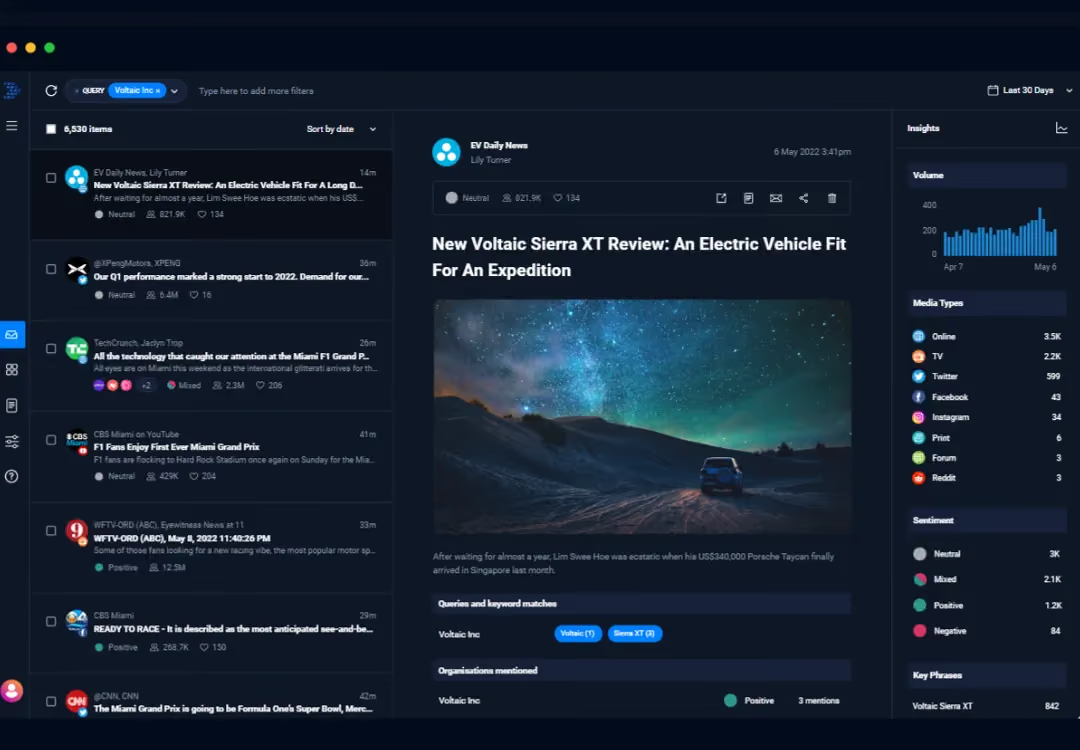


See how you can get more signals and insights from your media intelligence platform


