
I've spent nearly two decades working in media monitoring and intelligence. In the past few years I've noticed a pattern with new clients adopting AI media monitoring software.
They know they need better insights from their media coverage, but they're not sure how to get there. Some are pasting articles into ChatGPT and getting surface-level summaries back. Others have artificial intelligence features available in their platform but haven't moved beyond basic summarization. And some understandably are concerned about AI accuracy or potential data privacy issues.
Clients don't typically come to us wanting AI, but once they see what it can do it changes how they work.
That gap between what AI media monitoring can offer and what most teams are actually using it for is wider than it should be. This guide covers what AI media monitoring tools can actually do today, how PR teams are applying them to real use cases, what to watch out for, and how to choose the right platform for your team.
What AI media monitoring tools can now do
AI in media monitoring now covers everything from daily coverage summarization to deep, multi-threaded analysis, depending on the tool you use. Here's what the best platforms offer today:
- Coverage summarization. AI synthesizes thousands of articles and surfaces key themes, takeaways, and sentiment shifts with source citations. Truescope AI, for example, creates AI summaries across your inbox, charts, reports, and spike alerts. For most teams, this is where AI media monitoring delivers the fastest return on investment.
- Deep, multi-threaded analysis. Ask one question, and the AI breaks it into multiple research threads before delivering a structured, source-cited report. Truescope Analyst handles competitive analysis, journalist profiling, and trend detection this way.
- Pre-built templates. Rather than writing custom prompts, look for ready-made templates for common workflows. Truescope has 70+ fully-customizable templates covering competitive analysis, campaign measurement, stakeholder briefings, and more.
- Plain-language search building. AI converts natural-language descriptions into optimized Boolean queries, including related terms and translations. Truescope Search Assistant, for example, handles this natively so there’s no advanced Boolean search experience required.
- Anomaly and crisis detection alerting. AI monitors for unusual coverage patterns and flags them before they escalate. Truescope's Spike Alerts automate this so your team can respond while a story is still developing.
- AI-powered reporting. AI generates summaries at the section or report level for automated stakeholder reports. In Truescope, these can be scheduled and distributed automatically.
Why general-purpose AI tools fall short
If your team already uses ChatGPT, Claude, or Gemini, you might wonder why you need AI built into a media monitoring platform at all. Here's why general-purpose tools aren't a substitute:
- No access to your actual coverage data. General-purpose LLMs can't access licensed print feeds, broadcast transcripts, paywalled content, or enriched media data. They're guessing about your coverage instead of analyzing it, and they lack the kind of brand reputation and social listening functionality that specialized tools offer.
- No enrichment or scoring. They can't score sentiment at the entity level, attach audience figures to a broadcast segment, or distinguish between a passing mention and a prominent feature.
- Privacy risk. When you paste coverage into a general-purpose AI tool, that data may be used to train the model. Your media analysis, stakeholder reports, and competitive intelligence could end up influencing outputs for other users.
- Hallucination risk. General-purpose LLMs fill in gaps with plausible-sounding information instead of offering real-time monitoring features. Purpose-built AI working on structured, verified media data draws from real sources, not training data.
- No templates. These platforms don’t have built-in, tried-and-true templates that can help you generate high–performing reports quickly.
- Not purpose-built for comms professionals. General purpose tools aren’t built for PR and communication teams, which means they aren't equipped to produce share-of-voice breakdowns, journalist profiles, or stakeholder-ready reports without significant manual work.
How PR teams are using AI media monitoring tools
The features above are useful in theory, but what matters is how they translate into the actual work communications teams do every day. Here are the use cases where AI is making the biggest difference in real-time media monitoring.
Media campaign tracking and measurement
This is the use case that brings most customers to us here at Truescope. They want to track and assess their campaign effectiveness, and AI makes this easier than ever.
Instead of manually logging placements and pulling metrics into a slide deck, AI can analyze all coverage related to a campaign across print, online, broadcast, podcasts, and social media. Then, it can generate a report with potential impressions, sentiment analysis, key message pull-through, and source authority. You can create campaign measurement reports in a PowerPoint format that’s ready for stakeholder presentations, for example, in a matter of a few clicks.
Teams are tracking sentiment breakdowns including mixed sentiment for stories that carry both positive and negative elements, plus social engagement metrics like comments, shares, and likes. With this kind of fast analysis, your team can easily track your domestic and international campaigns and pass along the KPIs that matter most right to the stakeholders.
Competitive intelligence
Rather than manually tracking competitor coverage and compiling share-of-voice comparisons in spreadsheets, teams can now ask an AI analyst to run a competitive analysis across all media types and get a structured report back in minutes.
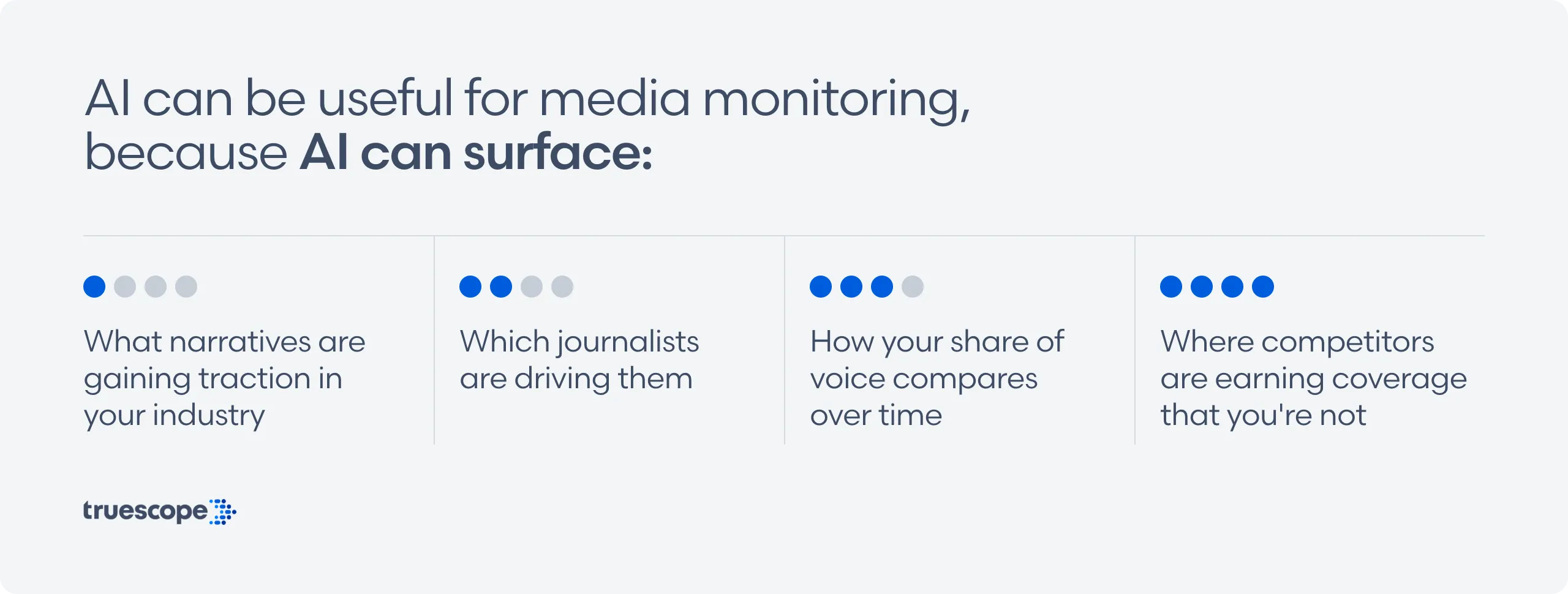
Many teams don't initially realize their monitoring platform can do this, but the ability to monitor competitors side by side, with the same depth of enrichment and analysis, is often what transforms a monitoring tool from a clip service into a strategic asset.
Market analysis and trend detection
Communications teams are increasingly expected to provide strategic insight, and AI-powered insights can help them do this effectively in always-changing markets.
AI media monitoring enables this by analyzing large volumes of coverage to identify emerging trends, shifting narratives, and changes in public sentiment before they become obvious. This is the kind of analysis that used to require a dedicated research team or an expensive agency engagement. Now it's available on demand, to anyone on the team.
Regulatory and industry tracking
Not every team uses media monitoring for traditional PR. Some organizations — particularly in financial services, healthcare, and government — use it to track regulatory developments, policy changes, and industry-specific news.
AI makes this practical by synthesizing coverage around specific regulations, flagging emerging policy trends, and surfacing relevant developments that might otherwise get buried in a high-volume feed.
Best practices for using AI media monitoring
The teams that get the most value from AI are the ones that adopt it intentionally. Here's what works and what to avoid:
- Start with your actual workflow. Identify the tasks that consume the most time on your team. The right AI features are the ones that directly reduce time spent on work you're already doing.
- Let AI handle volume and use your judgment for interpretation. AI is exceptional at reading thousands of articles and identifying patterns. It still needs human expertise to understand how factors like organizational context, political nuance, or stakeholder sensitivities impact next steps.
- Verify before you share. The best AI media monitoring platforms include citations and source links on every output. Before any AI-generated analysis goes in front of leadership, click through to the underlying sources.
- Don't ignore data privacy. If you're pasting proprietary coverage data into a general-purpose tool, you may be contributing to a training dataset. Confirm your platform's data handling policies before you adopt.
- Don't buy based on AI buzzwords. AI that helps you navigate a platform's interface is useful but limited. The real test is whether the AI reads and analyzes your actual coverage data. Ask for a demo on a real dataset, not a curated walkthrough.
- Don't skip onboarding. These platforms have depth. If your team doesn't know what's available, they'll default to basic summarization and miss the capabilities that deliver the most value.
How to choose the right platform
When evaluating AI media monitoring tools in 2026, focus on these criteria:
- Data foundation matters most. Look for platforms that ingest and enrich content across all media types with entity-level scoring for relevance, prominence, and sentiment. Without this foundation, AI analysis is just sophisticated (or not so sophisticated) guessing.
- Privacy is non-negotiable. Confirm that the vendor does not use your data for model training and that your queries remain confidential within your workspace.
- Depth over decoration. Summarization is the baseline. The real value is structured analysis across aggregate data.
- Integration into workflow. Look for AI that's embedded throughout search, reporting, dashboards, and alerts, not isolated in a separate chat window.
- Support that understands your work. AI doesn't eliminate the need for human expertise, and it never will. Instead, it changes what that expertise focuses on. A dedicated account manager with communications experience can help you get the most out of AI features and configure your environment for your specific needs.
Getting started with AI media monitoring: The PR team’s checklist
If you're ready to move from general-purpose AI tools to a purpose-built platform for media and brand monitoring, here's how to start.
- Audit your current workflow. Write down every task your team does manually each day: reading clips, compiling reports, tracking competitors, monitoring for crises. These are the tasks AI should handle first.
- Identify your must-have media types. List the specific publications, broadcast markets, social platforms, and content types your team needs. Confirm coverage with a media intelligence provider before you sign on the dotted line.?
- Test the demo with a real use case. Ask the vendor to run an analysis on a topic relevant to your industry so you can see what the output actually looks like.
- Check the support model. Ask who your account manager will be, what their background is, and what ongoing support looks like after onboarding. Read independent reviews on G2, Capterra, and Trustpilot to verify.
- Confirm contract terms upfront. Ask about auto-renewal clauses, cancellation windows, and what's included in your subscription versus what costs extra.
- Start with the features that save time immediately. AI summarization and automated reporting typically deliver the fastest ROI. Get those running first, then expand into deeper analysis and competitive intelligence as your team gets comfortable.
Ready to see what AI-powered media monitoring looks like in practice? Book a demo with Truescope to see how it fits your workflow.
See how you can get more signals and insights from your media intelligence platform




See how you can get more signals and insights from your media intelligence platform