

Earned media analytics is how communications teams turn unpaid coverage into evidence. Most teams already collect the coverage. The harder part is turning a pile of clips, mentions and broadcast segments into something a CEO will accept as proof that the press coverage mattered.
This guide covers what earned media analytics is, the metrics worth tracking, the ones to drop, how to set up a measurement program, and how to report it to the board. We have built it around the way PR and communications leaders in Australia and across APAC actually work, so the examples treat broadcast, online and social coverage as one picture rather than paid social or social media on its own.
What is earned media analytics?
Earned media analytics is the practice of tracking, measuring and analysing the unpaid media coverage a brand receives across news, broadcast, online and social, to understand reach, sentiment, share of voice and message pull-through.
Earned media refers to free media, any coverage you did not pay for and did not publish yourself, and it is generally considered more credible than paid media; a journalist's article, a broadcast segment, a podcast mention, organic posts from influencers, user-generated content like an analyst note, or a customer's review. It is the heart of public relations work, encompassing everything from news stories to customer testimonials, and earned media analytics is what happens after the coverage lands. It answers three questions: How much coverage did we get? What was its quality? Did it move specific audience segments or the business?
That last question is where most reporting falls down. Counting mentions is easy. Connecting coverage to reputation, message penetration and commercial outcomes takes a measurement framework, a content strategy, and a cohesive earned media strategy, which is what the rest of this guide sets out.
Why earned media analytics matter now for brand awareness
For years, the default way to value public relations was the advertising value equivalent, or AVE, a figure that estimated what coverage would have cost as paid advertising. AVE has since been retired. AMEC, the global body for communications measurement, rejected it as misleading and built the Integrated Evaluation Framework in its place. The industry has moved on, and modern earned media analytics helps businesses pinpoint strengths and gaps far more clearly than outdated valuation methods.
Three shifts make earned media analytics more useful, and more necessary, than it was a few years ago.
Coverage is fragmented. A single campaign can surface in a newspaper, a television bulletin, a podcast, a LinkedIn thread and a Reddit forum on the same day, demonstrating the reach of modern earned media campaigns. Without analytics that pull these together, you only ever see part of the picture. Earned coverage can also improve rankings in search engines through backlinks, and links from authoritative sites can significantly strengthen SEO efforts, lift brand visibility, increase organic traffic, and reinforce your web presence.
Budgets are under pressure. Communications leaders are asked to defend spend in the same terms as every other function. "We got 200 mentions" does not survive that conversation. Evidence of reach, sentiment and message delivery does, which is why earned media measurement now sits close to the budget cycle.
AI has changed what is possible. It can read thousands of articles and broadcast transcripts, classify sentiment, and flag emerging issues faster than a person can. Used well, AI means analysts spend less time tagging coverage and more time interpreting it. We covered this shift in more depth in our notes from AMEC's 2026 framing of AI and measurement.
The metrics that matter (and the ones to drop): including social media mentions
Good earned media analytics measures quality, not just volume. These are the metrics worth your time.
Share of voice. Share of voice is your brand's portion of total coverage in your category, set against your competitors. It tells you whether you are leading or trailing the conversation, and it is far more useful tracked over time than read as a single number.
Quality of coverage. A feature in a tier-one outlet with your key message intact is worth more than ten passing mentions. Score coverage by prominence (was the brand central or incidental), by outlet influence, and by whether the journalist actually carried your message.
Sentiment. Sentiment tells you whether coverage is positive, negative or neutral. On its own it is blunt. Paired with share of voice, it shows whether you are winning attention for the right reasons. Monitoring it also helps brands address negative word of mouth early, protecting the integrity of your word-of-mouth marketing efforts.
Message pull-through. Did the key messages you briefed appear in the coverage? This is one of the strongest signals that your communications worked, and one of the least reported.
Reach in context. Reach and impressions estimate how many people could have seen the coverage. Treat them as a sense of scale, not a precise count, and never as a stand-in for impact.
Two things to drop. First, drop AVE and treat Earned Media Value only as an estimate of what organic exposure would have cost in traditional advertising. As covered above, AMEC rejected it as misleading, and a board paper that quotes it invites the wrong question. Second, drop raw clip counts as a headline number. Volume without quality tells a leadership team almost nothing, and at worst it rewards noise over substance. For more on this, see why measuring media really matters.
How to set up earned media analytics: a step-by-step framework
You do not need a large team to measure earned media well. You need a clear scope and a consistent method.
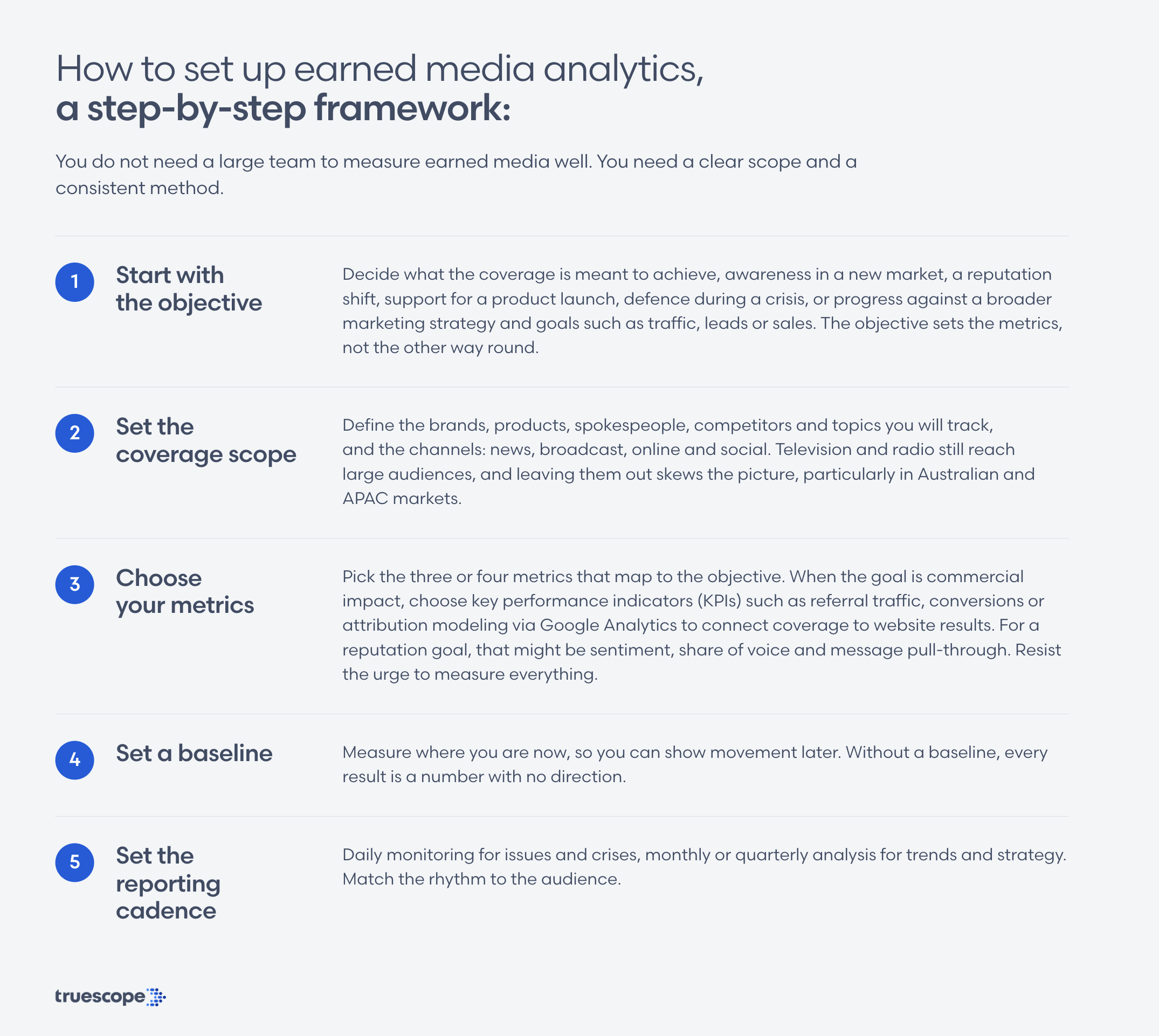
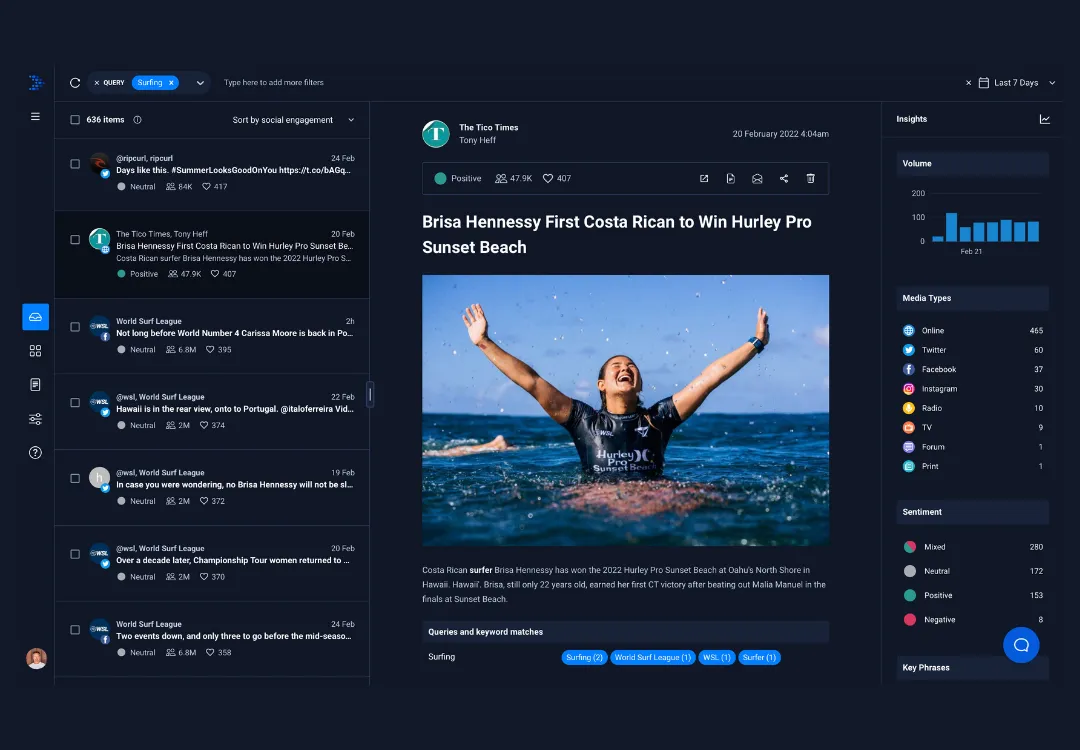
A media monitoring and analytics platform does the heavy lifting at steps two to five, collecting coverage across channels and applying consistent sentiment and message tagging so the numbers are comparable month to month, while also helping teams measure whether a press release or other earned placement drove website traffic, sales, and increased conversion rates. This is one of the five pillars of media intelligence that a modern program rests on.
How to report earned media analytics to the board
The board does not want your dashboard. It wants to know whether communications is protecting and building the business.Translate the analytics into that language. Boards already understand that coverage in respected outlets carries credibility paid advertising cannot buy, your job is to quantify how much, and what moved.
Lead with the answer. Open with the finding that matters. Reputation is up, the launch landed, the issue was contained. Put the detail underneath for anyone who wants it.
Tie metrics to goals, not activity. Connect share of voice to market position, sentiment to reputation risk, and message pull-through to whether the thought leadership strategy is working. A C-suite audience cares about outcomes not output. A clear line to ROI, framed as business impact not coverage volume, is what earns the next budget conversation.
Show the trend. One month of data is a snapshot while twelve months is a story. The trend is what lets leadership see the return on the communications program over time.
Be honest about negative coverage. A report that shows only good news loses credibility fast. Showing how you spotted and handled a problem is often the strongest case for the PR function. Our piece on the power of PR analytics goes deeper on building that narrative.
Frequently asked questions
What is the difference between earned, paid, and owned media monitoring and analytics?
Earned media monitoring is collecting and tracking brand mentions as they happen. Earned media analytics is interpreting that coverage to measure reach, sentiment, share of voice and impact. Monitoring tells you what was said. Analytics tells you what it means.
Is earned media value (EMV) still worth using?
Earned media value and the older AVE both try to put a dollar figure on coverage, and both have well-documented flaws. AMEC no longer endorses advertising-based valuations, and most mature teams have moved to outcome-based measurement instead. Earned media value can be a rough directional signal, but it should never headline a board paper.
What metrics should I track for earned media?
Start with share of voice, quality of coverage, sentiment and message pull-through, plus reach for a sense of scale. If reviews matter in your category, track their volume and tone too: positive reviews on platforms like Google Reviews, industry directories, and app store reviews are valuable earned media. They can increase customer engagement and brand awareness, may influence search engine visibility, and add social proof. Choose the few that map to your objective rather than tracking everything. Quality of coverage matters more than the raw number of mentions.
Can you measure broadcast coverage as part of earned media analytics?
Yes. Television and radio coverage can be captured, transcribed and analyzed alongside online and social. Including broadcast gives a fuller view of reach, which matters in markets like Australia where it still commands large audiences.
How often should I report earned media analytics?
Monitor daily for issues, and analyze monthly or quarterly for strategy. Match the cadence to the reader: operational teams need frequent updates, the board needs the trend.
Turn coverage into evidence
Earned media analytics is what separates a PR team that reports activity from one that proves value. Get the scope and the metrics right, anchor value to outcomes rather than ad-equivalent figures, and report the trend in language the board understands.
To see how this works in practice, see how Truescope works for PR teams, measuring earned coverage across broadcast, online and social and turning it into board-ready reporting. Book a demo and we will walk you through it with your own coverage.
See how you can get more signals and insights from your media intelligence platform



See how you can get more signals and insights from your media intelligence platform