
Top PR Monitoring Tools: A Comprehensive Review
A single critical story can travel further in an hour today than it could in a week ten years ago. Broadcast, podcasts, newsletters, and social media all boost each other, and AI-made content adds another layer of noise to filter.
For communications teams, Public Relations (PR) means tracking each mention as it happens, understanding what each mention means and being able to act before a narrative takes hold.
That's the job of a PR monitoring tool. The right one measures your reputation, flags issues, benchmarks you against competitors, and gives you the evidence to prove the value of your work. The wrong one will bury you in irrelevant alerts and miss the mention that actually mattered.
This guide walks through what PR monitoring is, what to look for in a platform, and how the leading PR tools stack up.
What is PR Monitoring?
PR monitoring means tracking and reviewing mentions of your brand, leaders, products, competitors, and industry across traditional and digital media. This includes online news outlets, print, TV, radio, podcasts, newsletters, blogs, and social media platforms.
A modern PR monitoring platform collects and tags mentions for sentiment, prominence and reach, surfaces patterns over time, then turns them into reports comms team can actually use.
Media monitoring refers to observing topics or brand mentions throughout all types of media. Uses keywords to identify relevant content so that measuring and analysing what's happening in the industry and with consumers.
The insights you discover can directly shape your social media strategy and business goals. Rather than relying on instinct alone, data through media monitoring gives you the confidence to make informed, deliberate decisions for your company.
Why PR Monitoring Matters
Crisis management: Real-time alerts let you spot a negative story, a viral post or a coordinated pile-on early, when there's still time to respond proportionally.
Competitive analysis: Tracking competitor coverage, with share of voice, key messages, journalist relationships, and sentiment, gives you a clear read on where they're winning and where the gaps are.
Measurement and reporting: Earning coverage means nothing if you can't prove it. Monitoring tools generate the data behind board reports, campaign post-mortems and budget conversations.
Content and campaign strategy: Patterns in what gets picked up, by whom, and how it's framed inform sharper messaging and better-targeted campaigns and PR efforts.
Stakeholder intelligence: Knowing what analysts, regulators, customers and investors are reading and saying helps comms teams brief executives with context, not just clippings.
What to Look For in a PR Monitoring Tool
Before comparing products, it's worth knowing which capabilities actually move the needle in 2026:
- Channel coverage: Online news, print, broadcast, podcasts and social media as a baseline, not just web scraping.
- Real-time alerting: Delays of even a few hours can turn a manageable issue into a crisis.
- Sentiment and prominence: Accurate sentiment tagging, plus the ability to tell a passing reference from a headline mention.
- Sentiment analysis and trend detection: AI that explains why and where coverage is spiking.
- Reporting and dashboards: Customisable reports, self-service dashboards and exportable data.
- Search quality: Boolean operators, smart filters and the ability to exclude noise without losing signal.
- Support: A real human who knows your account, what you're after, and how to assist you.
- Pricing transparency: Clear pricing beats opaque enterprise quotes, especially for mid-sized teams.
Top PR Monitoring Tools for 2026
1. Truescope
Best for: Comms teams and agencies that want enterprise-grade coverage with modern, user friendly UX and hands-on support.
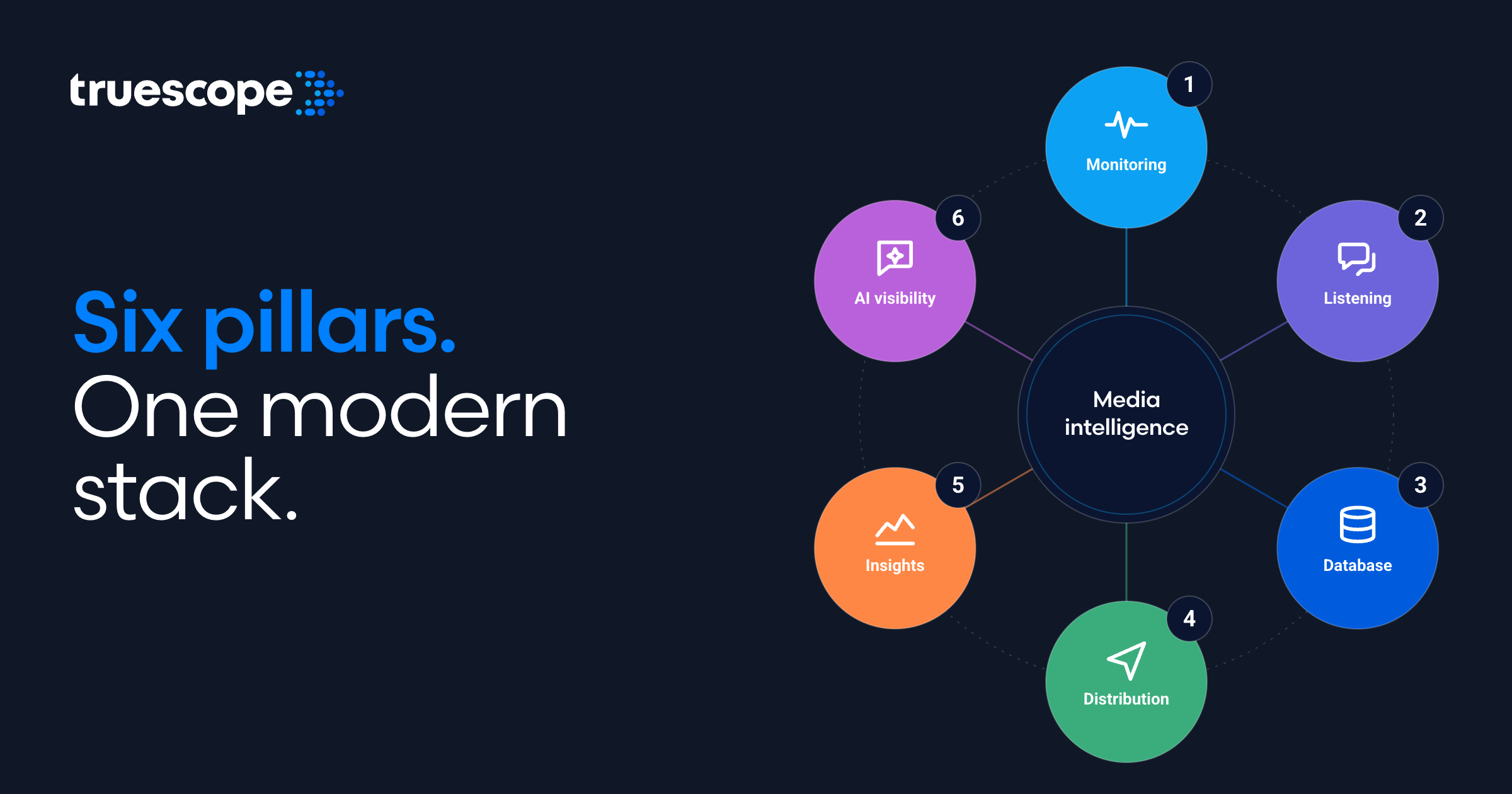
Truescope is a media intelligence platform built from the ground up for PR professionals. It monitors news, broadcasts, social media, podcasts, and online sources in real time. It includes sentiment analysis, competitor benchmarking, and customisable alerts and reports. Trend analysis helps teams see how narratives are shifting over time, not just where they are right now.
What sets Truescope apart is the combination of breadth (traditional plus digital plus broadcast in one platform), and an intuitive and comprehensive interface that doesn't require a week of training.
2. Cision / CisionOne
Best for: Large in-house teams and global agencies that need an end-to-end PR stack.
Cision is a long-established name in PR software, pairing media monitoring solutions with one of the world's largest journalist databases and PR Newswire distribution. CisionOne, its newer platform, layers AI-driven issue detection on top. It's powerful, but the scale brings complexity and pricing typically lands in the enterprise tier.
3. Meltwater
Best for: Enterprises that need a global media monitoring tool with strong social listening.
Meltwater offers wide international coverage across news, broadcast and social, with AI summarisation and competitive intelligence. It's a comprehensive option, though many of the most useful capabilities like broadcast, advanced analytics, and a deeper history are sold as add-ons, so the real cost can climb quickly.
4. Muck Rack
Best for: PR teams whose primary job is pitching and tracking earned coverage.
Muck Rack combines a constantly updated journalist database with coverage tracking, pitch management and reporting. Its strength is workflow, you can find a journalist, pitch, monitor the coverage and report on it without leaving the platform. Stronger on online news and outreach than on broadcast or international print.
5. Brandwatch
Best for: Brands that lead with social listening and consumer intelligence.
Now part of the Cision portfolio, Brandwatch is one of the deepest social listening platforms on the market, with image recognition, audience analytics and access to large volumes of historical conversation data. Best paired with a dedicated news monitoring tool as its strength is social over traditional media.
6. Talkwalker
Best for: Teams that want to detect narrative shifts and emerging conversations.
Talkwalker is strong on social and digital monitoring, with capable AI for surfacing emerging topics, visual content analysis and crisis signals. As with Brandwatch, broadcast and print coverage are typically lighter than what dedicated media intelligence platforms provide.
7. Mention
Best for: SMBs (Small and Medium Sized Businesses) and marketing teams focused on social and web references.
Mention is a clean, affordable tool for PR pros tracking brand callouts across social platforms and the web, with sentiment analysis and competitive comparison features for tracking public perception. Pricing starts in the low tens of dollars per month, which makes it accessible but news and traditional media coverage are limited compared with full media intelligence platforms.
8. Brand24
Best for: Small teams and solo communicators on a budget.
Brand24 tracks 25M+ online sources including social, news, blogs, forums, podcasts and video, with sentiment analysis, AI-generated insights and exportable reports. Pricing starts well below enterprise tools, making it a strong choice for SMBs that need real monitoring without an enterprise commitment.
9. Prowly
Best for: In-house PR teams that want monitoring bundled with outreach.
Prowly combines media monitoring with a media database, press release builder and CRM-style contact management. A good PR solution for lean teams that want one tool for both pitching and tracking, particularly across European media.
10. Google Alerts
Best for: Free, basic keyword tracking.
Google Alerts will email you when new content indexed by Google matches a keyword. It's free, simple and has its place as a backup or for personal-brand monitoring. Although, it misses social, broadcast, paywalled news and most of what serious PR strategy actually needs to cover.
How to Choose the Right PR Monitoring Tool
The right tool depends less on what the features include and more on what your team actually needs to deliver.
Start with the channels that matter to your stakeholders. If broadcast and print are central to your reporting, narrow to platforms that genuinely cover them, rather than those that bolt them on as add-ons. If your brand lives or dies on social media, weigh social listening capability more heavily.
Ask about support. PR doesn't run to the clock, and the difference between a tool that helps in a crisis and one that doesn't often comes down to whether you can get human support and assistance.
If your current platform isn't doing one of these jobs well, it's worth shopping around, the market has moved a long way in the last two years and there are more solutions to be offered.
Working with Truescope
Choosing a PR monitoring tool is about whether the platform gives your team the visibility, the insights, and the support to do their best work.
Truescope was built for that. A versatile and robust PR monitoring tool with comprehensive coverage across news, broadcast, social and podcasts; AI-driven sentiment and trend analysis, transparent pricing, and a support team that is truly dedicated. If your current service isn't delivering, or you're evaluating for the first time, we'd be glad to show you why Truescope stands out.
Book a demo with Truescope.
See how you can get more signals and insights from your media intelligence platform



See how you can get more signals and insights from your media intelligence platform