Top Sources Report
Coverage is a relationship business, and relationships are with named outlets, not abstract categories. The Top Sources Report ranks the outlets covering your brand, with their reach, sentiment and quality, so you can see exactly which to invest in, which to watch, which to address concerns with, and which to try to break into.
What it does
This template answers an operational question: which outlets are covering your brand most, with what reach, sentiment and quality, and what does the ranking reveal about your editorial relationships. Where tier analysis groups outlets by authority, this report names them one by one and makes the list scannable at the level of the individual outlet. It ranks by both volume and audience-weighted reach, surfaces who has turned friendly or critical, who has just started covering you, and who has gone quiet. The output is the raw material for outlet-by-outlet relationship strategy.
The questions it answers
- Which outlets cover us most, and which deliver the most reach per piece even if their volume is modest?
- Which outlets are markedly more positive or more negative than the rest of the pack, and on what themes?
- Which outlets have started covering us this period, and what triggered them?
- Which outlets that used to cover us have gone silent, and what might that mean?
- How much of our coverage is concentrated within a single parent media network?
What's in the report
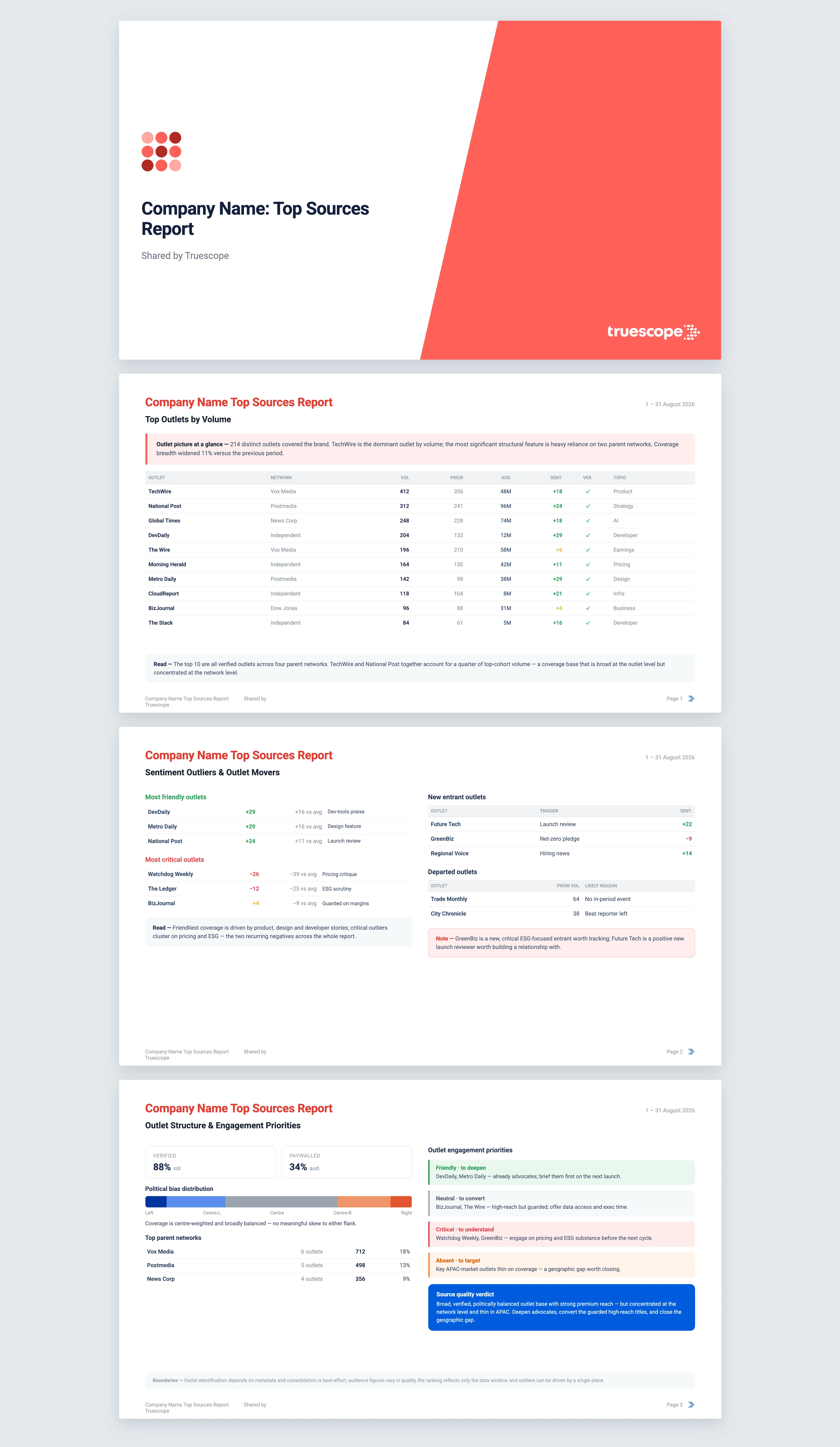
The report opens with a read of your outlet picture, naming the size of the cohort, the dominant outlet, and the most significant structural feature, such as network concentration or a geographic or political skew. Two ranked tables follow: the top outlets by volume, and the top outlets by audience-weighted reach, with low-volume high-reach outlets bolded so the names that punch above their count stand out. Each row carries reach, sentiment, intensity, authority rank, verified and paywall status, primary topic and the number of distinct journalists.
It then reads the cohort's dynamics:
- Sentiment outliers, splitting friendly outlets from critical ones, each with the recurring themes behind the score.
- New entrant outlets, each with the article that triggered first-time coverage.
- Departed outlets that have gone quiet, each with a plausible read framed as "consistent with" a beat change, a cooling relationship, or a single event now over.
- Verified, paywall and political-bias breakdowns across the cohort, plus geographic distribution and per-outlet topic specialisation.
- Parent-network aggregation, so you can see how much volume rolls up to a single owner.
Every finding is cited back to the source coverage behind it, and where the same outlet appears under name variations it is consolidated to one canonical name before ranking. The report ends with an editorial verdict on your source picture and a candidate list of outlets worth specific engagement attention, grouped into friendly to deepen, neutral to convert, critical to understand, and absent to target. These are offered for consideration, not as directives.
Who it's for
This is for PR and media relations professionals who run outlet and journalist relationships day to day, and for communications leaders who need a defensible answer to "who is actually covering us" for executives or the board. It suits anyone planning pitch targeting, managing a critical outlet, or trying to break into titles where the brand is currently thin.
Why Truescope Analyst
Building an outlet ranking by hand means consolidating messy source names, counting volume, looking up authority and bias for each, and spotting who is new or gone, then repeating it all next period. Agency reports give you a top-ten list without the audience-weighted view, the new-entrant triggers, or the network roll-up. A general AI tool simply cannot do it, since it has no ranked outlet data and only reads the single article you hand it.
Truescope Analyst ranks across your full dataset, consolidates outlet names, weights by reach, detects entrants and departures, rolls outlets up to their parent networks, and returns a cited, repeatable report in minutes. It is built into your subscription and available to the whole team, so the outlet picture is ready whenever a relationship decision needs making.
Frequently asked questions
What period does the ranking cover?
You can analyse up to the last 13 months for coverage already in your Truescope inbox, or the last 90 days for global data not yet matched to your workspace. Each run compares your window against the equal period immediately before it, which is how new entrants and departed outlets are detected.
How does it decide an outlet is a new entrant or has departed?
A new entrant is an outlet covering you for the first time in the period, or for the first time in 90 days, shown with the article that triggered it. A departed outlet had meaningful coverage in the prior period and none now, with a plausible, non-assertive read on why.
Are the engagement priorities instructions to act?
No. The engagement priorities are candidate-for-consideration suggestions, grouped to help you decide where to focus. Single influential pieces can drive an outlier, and the report flags when that is the case, so the judgement stays with you.