Investor Sentiment Report
Understand how the market really sees your company. The Investor Sentiment Report reads across financial media and analyst commentary to tell you what investors believe, what is shifting, and what it means for your positioning.
What it does
Investor coverage speaks its own language. The vocabulary, the evaluative frames, and the conventions are nothing like consumer or general business reporting, so general sentiment tools that lump it all together miss the picture entirely. This report scopes tightly to investor-relevant sources such as Bloomberg, Reuters, the Financial Times, the Wall Street Journal, CNBC, and the specialist financial press. It then maps the narratives that actually move valuation and investor decisions, and shows you how investor sentiment compares with the broader brand picture.
The questions it answers
- What is the overall sentiment toward the company across financial media and analyst commentary, and which way is it moving?
- Which investor narratives dominate right now, from growth thesis and valuation debate to execution risk, capital allocation, and regulatory exposure?
- Does investor sentiment diverge from how the company is seen in general coverage?
- What is the balance between the bull case and the bear case, and who is carrying each argument?
- Which named analysts are shaping the narrative, and what conviction are they signalling?
What's in the report
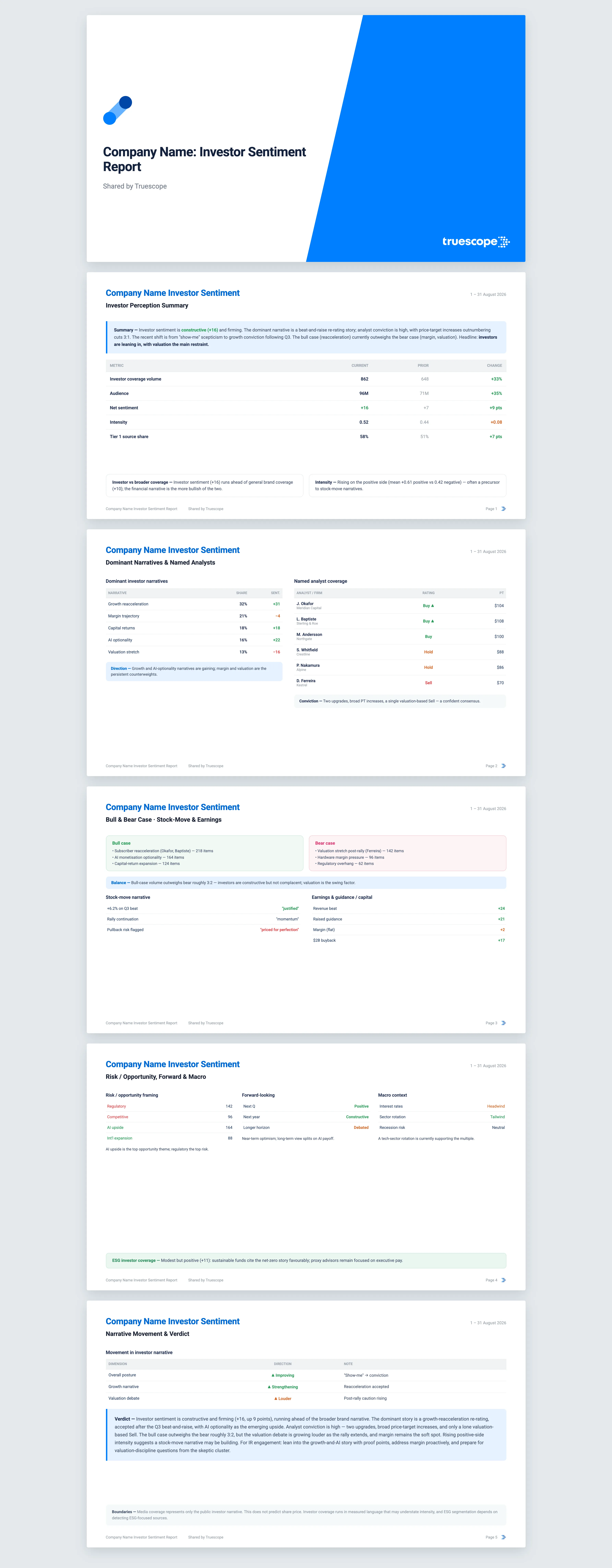
The report opens with a plain-English investor perception summary, then layers in the evidence beneath it. Every figure compares the current period against the prior one, so you can see what has changed rather than just where things stand. All findings are cited back to the source coverage they come from.
- An investor coverage scoreboard covering volume, audience reach, net sentiment, intensity, and source tier mix, with period-over-period change.
- A divergence view comparing investor sentiment against your general brand coverage.
- A ranked table of dominant investor narratives, each with its volume share, sentiment, the voices carrying it, and recent direction.
- A named analyst table covering firm, rating direction, conviction language, recent rating actions, and any price targets mentioned.
- Coverage attributing share-price movement to specific reasons, plus earnings and guidance reception and capital allocation framing across buybacks, dividends, M&A, debt, and capital expenditure.
- A structured bull and bear case map, forward-looking commentary by time horizon, risk and opportunity framing, ESG investor coverage, and macroeconomic context.
- A read on how the investor narrative has shifted period over period, and a closing sentiment verdict written in editorial voice.
Who it's for
This report is built for investor relations teams, heads of communications, and the executives who brief the board on market perception. It suits the run-up to results, the aftermath of a volatile share-price move, or any moment when you need a defensible read on the investor narrative for the CEO, the CFO, or the board.
Why Truescope Analyst
Getting this picture the traditional way means an IR team reading clippings and analyst notes by hand, or an agency turning around a perception study over weeks at considerable cost. By the time it lands, the narrative has often moved on. General AI chatbots cannot help either, because they only see the single article you paste in and have no access to the breadth of investor coverage that actually forms the consensus. Truescope Analyst reasons across your full media dataset, scopes the analysis to investor-relevant sources, separates the bull case from the bear case, and traces every claim back to the coverage behind it. It runs in minutes rather than days, it repeats on demand so you can track the narrative quarter to quarter, and it is built into your subscription and available to anyone on the team.
Frequently asked questions
What time period does the analysis cover?
It can draw on up to the last 13 months for coverage already in your Truescope inbox, or the last 90 days for global data not yet matched to your workspace. Investor narratives tend to shift on roughly quarterly cycles, so a 90-day view is a natural window for spotting movement.
Can it compare us against our peers?
Yes. If you supply a peer or competitor set, the report adds an industry-relative view showing whether your company has proportionally better or worse investor sentiment than peers, with the differential stated for each.
Is this investment advice?
No. The report is an observation of the public investor narrative, not a prediction of share-price movement or a recommendation. Private analyst notes and institutional discussions sit outside media coverage, and the analysis describes what is being said rather than forecasting what the stock will do.