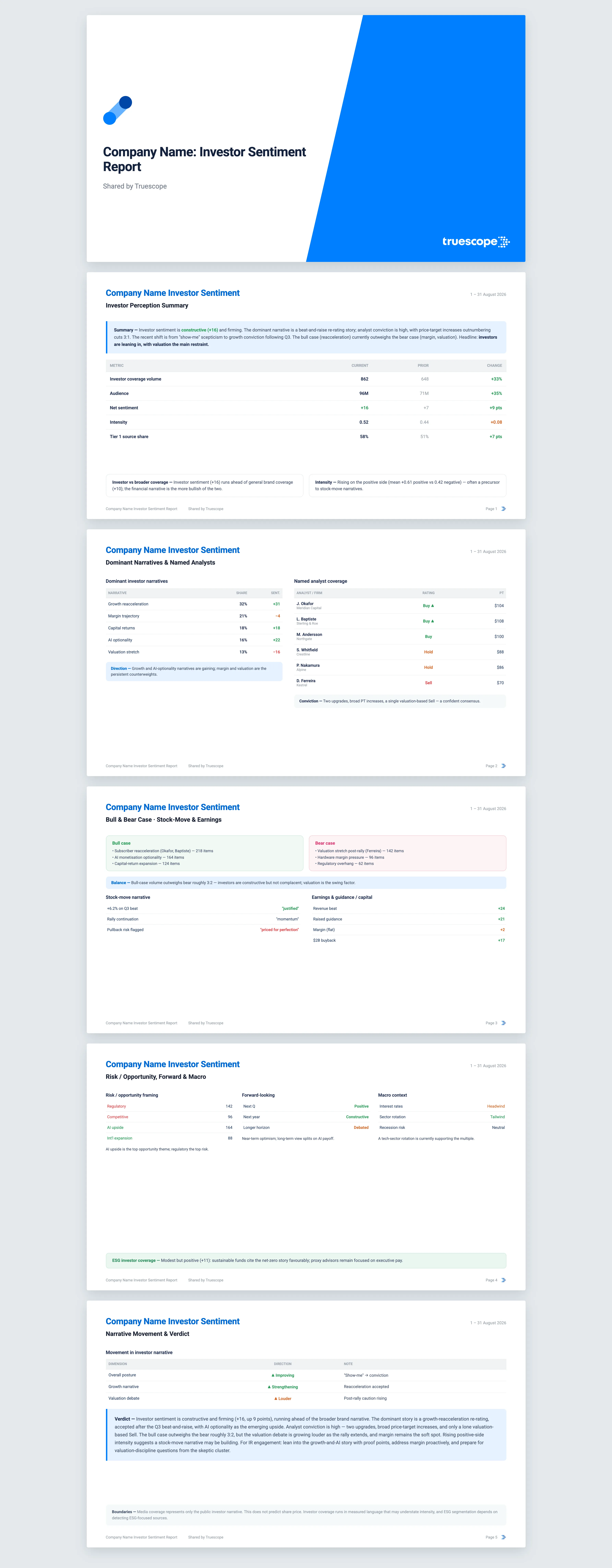
Investor Communications Effectiveness
Find out whether your message actually landed. This report measures how a specific investor communication was received, from an earnings release to a CEO interview, and tells you which of your intended messages got through and where reception diverged from intent.
What it does
You can craft an investor communication carefully, but the only thing that matters is how it was received. This report scopes tightly to investor-facing sources, measures the reception against the specific messages you set out to convey, and compares the picture before and after the event. It establishes the narrative the communication entered, tracks what changed in the days that followed, and pinpoints where the message landed, where it missed, and where reception drifted from your intent.
The questions it answers
- Did the communication achieve its intended objectives, and how was it received overall?
- Which of our intended messages landed, and which failed to get through?
- How did analysts respond, through rating actions, estimate revisions, and shifts in conviction language?
- Did the communication shift the investor narrative, or did the prior narrative persist?
- What scepticism or new concerns surfaced in response, and which spokespeople carried the message effectively?
What's in the report
The report begins with an effectiveness summary, then sets the pre-event baseline against the post-event reception so you can see what moved. A reference line marks the communication date on every time-series chart. Pre-versus-post comparison runs throughout, and findings are cited back to source coverage.
- A pre-event baseline of the dominant themes, sentiment, analyst conviction, and any expectations or speculation the communication entered.
- Communication coverage volume and reach, plus the sentiment of the coverage engaging with it.
- A message landing table scoring each intended message by hit count, share of post-event coverage, reach, and sentiment, with a plain read on which landed.
- Analyst response, narrative shift detection, counter-narrative and sceptical reception, and any new concerns raised in response.
- Stock-move narrative, spokesperson performance where executives are supplied, quotable moments, and the tier and source quality of reception.
- A pre-versus-post intensity comparison, comparison to expectations, forward-looking guidance reception, ESG reception where relevant, a per-message effectiveness summary, and a closing verdict.
Who it's for
This report is for investor relations teams and communications leaders who need to prove the impact of a results announcement, strategic update, or executive appearance. It helps an IR director show the CFO and the board exactly how the last communication landed, and sharpens the planning for the next one.
Why Truescope Analyst
The usual way to gauge reception is to skim a handful of analyst notes and headlines and form an impression, or to commission a perception study that arrives long after the moment has passed. Neither tells you, message by message, what actually got through. A general AI tool can summarise a single article you give it, but it cannot measure your specific messages against the full body of investor coverage or compare the narrative before and after the event. Truescope Analyst reasons across your full media dataset, scopes to investor sources, scores each intended message, detects narrative shifts, separates genuine scepticism from noise, and cites every finding back to source coverage. It runs in minutes, repeats after every communication so you build a track record, and is built into your subscription for the whole team.
Frequently asked questions
How do I tell it what to measure success against?
You supply between one and six specific messages the communication was meant to convey, the communication date, and a measurement window of 7 to 14 days. The report scores how each of those messages landed in the coverage that followed.
What time periods does it compare?
Reception is measured against a pre-event baseline, typically the 30 days prior, using the company's coverage. The analysis can draw on up to the last 13 months for coverage already in your Truescope inbox, or the last 90 days for global data not yet matched to your workspace.
Why might a clearly stated message still show as not landing?
Message landing depends on the message being specific enough to detect in coverage. Abstract or thematic messages produce looser detection than concrete ones. The report measures media and analyst reception, not private institutional discussions, and it is an observation rather than an investment recommendation.