Comment & Reaction Analysis
Posts are content. Comments are reaction. The comment layer is your audience's actual voice, and it often tells a very different story from the posts above it. Comment & Reaction Analysis goes beneath the surface to read what people are really saying about your brand.
What it does
This template dives into the comments and reactions beneath social posts that mention or are about your brand. The strategic question is what the audience is actually saying, what the dominant reactions are, and what the comment layer reveals that the post layer does not.
Sentiment in comments frequently diverges sharply from sentiment in the posts they sit under. A positive announcement can draw a wall of complaints; a critical news story can draw a wave of defenders. That divergence is the central diagnostic of this report, and it is often the most operationally useful read on how your brand is actually perceived.
The questions it answers
- What is the dominant audience sentiment in the comments, and does it diverge from the sentiment of the posts?
- Which specific posts triggered negative reaction, and which drew defending or positive reaction?
- What recurring themes are audiences raising that never appeared in the posts themselves, such as product complaints or service issues?
- Is the criticism diffuse and scattered, or concentrated on one or two specific issues we can address?
- Which voices carry disproportionate weight in the comment conversation?
What's in the report
The report opens with a short read on the comment picture, then moves through volume, sentiment divergence, themes and voices. Findings are characterised in plain language and cited back to source coverage, and to protect privacy, representative comments are paraphrased rather than quoted directly.
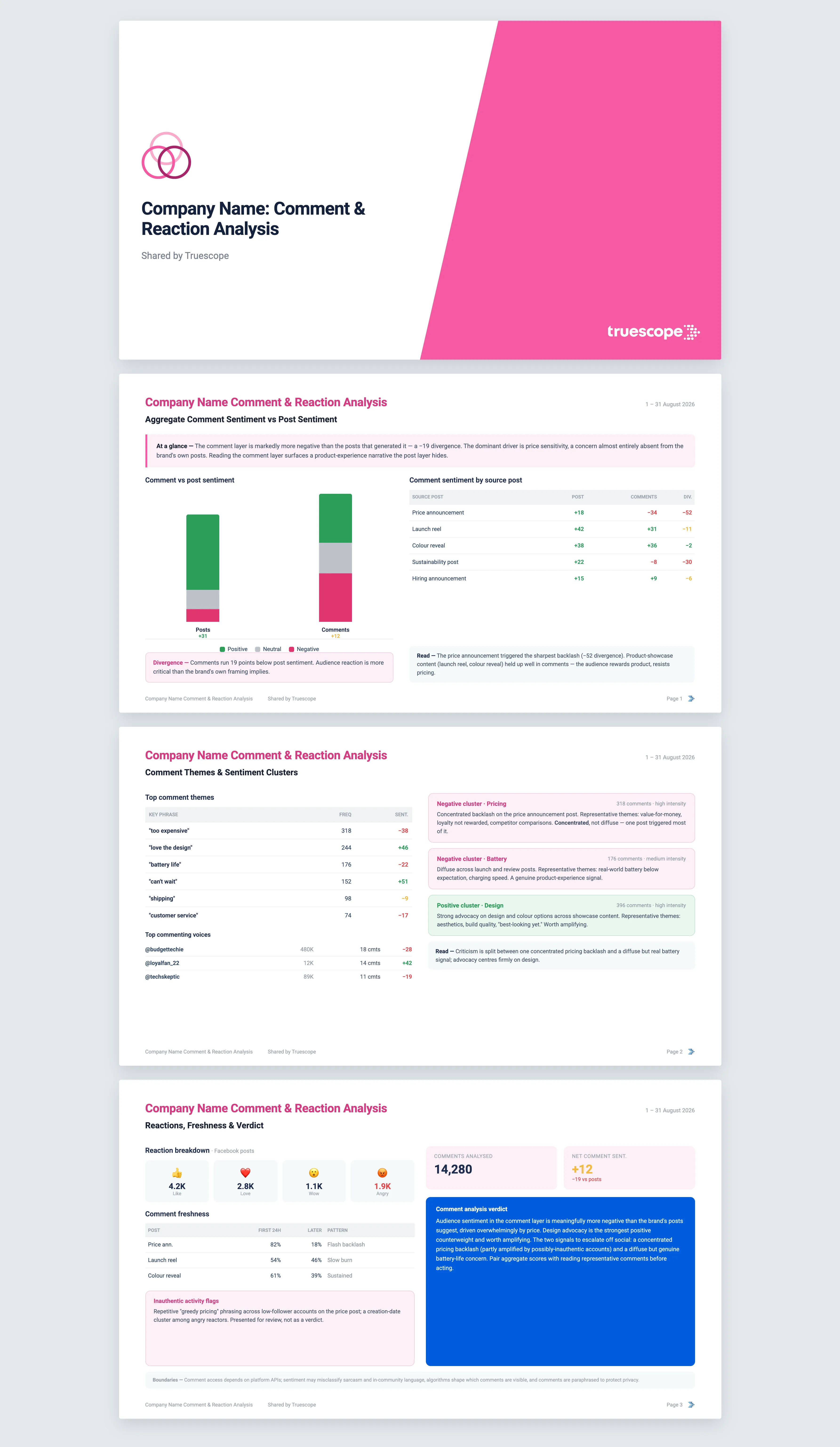
- Comment volume per source post, with comment counts, comment-to-engagement ratios, comment sentiment and the divergence from each post's own sentiment.
- An aggregate comment-versus-post sentiment chart, with a clear statement of the divergence direction.
- Negative comment clusters and positive comment clusters, each with volume, intensity, paraphrased representative themes, and the source posts that triggered them, plus a note on whether the criticism is concentrated or diffuse.
- A reaction breakdown using each platform's own reaction labels, where typed reactions are supported.
- Voice analysis of the accounts shaping the comment conversation, reply-network depth, comment freshness patterns, and language and emoji signals that read community mood honestly.
- Pattern-based signals of coordinated or inauthentic activity, flagged for your review rather than judged.
- An editorial verdict that states the post-versus-comment divergence explicitly and what it suggests about audience perception.
Who it's for
Communications and social teams who need to know how audiences are really reacting, not just how many engagements a post got. Customer-experience and product teams whose issues surface first in comments. Reputation and issues managers who need an early read on a building problem, and corporate-affairs leads who must brief executives on genuine audience sentiment rather than headline numbers.
Why Truescope Analyst
Reading comments properly by hand is brutal: scrolling endless threads, trying to hold a sense of the mood, and quietly biasing toward whatever the platform surfaced at the top. It does not scale, it is not repeatable, and it produces an impression rather than evidence. A general AI tool cannot reach the comment data at all, and pasting in a handful of comments tells you nothing about the divergence that matters.
Truescope Analyst reads across the comment layer at scale, measures it against the sentiment of the posts above it, and groups recurring concerns into clusters you can actually act on, all cited back to source coverage and paraphrased to protect individual users. It runs in minutes, it is repeatable whenever you need it, and it is built into your subscription for the whole team.
Frequently asked questions
Which posts can I analyse the comments on?
You can scope the analysis to your brand's own posts, posts about the brand, posts from a defined campaign or moment, or a workspace query that resolves to a set of source posts, across the platforms where comment data is available. You can also add an optional comparison period if you want a before-and-after read.
What time range and comparison does it use?
It covers up to the last 13 months for coverage already in your Truescope inbox, or the last 90 days for global data not yet matched to your workspace. Where you opt for a comparison, the prior period is the same number of days immediately before, with the reporting interval scaling from hourly up to weekly.
Will it quote individual users?
No. Representative comments are paraphrased or characterised in plain language so individual users cannot be identified. Comment sentiment is also computational and can misread sarcasm or in-community language, so the report is most reliable when read alongside the representative themes it surfaces.