Sustainability Initiative Tracking
Find out whether your named sustainability programmes are actually landing in coverage, how they are being framed, and whether you are getting credit for the work you have done.
What it does
General ESG analysis describes your overall profile. This template does something narrower and more useful when you have specific programmes to defend or promote: it tracks each named initiative as its own subject. You give it the initiatives you care about, each with a handful of distinctive identifying terms, and it measures whether each one is achieving real media visibility, how it is being framed, and whether external voices are giving it credibility. The discipline is deliberately tight scope. Without it, a specific programme gets lost in the broader sustainability conversation and you never learn whether it landed.
The questions it answers
- Is each of our sustainability initiatives actually landing in coverage, or is it invisible?
- How is each one being framed: as an announcement, as genuine progress, or with scepticism?
- Are our specific targets being cited accurately, or are the numbers getting lost?
- Are external voices carrying the initiative, or is it only our own communications and the trade press?
- Where is there coverage on a topic our programme addresses, but our programme is not getting the credit?
What's in the report
The report leads with a portfolio summary across all tracked initiatives, then drills into each one.
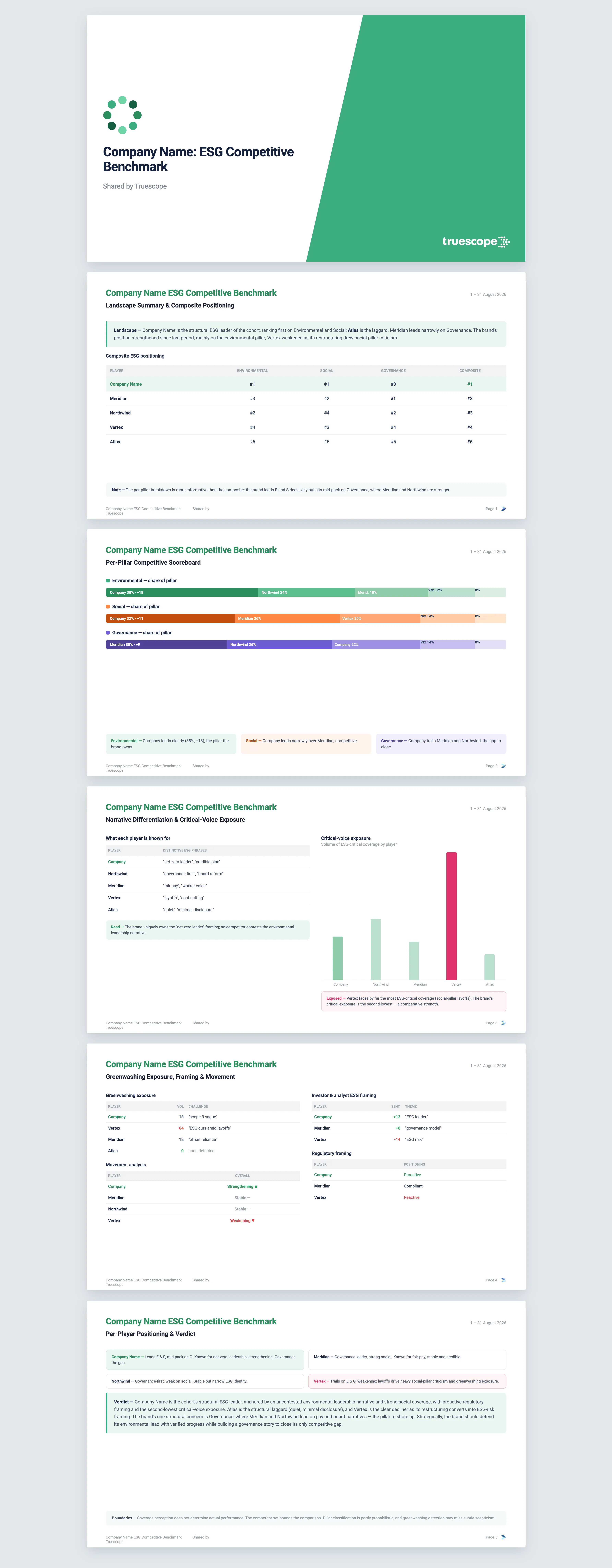
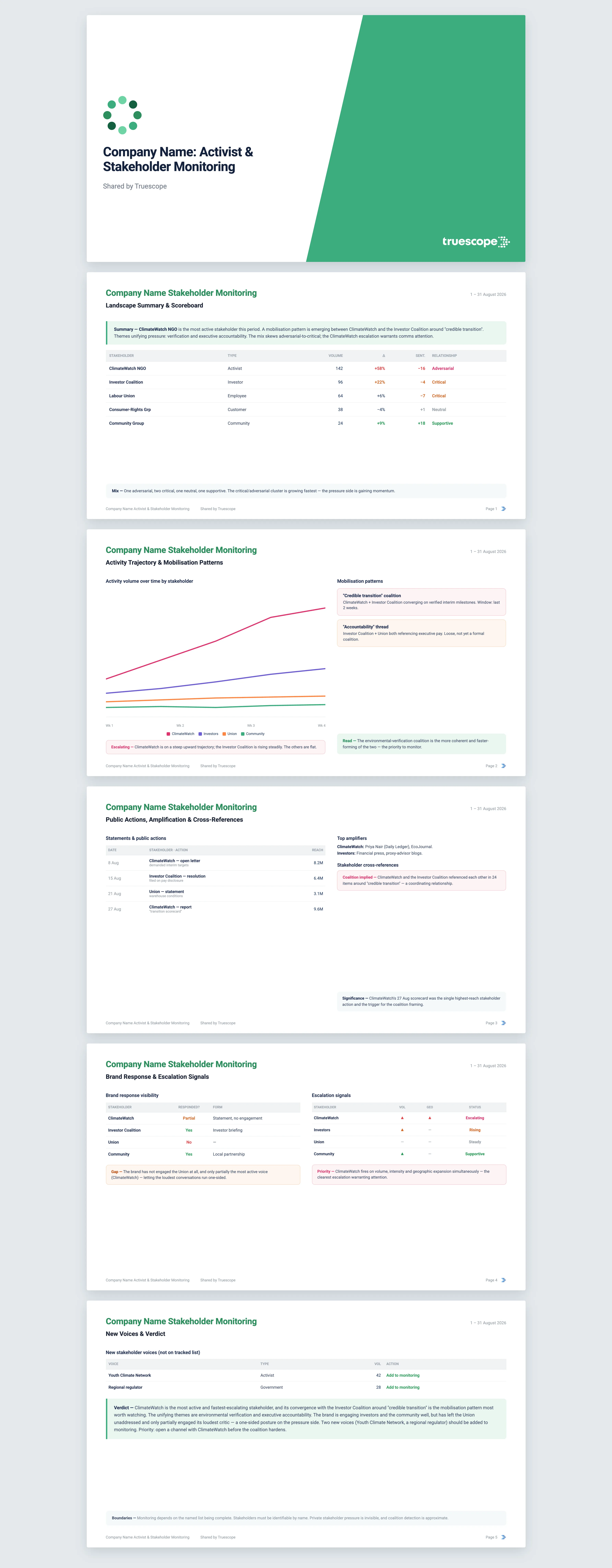
- A per-initiative scoreboard with volume, audience, net sentiment, intensity, the share carried by top-tier outlets, and the dominant framing, benchmarked against the prior period.
- A coverage trajectory chart per initiative that distinguishes a launch spike that decays from rarer sustained mention, which signals an initiative has entered ongoing public conversation.
- A framing breakdown for each initiative across announcement, progress, sceptical, comparison, and greenwashing language.
- Voice carriers per initiative, showing whether external journalists, analysts, and stakeholders are involved or only your own channels, since external carriers are the strongest credibility signal.
- A coverage-versus-stated-ambition view of whether your targets are quoted verbatim, paraphrased, or omitted.
- Credibility signals, a co-mention matrix showing whether your initiatives read as one coherent programme or as silos, and a gap analysis pinpointing topics you could claim but currently do not.
Thinly covered initiatives are flagged as tentative, and every reading traces back to source coverage.
Who it's for
This template is for sustainability and ESG communications managers, corporate affairs teams, and programme owners who have launched specific commitments and need to prove they are being seen and believed. It is ideal after a programme launch, ahead of a progress update, or when leadership asks the fair question of whether the sustainability work is actually cutting through.
Why Truescope Analyst
Measuring a single initiative the manual way means combing coverage for the right mentions, separating your programme from generic sustainability talk, and judging tone article by article, which is laborious and easy to do inconsistently. A general AI tool cannot scope reliably to your specific programme across your whole coverage, and it has no way to spot the gap where a topic is being discussed without crediting your work. Truescope Analyst holds each initiative to its own distinctive terms, reasons across your full media dataset, classifies framing consistently, and surfaces the credit you are missing, with every finding cited back to source. It lives in your subscription and is open to the whole team, so checking whether a programme has landed takes minutes rather than a manual review cycle.
Frequently asked questions
What do I need to provide for each initiative?
Each initiative needs a name and three to eight distinctive terms or phrases that reliably appear in its coverage. Generic descriptions such as "our sustainability efforts" cannot be tracked precisely, so sharper identifiers give a cleaner read. You can track up to ten initiatives at once.
What time period can I track over?
You can track up to the last 13 months for coverage in your Truescope inbox, or the last 90 days for global data not yet matched to your workspace. Sustainability coverage builds slowly, so a longer window usually shows the fuller arc of an initiative.
What can the gap analysis tell me?
It identifies topics being covered that your programme addresses, but where the coverage does not connect back to your initiative. That points you to communication opportunities where you are doing the work without receiving the credit.