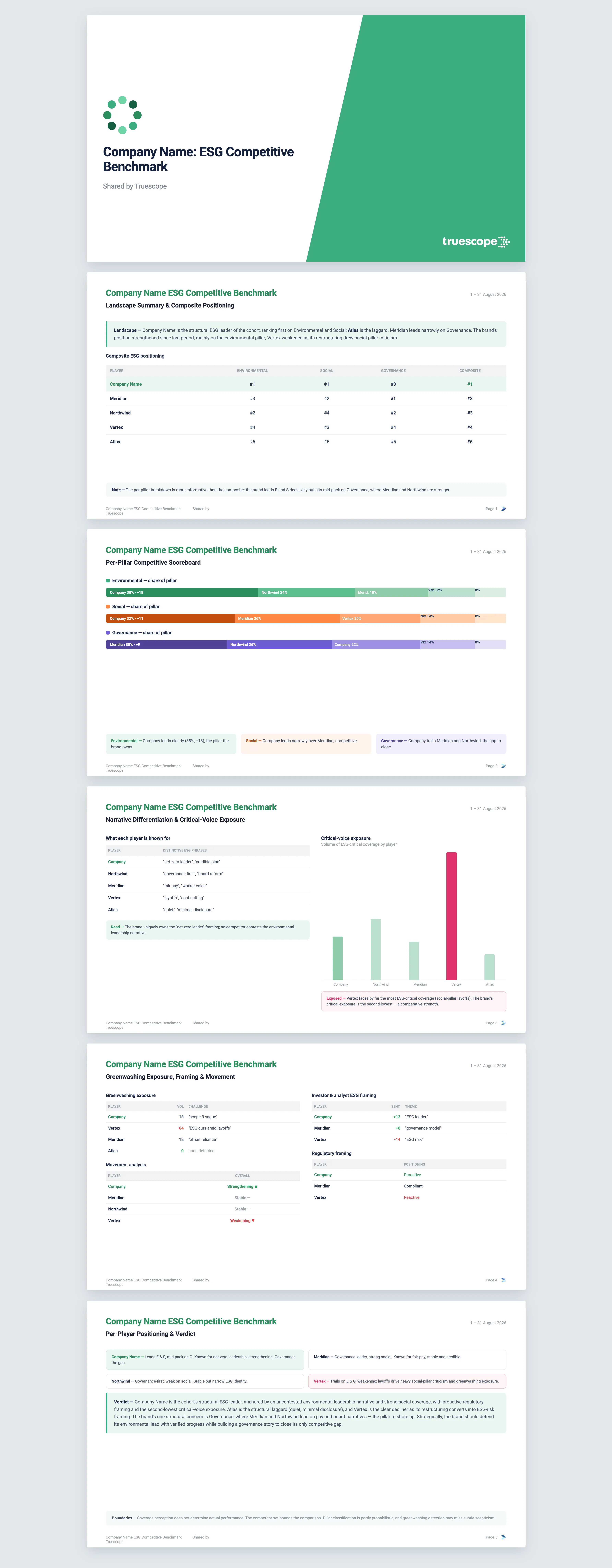
ESG Competitive Benchmark
See how your ESG perception stacks up against your named competitors, pillar by pillar, so you know who is seen as leading on environment, who on social, who on governance, and exactly where you sit.
What it does
ESG is increasingly material to investors, regulators, talent, and customers, and competitive position is rarely the same across all three pillars. The same cohort can have a clear environmental leader, a different social leader, and a different governance leader again. This benchmark measures your brand and three to six named competitors on each pillar separately, then combines them into a composite view, so you never collapse a substantive picture into a single misleading ranking. The discipline is per-pillar comparison, because that is where the strategic insight lives.
The questions it answers
- Who in our competitive set is perceived as the ESG leader, and who as the laggard?
- On which specific pillars do we lead, and on which do we trail?
- What is each competitor uniquely known for on environment, social, and governance?
- Which players carry greenwashing or critical-voice exposure, and which do not?
- Has anyone gained or lost ESG share of voice, sentiment, or credibility this period?
What's in the report
The report opens with a summary of the competitive landscape, then works through structured comparisons.
- Three per-pillar scoreboards, one each for Environmental, Social, and Governance, ranking every player by share of pillar with volume, audience, sentiment, intensity, and top-tier share, benchmarked against the prior period.
- A composite ESG positioning table giving each player a rank per pillar and an overall rank, with the reminder that the per-pillar detail matters more for strategy.
- Per-pillar narrative differentiation showing each player's distinctive phrases, plus a stakeholder voice comparison of the NGOs, analysts, and activists engaging each one.
- A critical-voice exposure chart and a greenwashing exposure comparison, where players with no greenwashing coverage are noted explicitly rather than left out.
- Investor and analyst framing, regulatory positioning, geographic patterns, a movement analysis showing who is strengthening or weakening, and the industry-wide themes the whole cohort is being held to.
Each player closes with a positioning summary, and an editorial verdict pulls the cohort together. Every comparison traces back to source coverage.
Who it's for
This benchmark is for ESG and sustainability leaders, corporate strategy teams, and investor-relations professionals who need to understand their relative ESG standing rather than their absolute one. It is well suited to strategy reviews, board and investor updates, and any moment when you need to show leadership exactly where the organisation sits against named rivals on each ESG dimension.
Why Truescope Analyst
Building a credible competitive ESG view by hand means tracking several brands at once, separating three pillars across thousands of articles, and somehow keeping the method consistent for every player, which is slow and rarely truly comparable. A general AI tool cannot pull each competitor's full coverage, cannot apply one consistent pillar method across the cohort, and cannot tell you who carries greenwashing exposure. Truescope Analyst reasons across your full media dataset for every named player, applies the same per-pillar method to all of them, and cites each comparison back to its source coverage. It is built into your subscription and open to the whole team, so a rigorous, repeatable competitive ESG benchmark is minutes away rather than an agency project.
Frequently asked questions
How many competitors can I include?
You can benchmark against three to six named competitors. The cap is set at six because the data load grows substantially beyond that, and a focused set keeps the comparison sharp.
What period does the benchmark use?
You can benchmark over up to the last 13 months for coverage in your Truescope inbox, or the last 90 days for global data not yet matched to your workspace. ESG positioning tends to move slowly, so meaningful movement across the period is itself a leadership signal.
Why report each pillar separately rather than one ESG score?
Because the three pillars frequently have different competitive leaders, and a single aggregate score hides that. Reporting Environmental, Social, and Governance leadership explicitly is what makes the benchmark useful for strategy. Bear in mind the comparison is bounded by the competitors you name, so a true market leader outside that set will not appear.