ESG Coverage Report
See how your organisation is being covered on environmental, social, and governance themes, and where the credibility risks sit, in one holistic report that treats ESG as the distinct conversation it really is.
What it does
ESG coverage is not just another topic category. It has its own voices, its own narrative conventions around commitments and targets, and its own risk dynamics, where a greenwashing accusation does damage that an ordinary negative story does not. This report analyses your media coverage across the three ESG pillars separately, measures sentiment and intensity in each, and shows where your media position aligns with or diverges from the commitments you have made publicly. Instead of a single ESG score, you get a substantive picture of what you are known for, who is shaping the conversation, and where you are exposed.
The questions it answers
- Which ESG pillar are we strongest on, and which leaves us most exposed?
- Is our ESG coverage balanced across all three pillars, or concentrated in one?
- Are our stated commitments landing credibly, fading from the conversation, or attracting greenwashing scrutiny?
- Which stakeholders, from NGOs and activists to regulators and ESG analysts, are driving how we are covered?
- Does media reality match our stated ambition, or are we being held to standards we have not set, or communicating ambition that has not landed?
What's in the report
The report opens with an at-a-glance read of your strongest and most exposed pillars, then breaks the detail down across structured sections.
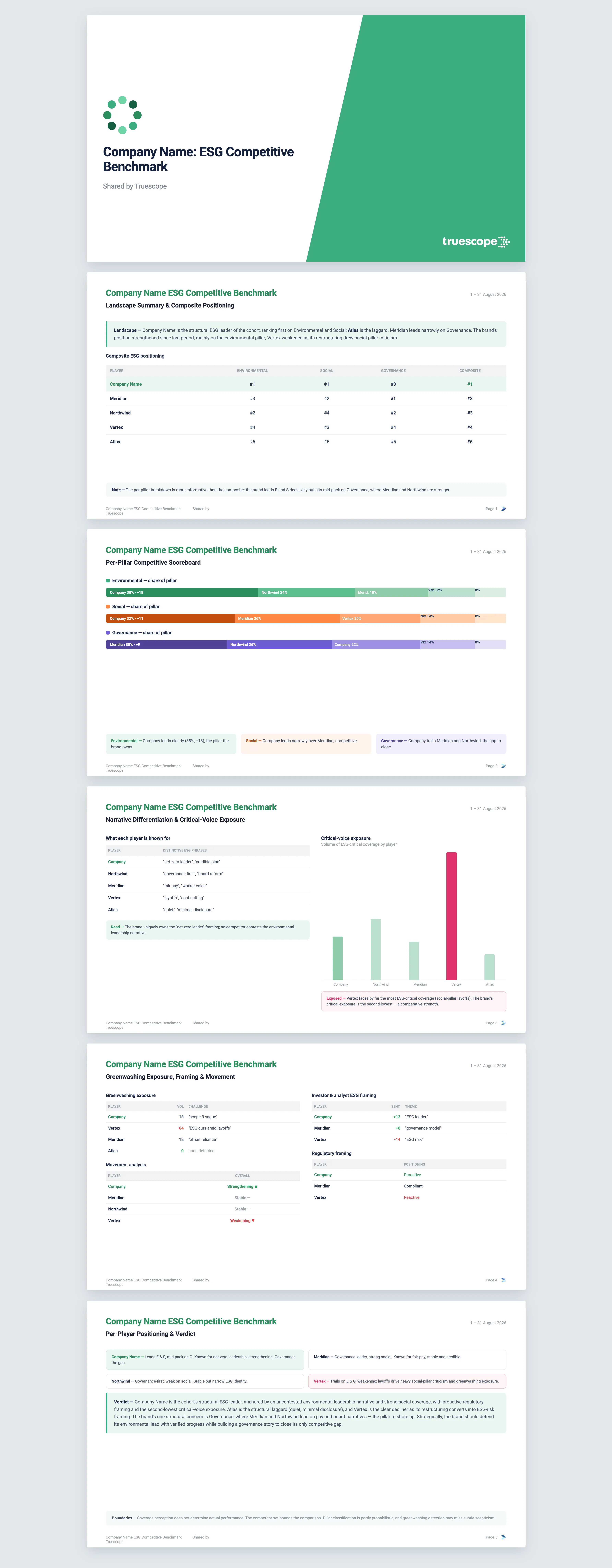
- A three-pillar scoreboard with volume, audience, net sentiment, intensity, social engagement, and each pillar's share of your total ESG coverage, benchmarked against the prior period so movement is visible.
- Per-pillar narrative themes showing what you are actually known for on environment, social, and governance.
- A stakeholder voice map grouping named activists, NGOs, regulators, ESG analysts, customer-rights groups, and employee voices, each marked supportive, neutral, or critical.
- Commitment tracking that shows how each public commitment is being framed and whether its credibility is holding.
- A dedicated greenwashing and credibility-risk section, plus crisis and incident coverage, investor ESG framing, and geographic patterns across European, US, and emerging markets.
- A per-pillar volume trend chart and an editorial verdict on your overall ESG media position.
Every finding traces back to the source coverage behind it, so any figure can be checked.
Who it's for
This report is built for sustainability and ESG leads, corporate affairs and communications directors, and investor-relations teams who need to understand their ESG reputation in substance rather than as a single number. It suits the moment before a board update, a sustainability report launch, or an investor briefing, when you need to know exactly how your environmental, social, and governance story is being received.
Why Truescope Analyst
The traditional route to this picture is an agency or in-house team reading hundreds of articles, hand-sorting them into pillars, and forming a view that is slow to produce and hard to repeat. A general AI chatbot can summarise an article you paste in, but it has no access to your full media coverage, cannot separate the three pillars consistently across thousands of items, and cannot tell you whether a greenwashing narrative is forming. Truescope Analyst reasons across your complete media dataset, applies a consistent three-pillar method every time, distinguishes the specific ESG stakeholder voices that matter, and cites every claim back to the coverage it came from. It is built into your subscription and available to anyone on the team, so the same rigorous ESG read is minutes away whenever you need it, not weeks.
Frequently asked questions
What time period does the report cover?
You can analyse up to the last 13 months for coverage already in your Truescope inbox, or the last 90 days for global data not yet matched to your workspace. ESG narrative cycles move more slowly than commercial ones, so a longer window usually gives the truest read.
Do I need to provide our ESG commitments?
No, the report runs without them. But if you supply your specific climate targets, social initiatives, or governance reforms, the report adds a commitment-tracking section showing how each one is being framed and whether it is holding credibility.
How are pillars decided, and what might be missed?
Coverage is sorted into Environmental, Social, and Governance using the language each story uses, and items that span pillars are assigned to the dominant one. Coverage with ESG implications that does not use recognisably ESG language, and stakeholder activity in filings or investor letters rather than the media, may not appear.