Activist & Stakeholder Monitoring
Track the named activist groups, NGOs, regulators, and critical stakeholders that matter to your organisation as distinct entities, so you can see what each is saying, what each is mobilising around, and where pressure is building.
What it does
A passing critic is one voice. A stakeholder is an organisation with a sustained agenda, the capacity to act, and a durable narrative, and those need to be tracked differently. You give this template a list of the specific groups you need to watch, and it monitors each one as an entity: its volume and intensity over time, its consistent themes, and its relationship to your brand. Just as importantly, it looks across the cohort for convergence and coalition signals, because coordinated action is operationally far more significant than any single group acting alone.
The questions it answers
- What is each tracked stakeholder actually saying about us, and what are they mobilising around?
- Which stakeholder is most active this period, and is anyone escalating?
- Are multiple stakeholders converging on the same theme at the same time, suggesting coordination?
- Has our organisation visibly responded to a stakeholder's concerns, or is the conversation running one-sided?
- Are new stakeholder voices appearing in our coverage who we should add to monitoring?
What's in the report
The report opens with a stakeholder landscape summary, then works through each group and the cohort as a whole.
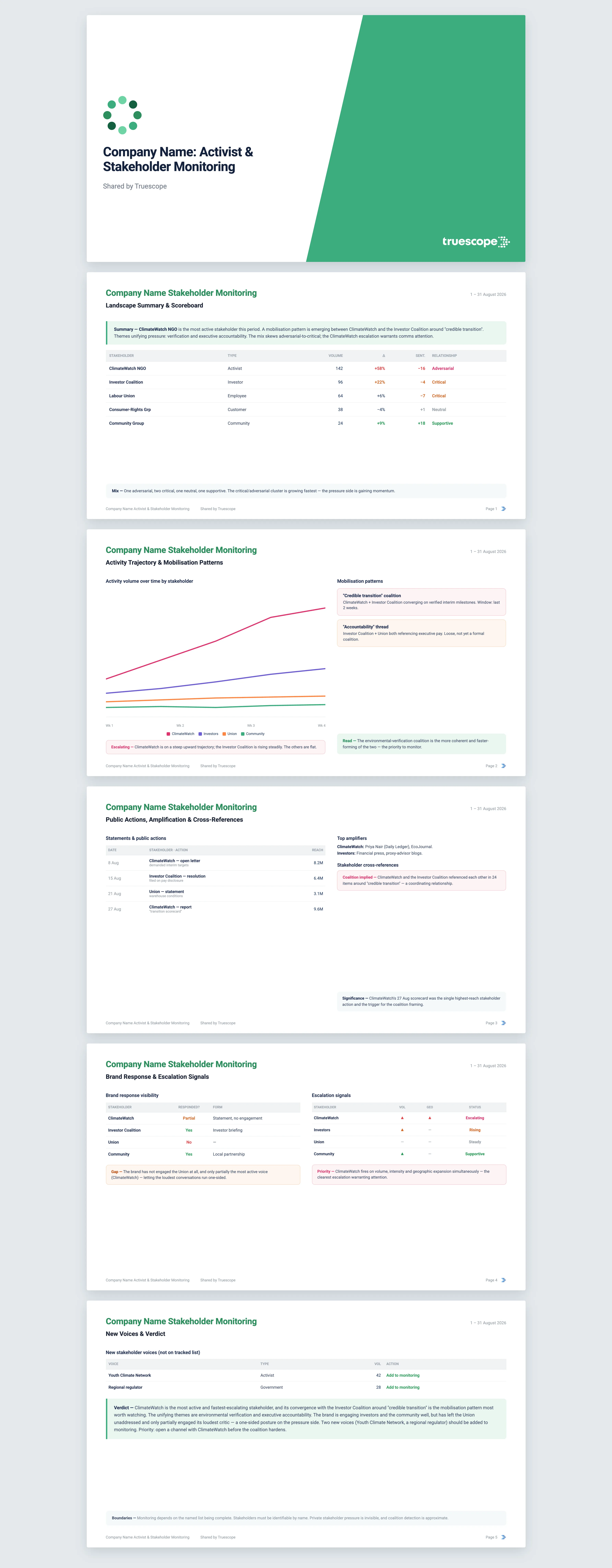
- A per-stakeholder activity scoreboard with organisation type, volume, sentiment toward the brand, audience reach, and a relationship state, benchmarked against the prior period.
- Per-stakeholder narrative themes and an activity trajectory chart that highlights escalation, de-prioritisation, or single-trigger spikes.
- A mobilisation patterns table flagging where stakeholders converge on a shared theme in the same window, plus a cross-reference table showing which groups appear together and may form coalitions.
- A log of specific statements and public actions, the journalists and outlets amplifying each stakeholder, and a brand-response view of where you have engaged and where you have not.
- Geographic concentration, per-stakeholder escalation signals, a relationship-state map across Adversarial, Watchful, Conditional, Cooperative, and Quiet, and a list of new voices appearing in your coverage.
Convergence is always framed as a possible coordination signal rather than confirmed, and every finding traces back to source coverage.
Who it's for
This template is for corporate affairs and ESG teams, issues and reputation managers, and government-relations professionals who carry a defined set of stakeholders they must keep in view. It suits an ongoing monitoring rhythm and the moments before AGMs, campaign seasons, or regulatory milestones, when knowing each group's current posture and any emerging coalition is essential.
Why Truescope Analyst
Tracking a roster of stakeholders by hand means following each group across the media, recalling what each said last period, and somehow noticing when two of them start moving in step, which is exactly what gets lost in day-to-day work. A general AI tool cannot watch your coverage, cannot hold each named stakeholder as a consistent entity over time, and cannot spot convergence across a cohort. Truescope Analyst reasons across your full media dataset, tracks each named group as its own subject, surfaces mobilisation and coalition patterns, and cites every statement and theme back to its source. It is part of your subscription and open to the whole team, so a disciplined stakeholder read takes minutes and can be repeated on a steady cadence.
Frequently asked questions
What do I need to provide to track a stakeholder?
For each one, supply the organisation name, any alternative names or abbreviations, and known leaders or spokespeople. Generic categories such as "environmental NGOs" cannot be tracked precisely, so named organisations give the cleanest results.
What period does the monitoring cover?
You can monitor over up to the last 13 months for coverage in your Truescope inbox, or the last 90 days for global data not yet matched to your workspace. Stakeholder activity develops over time, so a longer window tends to reveal trajectory and escalation more clearly.
Will it find stakeholders I haven't listed?
Yes. The report surfaces a separate list of stakeholder voices appearing in your coverage who are not on your tracked list, with a suggested action for each. These are flagged for your consideration as leading indicators of future pressure, not added to monitoring automatically.