This template is one of 70+ report templates that is available in Truescope Analyst, your AI media analyst teammate. Book a demo to use this template or to create your own reusable template.
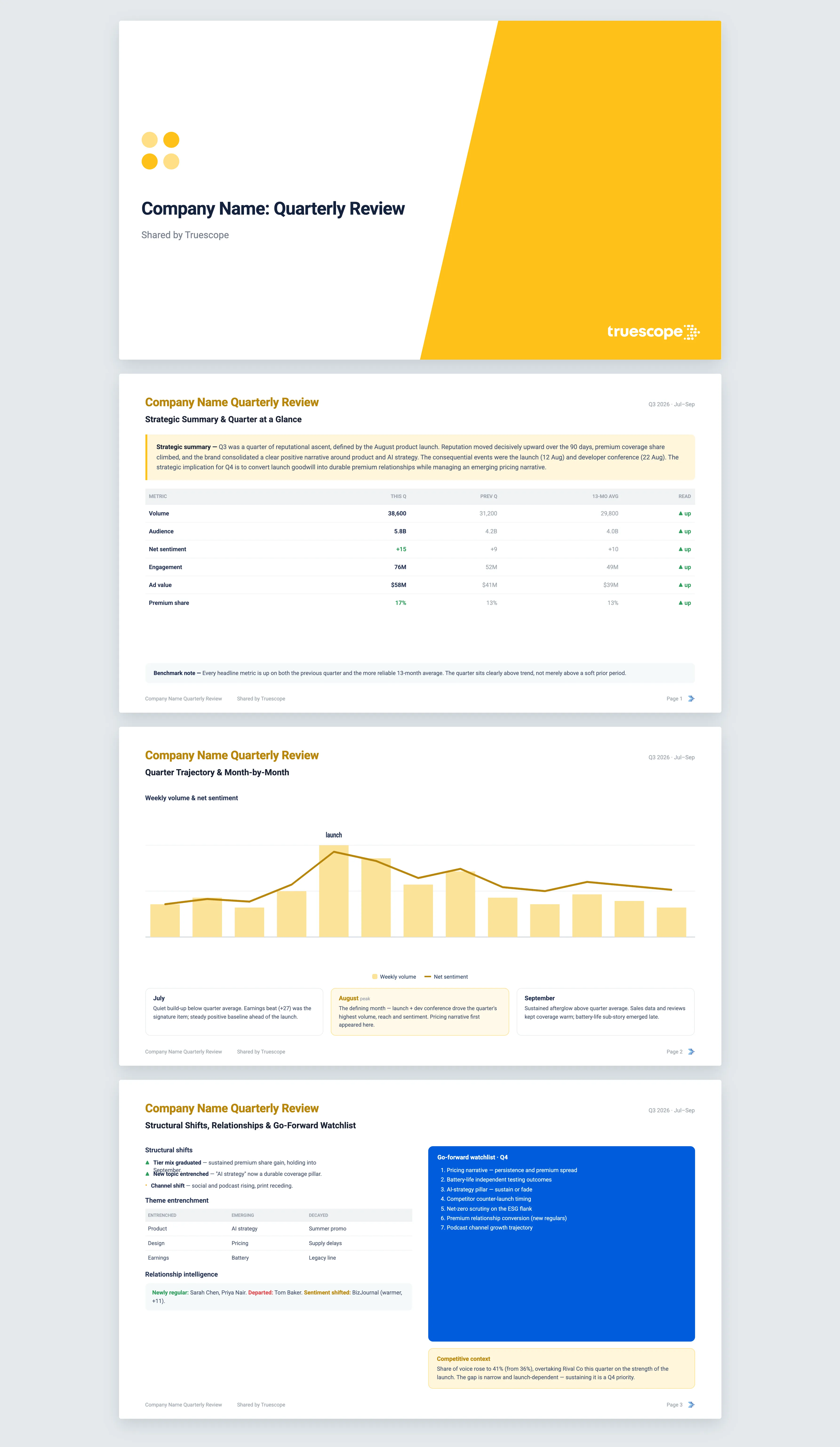
The strategic retrospective for the quarter. The Quarterly Review answers why coverage moved and what it means, not just what happened, and it sets the planning agenda for the quarter ahead.
What it does
Ninety days is long enough to see what is structural rather than episodic, and the cadence matches how the business thinks about quarters. This is a planning document, not a reaction document. It traces the shape of the quarter at weekly resolution, breaks it into a month-by-month narrative, and makes an explicit call on what changed about the way the brand is being covered. Crucially, it puts the quarter in context. Because the prior-quarter comparison sits at the very edge of the available data, the review leans on a 13-month view as the more reliable benchmark for what is normal for your brand.
The questions it answers
- What was the dominant narrative of the quarter, and where did reputation move across the 90 days?
- Is this quarter normal for us, judged against our longer history rather than just last quarter?
- What changed structurally in how we are covered, in outlet tier, journalist mix or geography?
- Which themes became entrenched, which emerged late, and which decayed?
- Which journalists joined our regular coverage, which departed, and whose view of us shifted?
- How does our share of voice compare with named competitors?
What's in the report
The review opens with a strategic summary written for a board audience: the quarter's dominant arc, where reputation moved, the one or two events that defined the period, and the implication for the quarter ahead. A quarter-at-a-glance table follows, comparing the quarter against both the previous quarter and the 13-month average, with a clear caveat that the longer average is the benchmark to trust.
The body then works through:
- A weekly trajectory chart with a narrative tracing whether the quarter was front-loaded, back-loaded, sustained or punctuated by isolated spikes, naming the inflection weeks.
- A month-by-month narrative, three paragraphs giving the quarter a chronological backbone.
- A structural shifts assessment, the strategic read on what changed in how the brand is covered, named explicitly rather than buried in tables.
- Theme entrenchment, decay and emergence, three parallel tables tracking phrases across the three months.
- A source quality trajectory showing whether the brand is graduating into premium coverage or sliding into the long tail.
- Signature stories of the quarter and every Tier 1 placement, for the historical record.
- Relationship intelligence, the operational gold of the quarterly: journalists newly engaging, regulars who departed, and those whose sentiment shifted materially.
- A competitive context table where competitors are tracked.
- A go-forward watchlist of specific signals to monitor next quarter.
Every story and signal is cited back to the source coverage behind it.
Who it's for
The Quarterly Review is for senior communications and corporate affairs leaders and the executives they brief. It suits a comms director preparing a quarterly board paper, a corporate affairs team setting strategy for the next 90 days, and an investor-relations or government-relations lead who needs the longer view rather than the weekly churn.
How to use this template
This template runs inside Truescope Analyst, the AI media analyst in the Truescope platform. Point it at your own coverage, set the window, and Analyst returns the full report with every claim cited to source. You can also save your own analysis as a reusable template and run it on a schedule. Book a demo and we will run this one on your coverage.
Why Truescope Analyst
A genuine quarterly retrospective is rarely attempted in-house because it is so demanding. It means assembling three months of data, tracking how themes evolved across the period, working out which journalists came and went, and forming a defensible view on what changed structurally, all while the comparison data is thin at the edges. Most teams settle for a thickened-up monthly instead. A general AI tool is no help, because it cannot see your quarter, cannot weigh it against your 13-month history, and cannot tell an entrenched theme from a passing one.
Analyst reads the full quarter at weekly resolution, segments it into three months to track theme entrenchment and decay, and identifies the journalists entering and leaving your coverage rotation. It anchors every claim of normality against the 13-month context rather than the unreliable edge of the window, names the structural shifts plainly, and builds a watchlist grounded in what the data actually surfaced. The whole retrospective is cited to source, produced in minutes, and available to your team inside your Truescope subscription.
Frequently asked questions
Why does the review treat the previous quarter so cautiously?
The data window holds up to the last 13 months of coverage in your Truescope inbox, so a comparison against the prior 90 days sits at the very edge of what is available and may be partial. The review uses the 13-month average as its primary benchmark for whether the current quarter is normal, and flags the prior-quarter comparison as the less reliable of the two.
Can it compare us against competitors?
Yes, if you name one to five competitors to track. The review then adds a share-of-voice table showing how your share moved against theirs across the quarter. Without competitors, that section notes that adding them would strengthen the assessment.
Can a quarterly answer year-over-year questions?
No. With a 13-month window the review can compare quarter against quarter and set the quarter against your longer recent history, but it cannot establish reliable multi-year trends. The go-forward watchlist is informed judgement about what to monitor, not a prediction of specific outcomes.
See how you can get more signals and insights from your media intelligence platform
See how you can get more signals and insights from your media intelligence platform


.svg)