Recovery Monitoring
A crisis is easy to see; it spikes. Recovery is harder, because it shows up as the absence of negative coverage rather than the presence of any single signal. This template tracks whether your reputation is genuinely recovering, across every dimension that recovers on its own timeline.
What it does
The risk after a crisis is declaring victory too early. Volume usually normalises first, which makes the dashboards look calm while sentiment is still depressed and the old narrative still lingers. To avoid that false comfort, this template tracks recovery on four separate dimensions at once: volume, sentiment, the intensity of negative coverage, and the residue of the crisis narrative itself. It measures your recovery window against a pre-crisis baseline of equal length, separates coverage that still references the crisis from coverage that does not, and is deliberately honest about new normals. Not every crisis is fully recoverable, and a report that pretends otherwise is not helping you.
The questions it answers
- Where does our recovery stand on each dimension: volume, sentiment, intensity, and narrative?
- What is the dominant narrative about us now, compared with during the crisis?
- Which crisis-period themes have decayed, and which have entrenched as lasting narrative damage?
- Are we being talked about again for the right reasons, or are we still defined by the event?
- What conditions exist that could cause the crisis to re-flare, and is full recovery to pre-crisis levels even realistic?
What's in the report
The report opens with a recovery verdict: an honest assessment of where each dimension stands, the dominant narrative now, the damage that may persist, the recurrence risk, and a candid estimate of whether full recovery is reasonable or whether the brand has reached a new baseline.
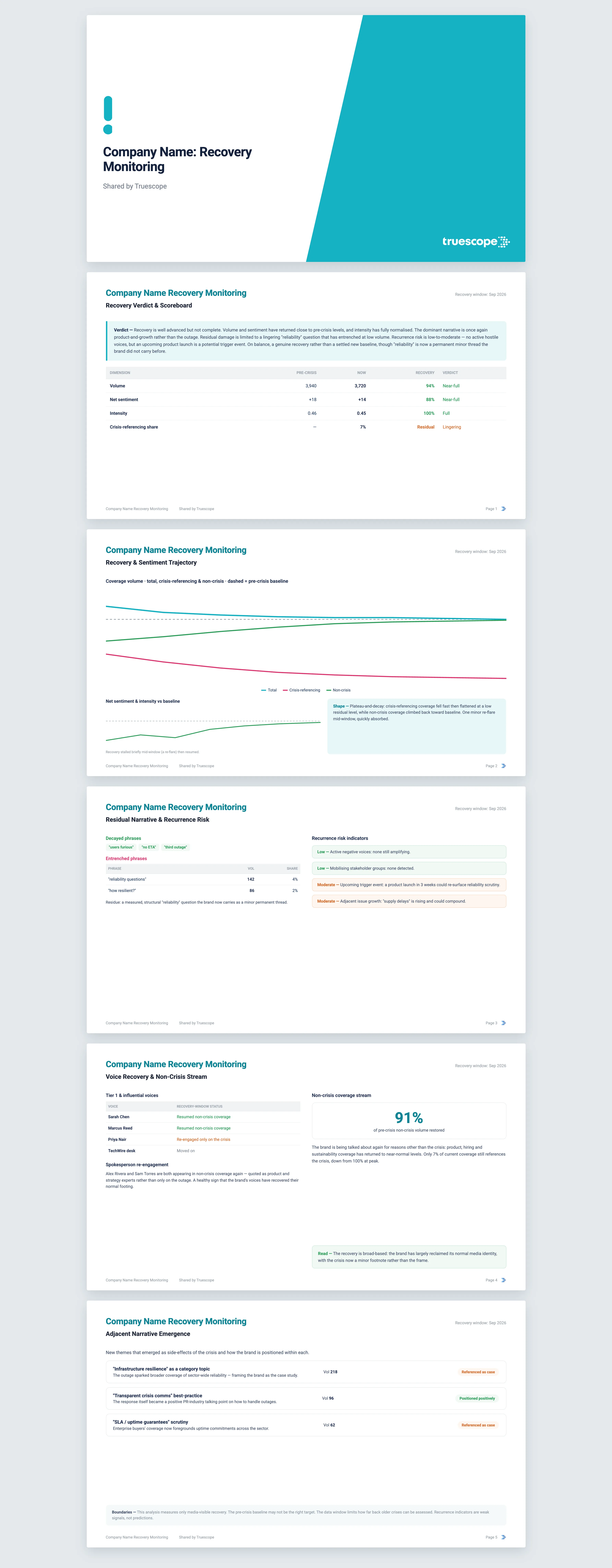
- A recovery scoreboard scoring volume, sentiment, intensity, and narrative residue against the pre-crisis baseline, with a recovery percentage for each.
- A recovery-trajectory chart splitting coverage into total, crisis-referencing, and non-crisis streams, with the pre-crisis baseline marked, so you can see smooth decay, plateau, or re-flares.
- A sentiment-recovery chart tracking net sentiment and negative intensity against baseline, with inflection points where recovery accelerated, stalled, or relapsed.
- A residual-narrative analysis separating crisis phrases that have decayed from those that have entrenched, with what each entrenched phrase represents.
- Recurrence-risk indicators: residual critical voices, stakeholder groups still mobilising, adjacent issues growing, and upcoming events that could reignite coverage.
- A non-crisis coverage stream read, the strongest positive signal, showing whether you are back in the conversation for reasons other than the event.
Findings are benchmarked against the pre-crisis baseline and cited back to source coverage.
Who it's for
This is for the teams responsible for the long tail after the headlines fade: in-house communications and corporate affairs leaders rebuilding reputation, crisis and issues managers reporting recovery progress upward, and agency teams accountable to a client for getting them back to normal. It is built for the quarterly or monthly update where a comms director must show executives or the board, with evidence, how far the recovery has actually come.
Why Truescope Analyst
Recovery is the hardest thing to measure manually, because there is no spike to count; you are tracking a gradual absence across weeks or months. An analyst doing this by hand has to reconstruct a pre-crisis baseline, separate crisis-referencing coverage from everything else article by article, and keep four moving dimensions in view at once, and the temptation to call it recovered once volume settles is strong. A general AI tool cannot attempt it: it has no baseline, no access to your coverage streams, and no way to tell whether a phrase from the crisis still lingers across outlets it cannot see. Analyst holds all four dimensions in parallel, separates the crisis stream from the non-crisis stream automatically, is built to name a new normal honestly rather than force a flattering comparison, cites every finding back to coverage, and runs in minutes. It is included in your subscription, so progress can be re-run on the same basis at every checkpoint and shared across the team.
Frequently asked questions
How long a recovery can it track, and what is the baseline?
It works across up to the last 13 months of coverage in your Truescope inbox, or the last 90 days for global data not already matched to your workspace. The recovery window is typically 30 to 180 days from the crisis end date, measured against a pre-crisis baseline of equal length. For crises older than the 13-month window, the pre-crisis baseline may no longer be retrievable.
What if our coverage never fully returns to pre-crisis levels?
The report is designed to say so plainly. Some brands settle into a new baseline below pre-crisis, and forcing the old comparison would produce a misleadingly negative verdict. Recovery percentages above 100% are also flagged, since a brand can become more visible in industry conversation after a crisis than before it.
Does a recurrence-risk flag mean the crisis will come back?
No. Recurrence-risk indicators are weak signals by construction; a flag means the conditions for a re-flare exist, such as residual critical voices or stakeholder groups still active, not that a re-flare is predicted. They are stated as risks, never as forecasts.