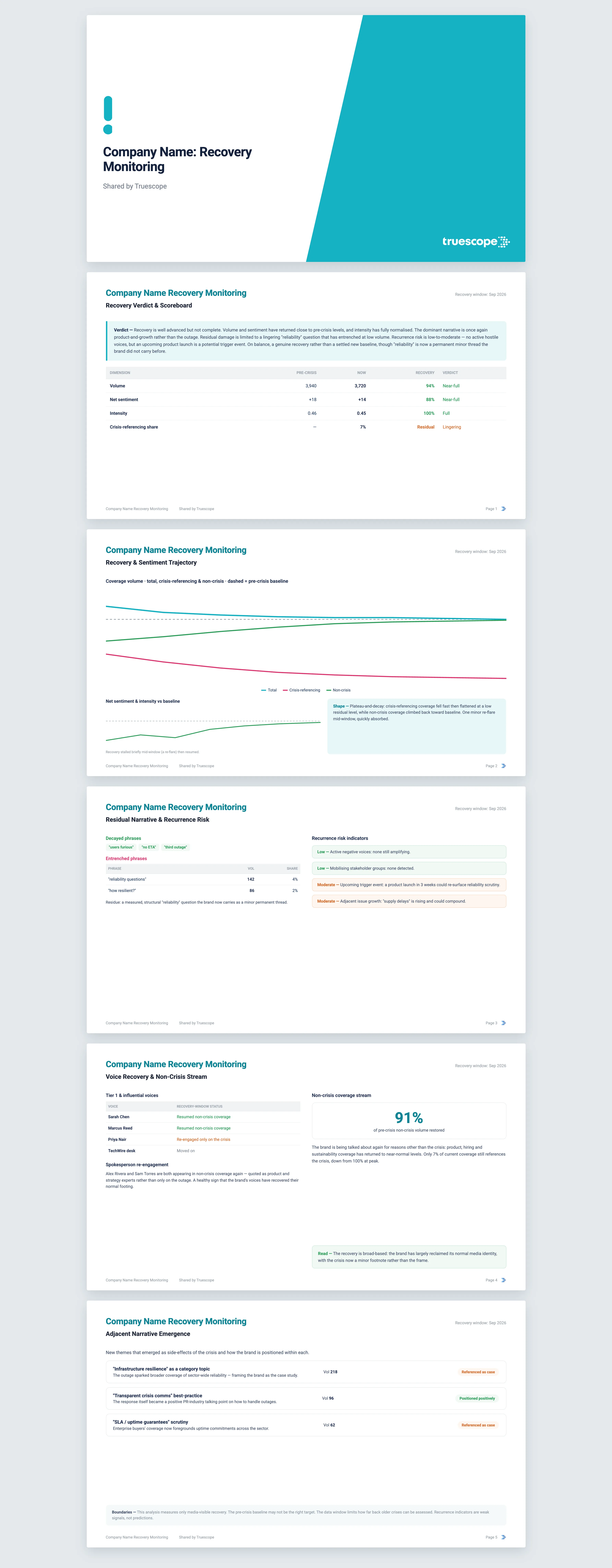
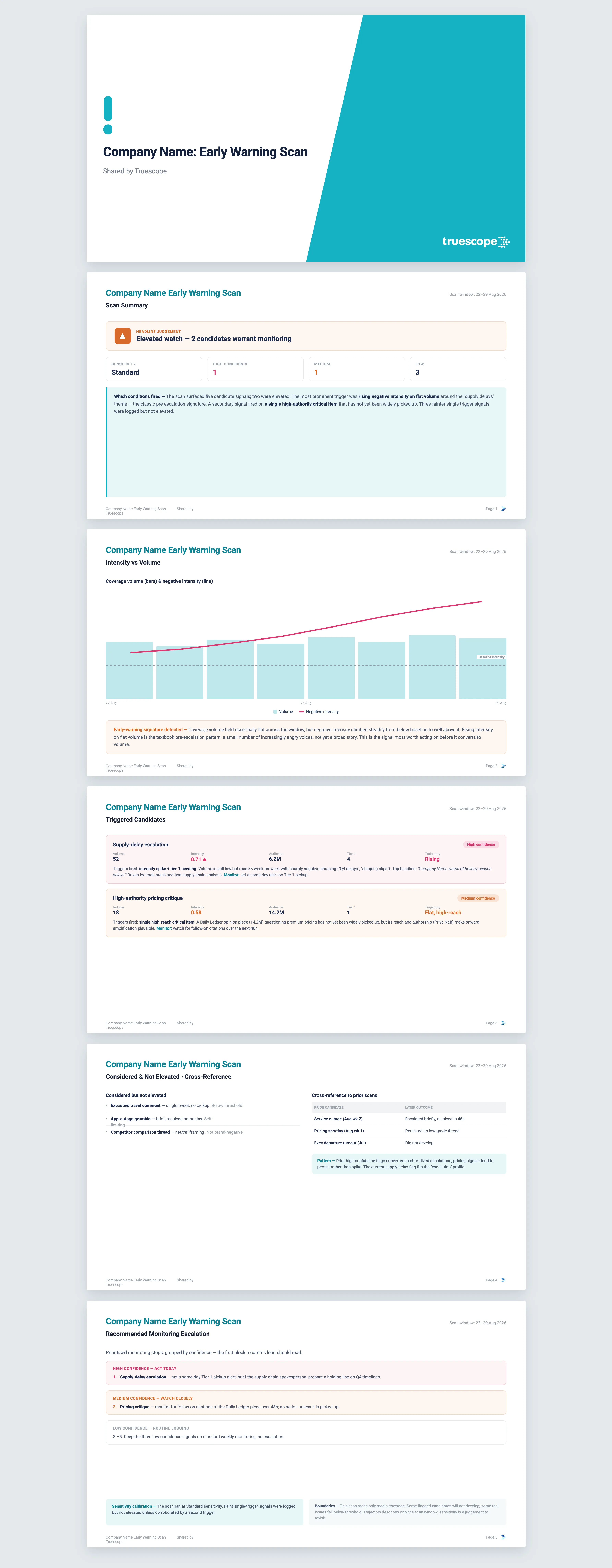
Crisis Assessment Report
A crisis is unfolding right now and you need a clear read in minutes, not a post-mortem next week. This template gives you a rapid, operationally useful picture of an active situation: its shape, its severity, who is amplifying it, where it is spreading, and what the next 24 to 72 hours might bring.
What it does
Assessing a live crisis is a different job from reviewing one after the fact. The story is still moving, the trajectory can turn quickly, and speculation dressed up as analysis is worse than honestly naming what is unknown. This template reads the past 24, 48, or 72 hours of coverage up to the moment you run it, compares it against the prior week, and answers the only question that matters in the heat: what does the comms team need to know to make decisions now. It tracks how fast the story is growing, whether it has crossed from online into broadcast and print, which voices are driving it, how it is being framed, and which stakeholders have weighed in, then lays out scenarios for what could happen next without pretending to predict.
The questions it answers
- How severe is this right now: emerging, escalating, peaking, plateauing, or declining?
- How is the coverage actually framing the crisis, which often differs from the underlying facts?
- Who is amplifying it, and is it a small concentrated set of voices or a broad entrenched one?
- Where is it spreading, geographically and across channels, and has it reached broadcast, print, or top-tier outlets?
- Have regulators, activists, NGOs, or other stakeholders entered, and what decisions should the comms team be weighing in the next 24 to 72 hours?
What's in the report
The report leads with a hot panel sized to fit on the first screen: current volume against normal, sentiment, intensity, top-tier negative items, country and channel spread, and a single severity rating with a one-line headline read.
- A trajectory chart of volume and sentiment across the assessment window in hourly buckets, with the prior-week average marked, so the shape is readable at a glance.
- Geographic spread showing the country of origin, how fast new countries are entering, and whether spread is still expanding.
- Channel spread showing when the story crossed from online into broadcast and print, a discrete escalation moment.
- Voice and amplifier mapping: the journalists, named critics, stakeholders, and high-influence social accounts driving it.
- The dominant narrative in plain language with representative headlines, plus whether any counter-narrative or the brand's own voice is appearing.
- A stakeholder-activation grid, three forward scenarios framed as scenarios not predictions, decision-relevant questions for the comms team, and specific triggers to watch that would change the read.
Findings are benchmarked against the prior week and cited back to source coverage throughout.
Who it's for
This is for the people in the room when a crisis breaks: in-house communications and corporate affairs leads, crisis managers, and on-call agency teams who need a structured situational read fast. It is built for the first hours, when a comms director has to brief the executive team, a minister, or the board on where things stand and what is likely next, and needs evidence rather than instinct under pressure.
Why Truescope Analyst
In a live crisis the manual alternative collapses under time pressure: an analyst cannot hand-count hourly volume across countries, map every amplifying voice, and judge channel spread while the story is still moving, and whatever they produce is hours old by the time it lands. A general AI tool is no help in the moment either; it has no access to your live coverage, cannot tell you when broadcast first picked up the story, and cannot map the named voices and stakeholders driving it. Analyst reasons across your full media dataset in minutes, applies consistent severity logic so the rating is not a guess, separates the framing in coverage from the underlying event, stays honest about uncertainty by offering scenarios rather than forecasts, and cites every claim back to coverage. It is part of your subscription, so anyone on call can run an assessment immediately, without waiting for the one analyst who knows how.
Frequently asked questions
How recent is the data, and how far back does it compare?
The assessment ends at the exact moment you run it, so it reflects the current state, and uses hourly buckets across a 24, 48, or 72 hour window. It draws on up to the last 13 months of coverage in your Truescope inbox, or the last 90 days for global data not already matched to your workspace, and always benchmarks against the seven days immediately before the window.
Does it predict what will happen next?
No. The next-24-to-72-hours section is explicitly scenario analysis, a likely, a possible, and a less-likely path, not a forecast. Real-time assessment is the most uncertain analysis in the portfolio, and the report is clear that it is a current-best read which can change quickly.
Does it tell us whether to issue a statement?
It surfaces the decisions, it does not make them. The report frames decision-relevant questions, such as whether a public response should be issued and from whom, or which journalists or stakeholders might be briefed, but those choices need legal, executive, and operational context the assessment does not have.