Policy Sentiment Analysis
Know exactly how a named policy is landing in the media, who is shaping the conversation, and what that means for its political durability. This template reads the sentiment toward the policy itself, not just the volume of coverage, and hands you the picture in minutes.
What it does
Policy impact analysis asks what a policy does. This template asks something different: how the policy is being received. It tracks sentiment toward a specific named policy, separates genuine sentiment from neutral analytical coverage, and surfaces who is driving support and who is driving opposition. The result is a clear read on whether a policy is gaining ground, losing it, or hardening into a polarised fight.
It works from the policy name and any alternative references you supply, across the jurisdictions you choose, and can drill into specific provisions where the headline policy and its detail are received very differently.
The questions it answers
- Is media and public sentiment toward this policy net positive, negative, or simply neutral and analytical?
- Who is shaping the sentiment, and which named individuals, organisations, and outlets are carrying support versus criticism?
- How does sentiment vary across stakeholder groups, political leaning, and geography?
- Which arguments are doing the work on each side, and where is the opposition concentrating its case?
- What does the sentiment landscape suggest about the policy's political durability?
What's in the report
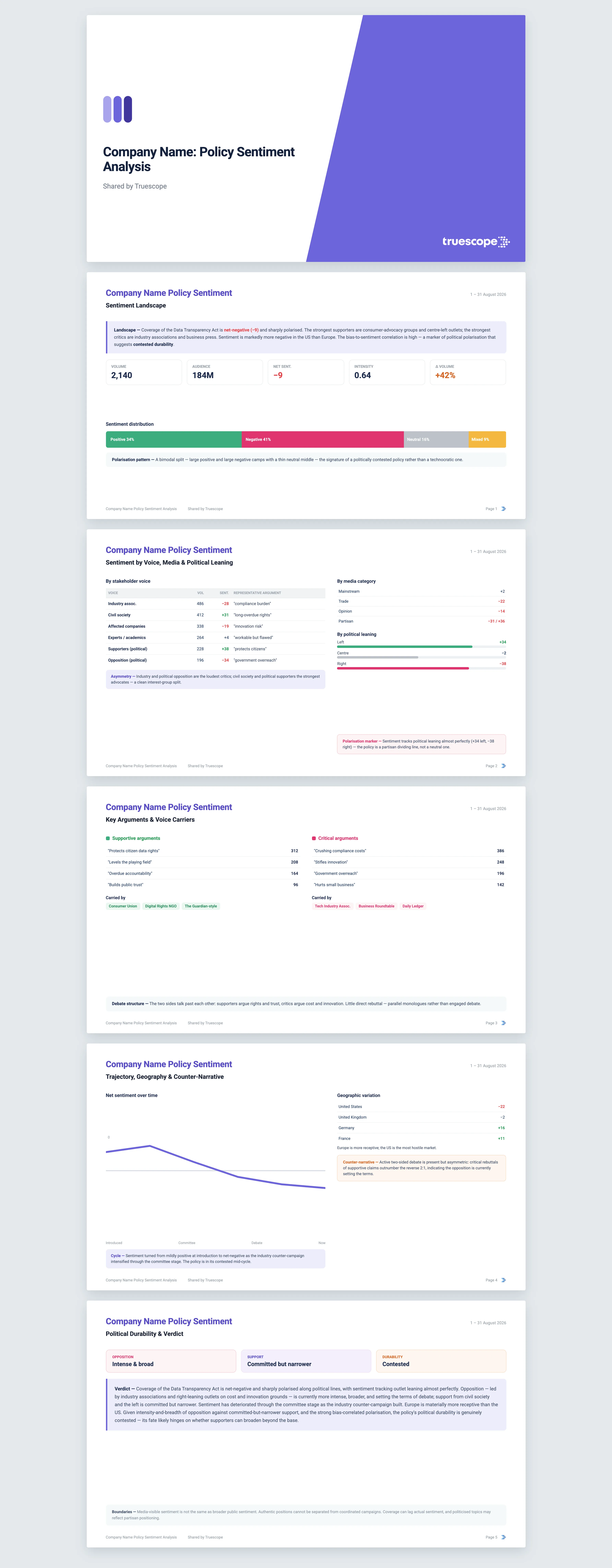
You get a structured read that opens with a plain-language sentiment landscape summary and a headline scoreboard covering volume, audience, net sentiment, intensity, and the change against the equivalent prior window.
- A sentiment distribution chart showing positive, negative, neutral, and mixed shares, with a reserved descriptor such as heavily polarised or predominantly neutral analytical.
- Sentiment broken down by stakeholder voice, by media category, by political leaning, and by country or region, so you can see where support is concentrated and where opposition lives.
- The key arguments in supportive and critical coverage, each tied to the voices making it, alongside the named supportive and critical voice carriers.
- A sentiment trajectory over time, plotted across the chosen window, showing where the policy sits in its political cycle.
- Provision-level sentiment where you supply specific provisions, plus counter-narrative and implementation coverage, and a durability assessment.
Every finding is benchmarked against the prior period where relevant, and every claim traces back to the source coverage it came from.
Who it's for
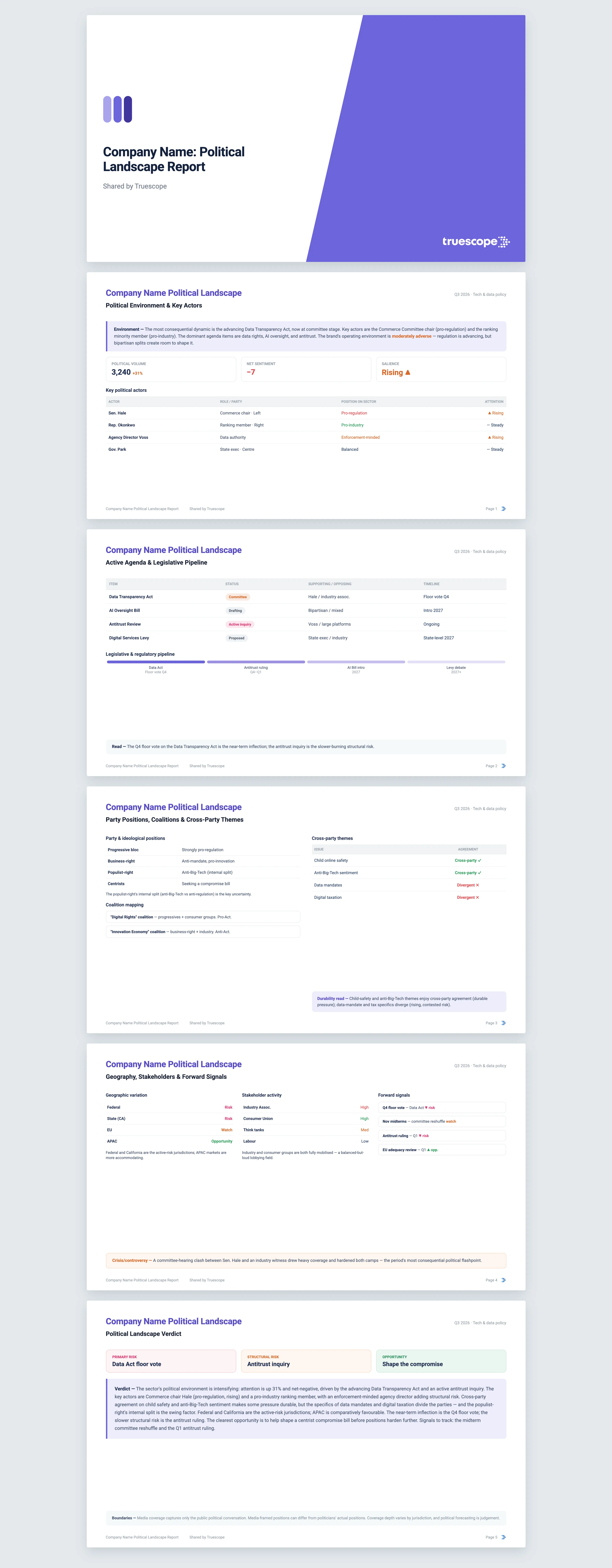
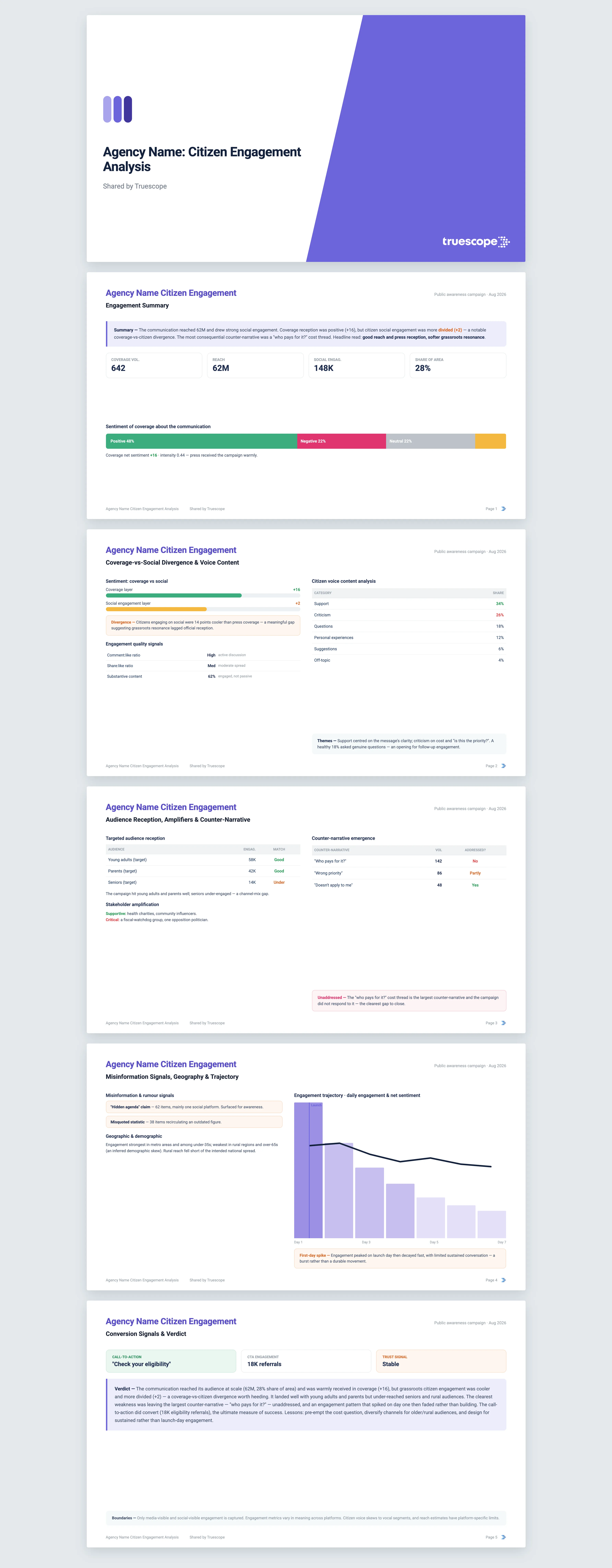
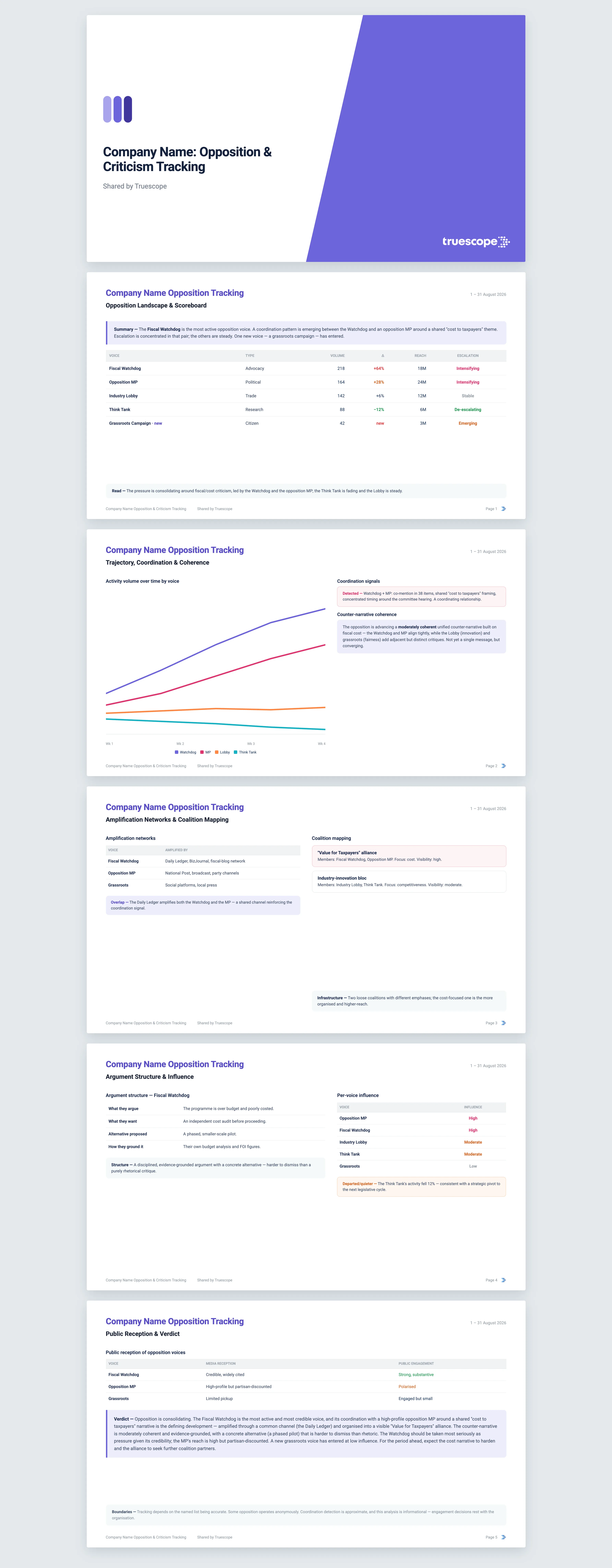
This template is built for government affairs teams, policy advisers, and ministerial communications staff who need to understand reception, not just count clippings. It also serves industry associations and corporate affairs leaders assessing how a regulatory proposal that affects them is being argued in public, and what they may have to answer.
Why Truescope Analyst
The manual version of this is a comms officer skimming clippings and forming an impression, or an agency turning around a sentiment note over several days at considerable cost. Both rely on a sample, and both struggle to separate true sentiment toward the policy from coverage that merely mentions it. A general AI chatbot is worse for this: it can summarise an article you paste in, but it has no live view of your media coverage and cannot tell you how a named provision is being received across partisan outlets this fortnight.
Truescope Analyst reasons across your full media dataset rather than a single article. It distinguishes sentiment from analysis, ties the bias-sentiment correlation to a clear read on polarisation, and traces every number back to source. It is built into your subscription, available to anyone on the team, and it repeats on demand so you can watch the trajectory move rather than guess at it.
Frequently asked questions
How far back can it track sentiment toward a policy?
It can analyse up to the last 13 months for coverage already in your Truescope inbox, or the last 90 days for global data not yet matched to your workspace. That is usually enough to trace a policy from emergence through the early implementation period.
Can it tell me how individual provisions are received, not just the policy overall?
Yes. If you supply specific named provisions, the report adds provision-level sentiment with the supportive and critical themes for each. It is common for a headline policy to enjoy broad support while one contested provision drags the net sentiment down.
Does this measure what the whole public thinks?
No, and the report says so plainly. It describes media-visible sentiment toward the policy. Broader public opinion needs polling or survey data, and sentiment in coverage can lag genuine shifts in the public mood.