Opposition & Criticism Tracking
Keep a standing watch on the named critics, opposition figures, and adversarial voices your organisation needs to track. This template treats each as an entity, reads what they are saying, and surfaces the coordination and escalation patterns that reveal the structure of dissent, in minutes.
What it does
Critics and adversaries are rarely random. They carry sustained agendas, organisational structures, narrative discipline, and often coordination. This template tracks a list of named voices you define, the foundation the analysis is built on, and monitors each one as an entity: their consistent themes, who amplifies them, whether they are escalating, and whether they are converging with one another into a coordinated effort.
It works from your opposition list, with name and identifying terms for each voice, the brand or organisation being opposed, and the period you choose.
The questions it answers
- Which tracked voices are most active against us right now, and which are intensifying or going quiet?
- What is each voice consistently arguing, and what do they claim to want?
- Who amplifies each voice, across which journalists, outlets, and platforms?
- Are the voices coordinating, converging on shared themes, cross-referencing, or launching in the same windows?
- Are new critical voices emerging that we should consider adding to the watch list?
What's in the report
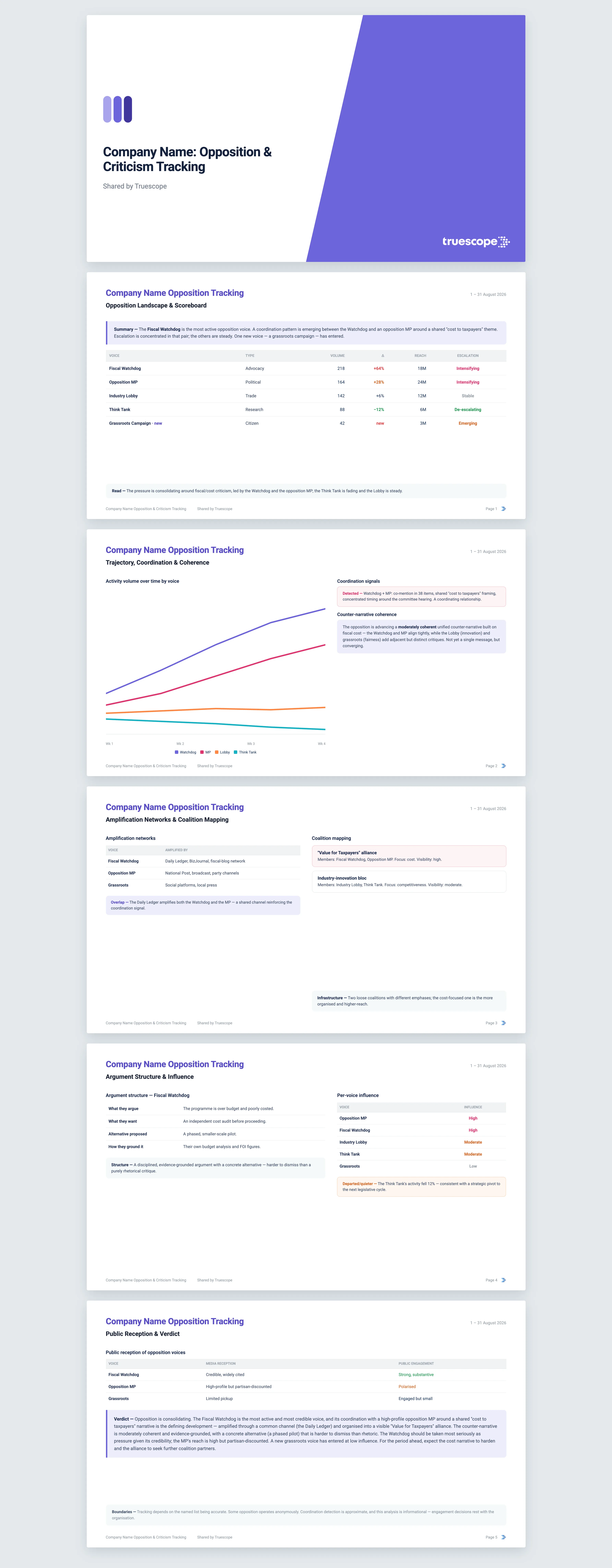
The report opens with an opposition landscape summary, then a per-voice activity scoreboard showing volume, change against the comparison period, sentiment toward the organisation, intensity, audience reach, and escalation status, sorted by volume.
- Per-voice narrative themes, the consistent key phrases behind each critic, and an activity trajectory chart with one line per tracked voice.
- Coordination signals across co-mention, cross-referencing, shared amplifiers, and time-window concentration, with a clear statement when no coordination is detected.
- A per-voice escalation table covering language intensity, argument scope, geographic spread, new coalition partners, and platform diversification, each marked stable, intensifying, or de-escalating.
- A counter-narrative coherence read, voice amplification networks, new and departed voices, geographic concentration, and an influence assessment ranking each voice high, moderate, or low.
- Coalition mapping, an argument structure analysis of the strongest cases, and public reception of each voice.
Both the current and comparison periods are measured, and every finding traces back to the source coverage behind it.
Who it's for
This template is built for issues and crisis teams, government affairs units, and corporate affairs leaders who face organised criticism and need to understand it rather than react to it piecemeal. It also serves reputation managers and public sector communicators monitoring watchdogs, advocacy groups, and adversarial commentators over time.
Why Truescope Analyst
The manual version is an analyst maintaining a spreadsheet of who said what, which captures activity but misses the structure: the convergence, the shared amplifiers, the coordinated timing that turn scattered critics into a movement. An agency monitoring report arrives days late and rarely tracks the same named voices consistently enough to show escalation. A general AI tool cannot do this at all, with no live coverage feed and no memory of how each voice behaved last period.
Truescope Analyst reasons across your full media dataset, holds each named voice as a tracked entity, and frames coordination and escalation as observed patterns rather than overclaimed conspiracy. It distinguishes the strongest opposition arguments so you can engage substantively, not dismiss them. It is built into your subscription, available to the team, runs in minutes, and repeats so you can watch the cohort move. Every finding is cited and traceable to source.
Frequently asked questions
What do I need to supply for this to run?
An opposition list of named voices, each with identifying terms, plus the organisation being opposed. The list is the foundation and the template cannot run without it. Voices not on the list will not be tracked, so keeping it current matters.
What time range does it cover, and does it show escalation over time?
It draws on up to the last 13 months for coverage already in your Truescope inbox, or the last 90 days for global data not yet matched to your workspace, and it measures both the current and prior period so escalation, decline, and single-trigger spikes all show up in the trajectory.
How confident can I be that coordination is real?
Treat it as a signal, not proof. Coordination is framed as patterns observed in coverage, and convergent activity may be coordinated, mimicked, or coincidental. Likewise, new voices are flagged for your consideration, not added automatically.