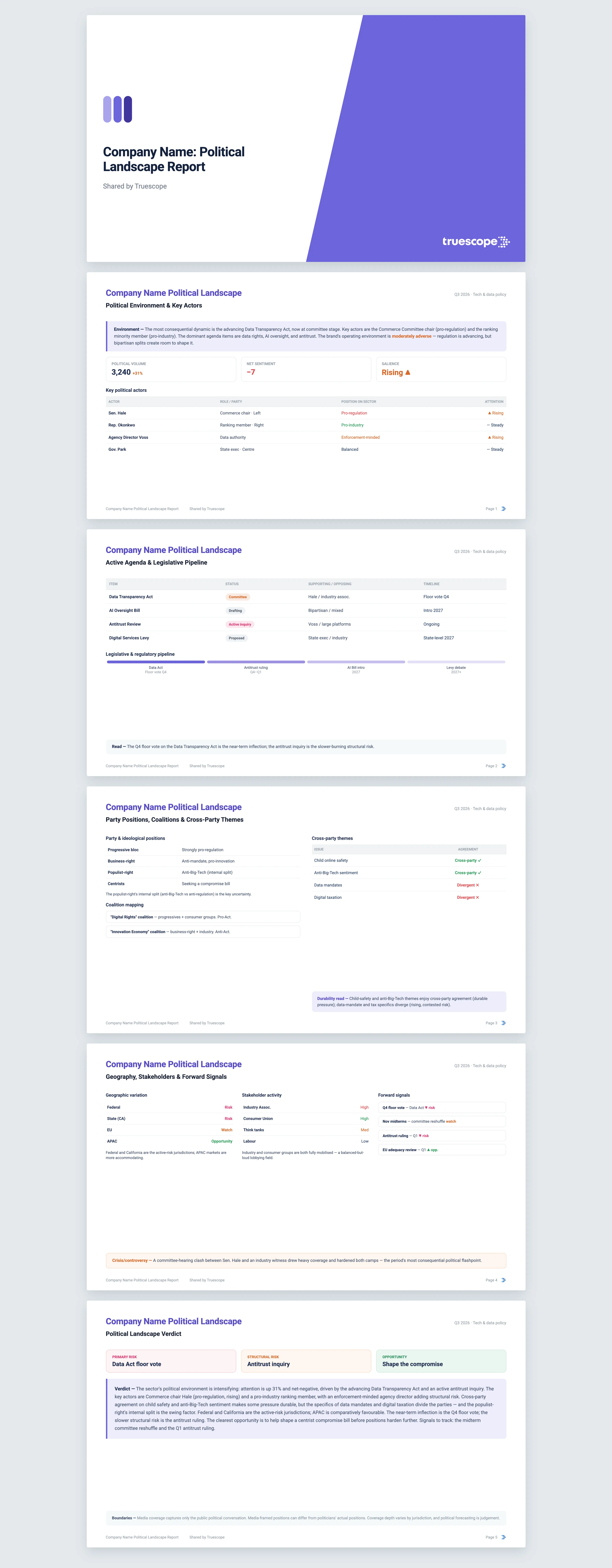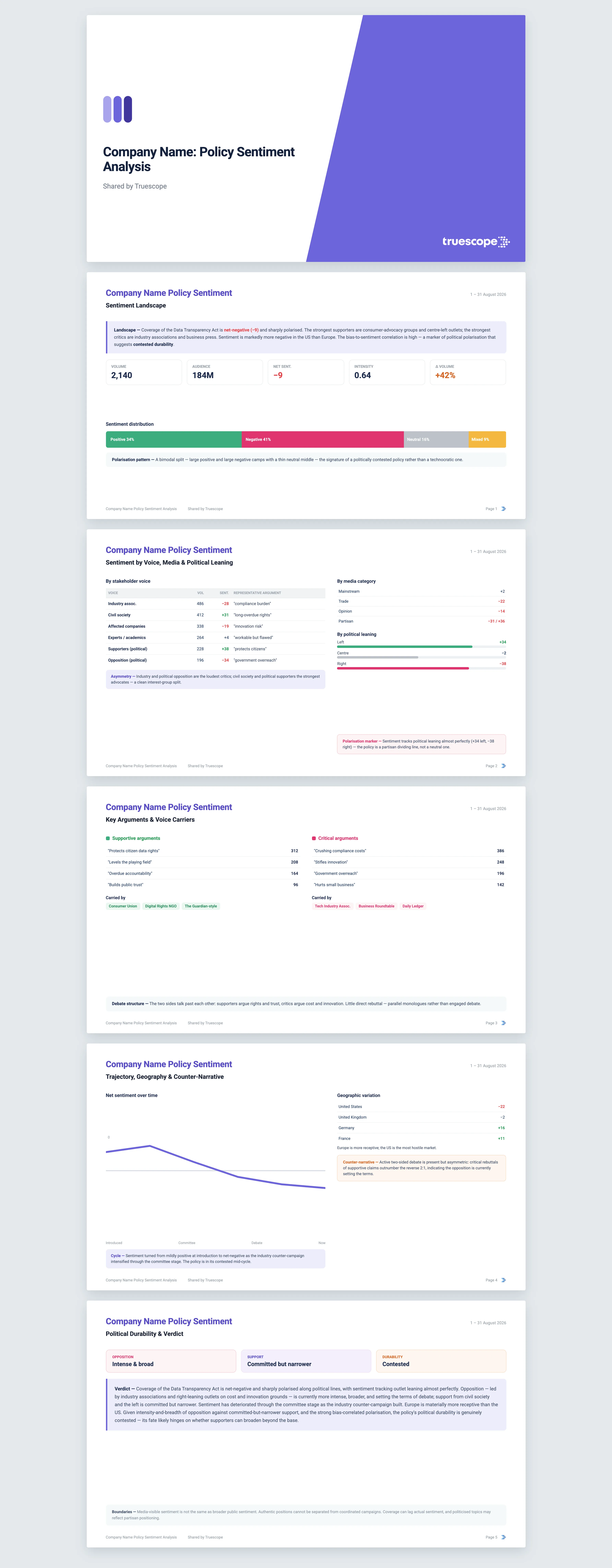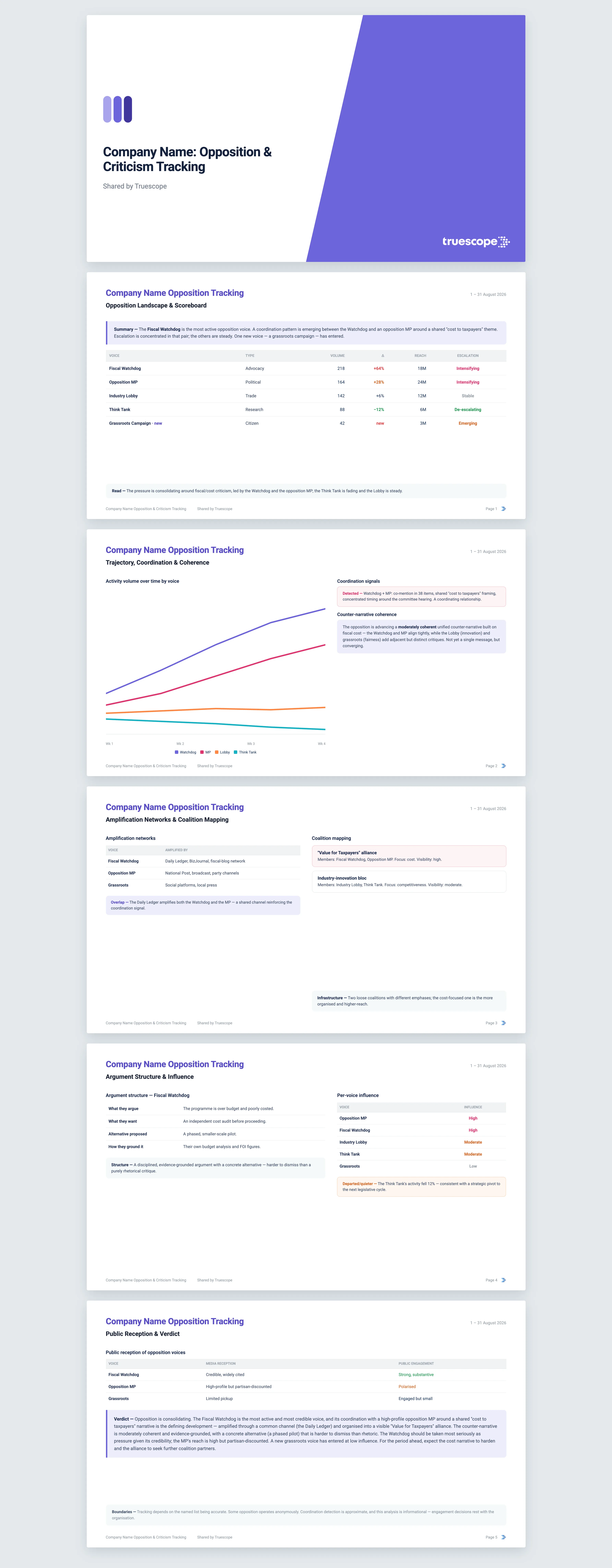
Citizen Engagement Analysis
Find out how citizens actually responded to a government communication, not just whether it got coverage. This template measures the gap between what the government said and how the public engaged, and tells you what that means for communication effectiveness and public trust, in minutes.
What it does
A well-crafted announcement can land in coverage and still generate sceptical or hostile citizen engagement. This template tracks the audience side of the response: reach and pickup, the sentiment of coverage set against the sentiment in comments and replies, the themes in citizen voice, and the counter-narratives and amplifiers that shaped reception. The central diagnostic is the divergence between how the media covered the communication and how citizens engaged with it.
It works from the specific communication you name, its date, the audience it was intended for, the messages it was meant to convey, and an analysis window of the communication date plus seven to thirty days.
The questions it answers
- How far did the communication reach, and what share of policy-area coverage did it capture?
- Did the sentiment of media coverage match the sentiment of citizen engagement, or diverge?
- What were citizens actually doing: supporting, criticising, asking questions, sharing experiences, or requesting action?
- Did the intended audience engage, or did engagement skew elsewhere?
- What counter-narratives, amplifiers, and misinformation emerged, and did the communication address them?
What's in the report
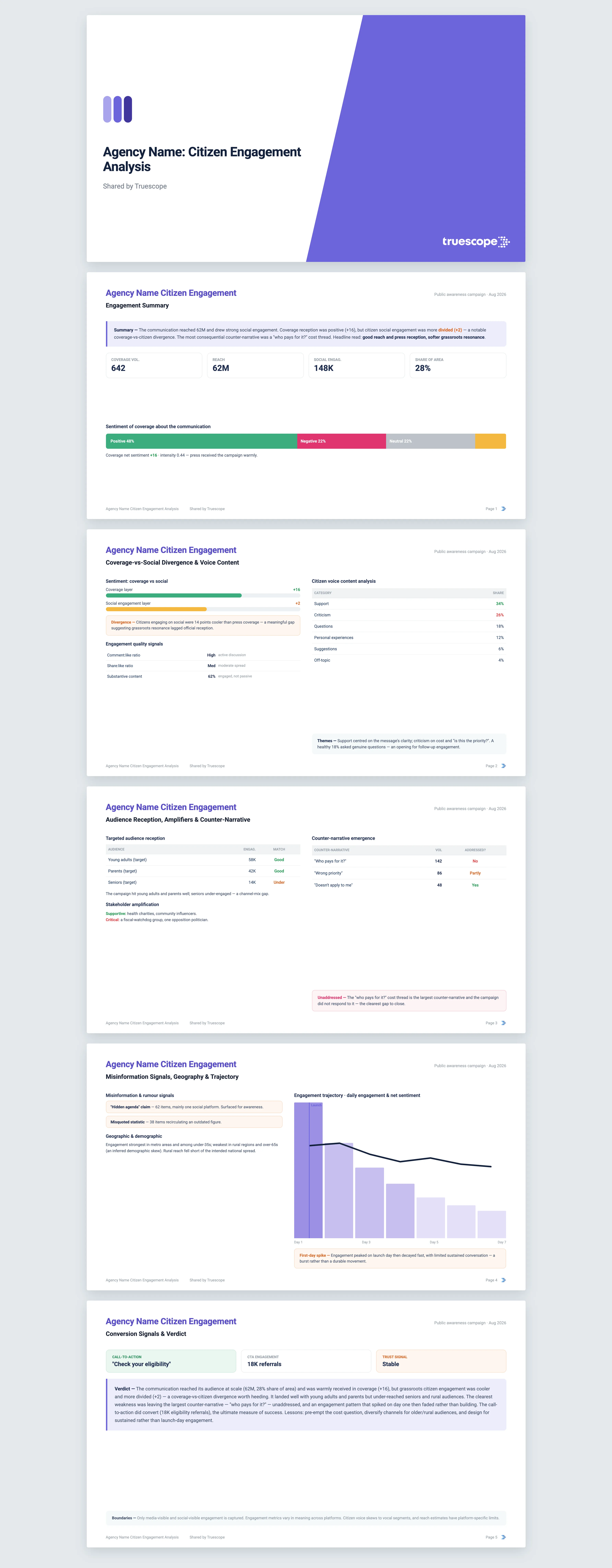
The report opens with an engagement summary, then a reach and pickup scoreboard covering coverage volume, audience reach, social engagement totals, and share of policy-area coverage in the window.
- Sentiment of coverage about the communication, set side by side with the sentiment of social engagement, with the divergence stated explicitly.
- Engagement quality signals such as comment-to-like and share-to-like ratios, profiled as active discussion, passive consumption, content spread, or mostly acknowledgement.
- Citizen voice content broken into reserved categories: support, criticism, questions, requests for action, personal experiences, suggestions, and off-topic, with themes paraphrased to protect privacy.
- Targeted audience reception, misinformation and rumour signals, stakeholder amplification, and counter-narrative emergence with a note on whether the communication addressed each.
- Geographic and demographic engagement variation, call-to-action conversion signals, public trust signals, and an engagement trajectory chart marking the communication date with a reference line.
Where comparable past communications are on file, the report benchmarks against them. Every finding traces back to source coverage and engagement.
Who it's for
This template is built for government and agency communications teams who launch announcements, programme launches, and public information campaigns and need to know whether the message converted into genuine engagement. It also serves ministerial advisers and campaign managers assessing whether a flagship communication earned trust or merely earned coverage.
Why Truescope Analyst
The manual approach means a comms officer reading replies by hand and forming a hunch, or an agency assembling a post-campaign note days later from a thin sample. Neither can put coverage sentiment and comment-layer sentiment side by side at scale, which is the very thing that reveals whether a message actually landed. A general AI tool cannot do it at all, because it has no live view of your coverage or the social engagement beneath it.
Truescope Analyst reasons across your full media dataset and the engagement around it, makes the coverage-versus-engagement divergence the headline read, and surfaces misinformation for you to act on rather than burying it. It is built into your subscription, available to the whole team, runs in minutes, and repeats so you can compare one communication against the last. Every finding is cited and traceable to source.
Frequently asked questions
How long after the communication should I run this?
The analysis window is the communication date plus seven to thirty days, which is enough to see whether first-day attention turned into sustained engagement. Underlying coverage can be drawn from up to the last 13 months in your Truescope inbox, or the last 90 days for global data not yet matched to your workspace.
What is the divergence read, and why does it matter?
It is the difference between the sentiment of media coverage and the sentiment of citizen engagement on the same communication. When coverage is warm but the comments are cold, the message reached people without persuading them, and that gap is the operationally important finding.
Can it tell whether the right audience engaged?
Yes. If you supply the intended audience, the report compares engagement among that audience against the general public and notes whether reception matched intent or skewed to a different group.