
Television and radio still set the news agenda. A segment on 60 Minutes, Insiders or Meet the Press may not quite reach the audience it did a decade ago, but its influence hasn't shrunk. Those segments get clipped, shared, posted to YouTube, and picked apart across social media for days. That means for PR and communications teams, knowing what's being said about your brand on air isn't optional.
But broadcast media monitoring means different things to different vendors, and most buyers don't know to ask about the distinction.
This post explains what broadcast monitoring is, why it matters for PR campaigns, and what to look for in broadcast monitoring software.
What broadcast media monitoring actually means
Broadcast media monitoring is the process of tracking and capturing mentions of your brand, industry, or topics across TV and radio broadcasts. This includes national networks, local stations, cable news, talk radio, and increasingly, podcasts.
The key distinction is the source material. Unlike online or print monitoring — which works with text — broadcast monitoring captures audio and video content from actual over-the-air transmissions. The content is then transcribed, indexed, and made searchable so communications teams can find, clip, and report on relevant segments.
This matters because a significant amount of broadcast coverage never appears online. Think a local TV news story about a workplace incident at one of your project sites, a radio interview with an industry executive, or a breaking segment on a regional cable affiliate. These reports may never be published as articles on a website, but they still matter. And without true broadcast monitoring, you'd miss them entirely.
Why broadcast media monitoring matters for PR teams
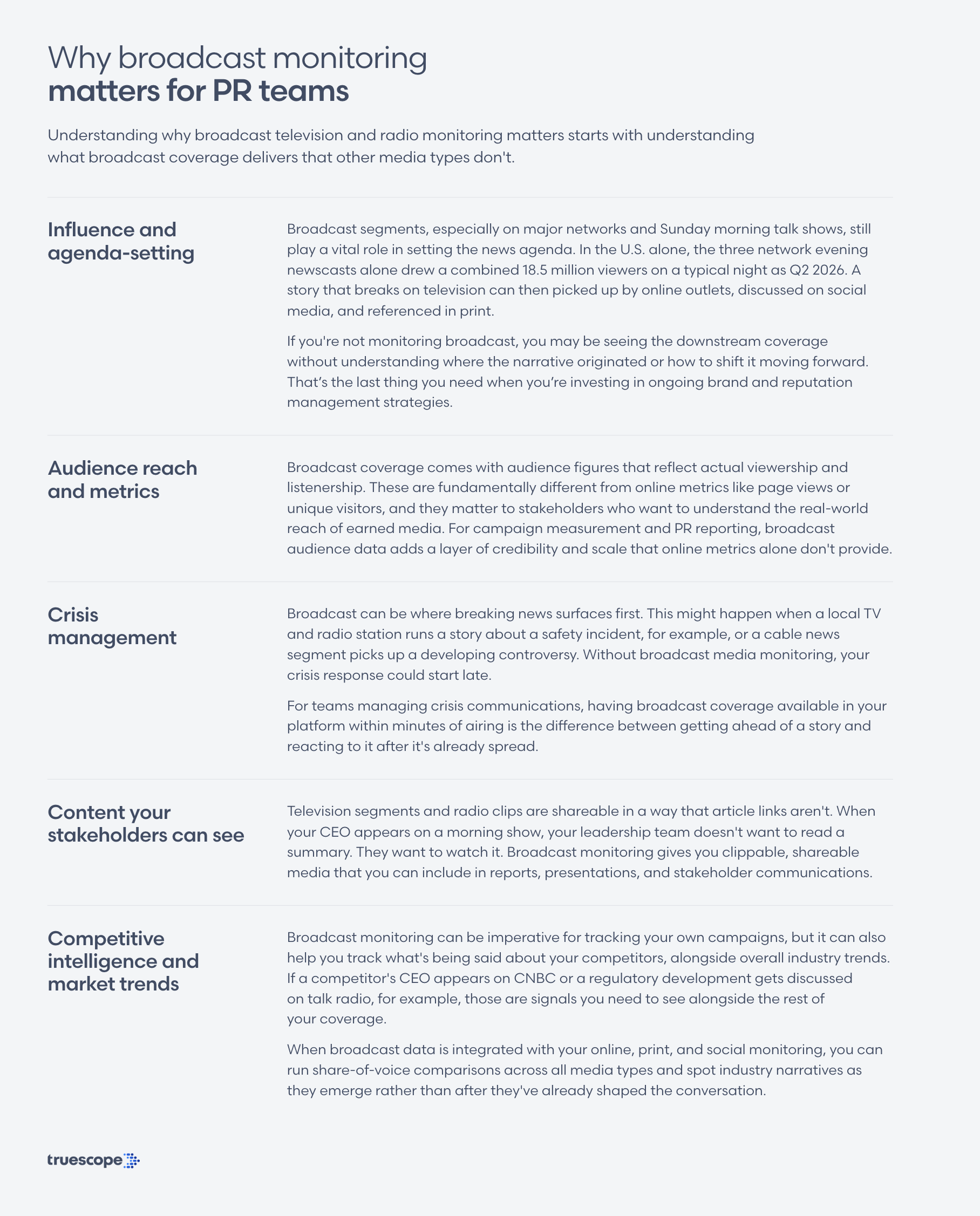
Understanding why broadcast television and radio monitoring matters starts with understanding what broadcast coverage delivers that other media types don't.
What to ask vendors about their broadcast monitoring service
Not all broadcast monitoring services are created equal. Before you sign with any vendor, ask these questions:
- Are you capturing actual over-the-air TV and radio segments, or tracking broadcast websites? If the answer is websites, you may be getting online monitoring with a broadcast label. Ask specifically whether the platform captures live broadcast segments.
- How quickly is broadcast content available after airing? Speed matters for crisis response and timely reporting. Some platforms make segments available within minutes of airing. Others may take hours or longer. Ask for specifics and verify during your demo.
- Which markets and stations do you cover? Confirm that the specific broadcast markets, networks, and stations relevant to your organization are included. National coverage is standard, but local market coverage varies significantly between vendors.
- Is broadcast data integrated with your other media types? Can you view broadcast coverage alongside online, print, social, and podcast coverage in a single dashboard? Or is broadcast siloed in a separate module? Integration matters for unified reporting and share-of-voice analysis across media types.
- What broadcast metrics are included? Look for actual audience figures beyond estimated impressions. Ask whether sentiment analysis is applied to broadcast content the same way it's applied to other media types.
- Is broadcast included in your subscription, or is it an add-on? Some platforms include broadcast news monitoring in their standard offering. Others charge extra for it, sometimes significantly. Get this in writing before you sign so there are no surprises.
- Can I clip, share, and include broadcast segments in reports? The ability to clip relevant portions of a broadcast segment and include them in stakeholder reports is a practical feature that matters for daily workflow.
How Truescope handles broadcast media monitoring
Truescope captures true over-the-air TV and radio segments, not just broadcast website articles. Broadcast coverage is typically available on the platform within minutes of airing, giving communications teams the speed they need for crisis response and timely reporting.
Here's what Truescope's broadcast monitoring includes:
- True over-the-air capture of TV and radio segments across national and local markets.
- Near real-time availability. Coverage is typically searchable and reportable within minutes of broadcast, giving you almost immediate access.
- Integrated with all media types. Broadcast coverage sits alongside online, print, social, and podcast data in a single view. No separate modules, no switching between tools.
- Audience metrics attached. Broadcast segments come with actual audience figures, so your reporting reflects real reach rather than estimated impressions.
- Entity-level enrichment. Every segment is scored for relevance, prominence, and sentiment at both the content level and the individual entity level, so you can see how your brand was positioned in context.
- Included in automated reporting. Broadcast coverage flows into the same automated, brandable reports as every other media type, with AI-generated summaries available at the section or report level.
- Dedicated account manager. Every Truescope client gets a dedicated account manager with PR or communications experience who can help configure broadcast monitoring for your specific markets and needs.
- AI-powered summarization and analysis. Truescope Assistant summarizes broadcast coverage alongside all other media types, so you get the full picture without watching every segment. Truescope Analyst runs multi-threaded research across broadcast, online, print, and social data to deliver structured, source-cited reports in minutes.
70+ pre-built templates for broadcast reporting. Ready-made templates cover campaign measurement, competitive analysis, stakeholder briefings, and more, all working across media types including broadcast. Broadcast is fully integrated into Truescope's platform rather than bolted on as a separate product. That means your broadcast coverage, online mentions, print clippings, and social media data all live in one place, with the same enrichment, AI PR analysis, and reporting tools applied across the board.
Common mistakes when evaluating broadcast media monitoring software
Here's what trips up most buyers when they’re choosing and leveraging broadcast monitoring tools:
- Assuming "broadcast" means broadcast. Always ask whether the vendor captures over-the-air segments or tracks broadcast websites. The distinction is the difference between getting coverage you can't find anywhere else and paying extra for online monitoring.
- Not verifying market coverage before signing. National broadcast coverage is fairly standard, but local market coverage varies significantly. If local TV and radio matter to your organization, confirm the specific stations and markets before you commit.
- Ignoring integration. Broadcast data that lives in a separate module creates extra work. Look for platforms where broadcast media monitoring is part of a unified view alongside online, print, and social coverage.
- Overlooking speed. If you need broadcast monitoring for crisis communications, minutes matter. Ask how quickly segments are available after airing and test this during your evaluation.
The bottom line on broadcast media monitoring
Radio and TV broadcasting may not dominate the media landscape the way it once did, but its influence on PR measurement, crisis response, and stakeholder reporting still matters, especially for local and regional campaigns.
The best media intelligence platforms for broadcast news capture actual over-the-air segments, make them available quickly, integrate them with your other coverage, and attach the metrics you need for the reporting that keeps your team always in the know.
Want to see how Truescope handles broadcast monitoring alongside every other media type? Book a demo to see it in action.
See how you can get more signals and insights from your media intelligence platform




See how you can get more signals and insights from your media intelligence platform


.svg)