This template is one of 70+ report templates that is available in Truescope Analyst, your AI media analyst teammate. Book a demo to use this template or to create your own reusable template.
Two competitors can have the same share of voice and completely different reputations. Competitive Messaging Comparison shows you what each player is being talked about for, not just how much.
What it does
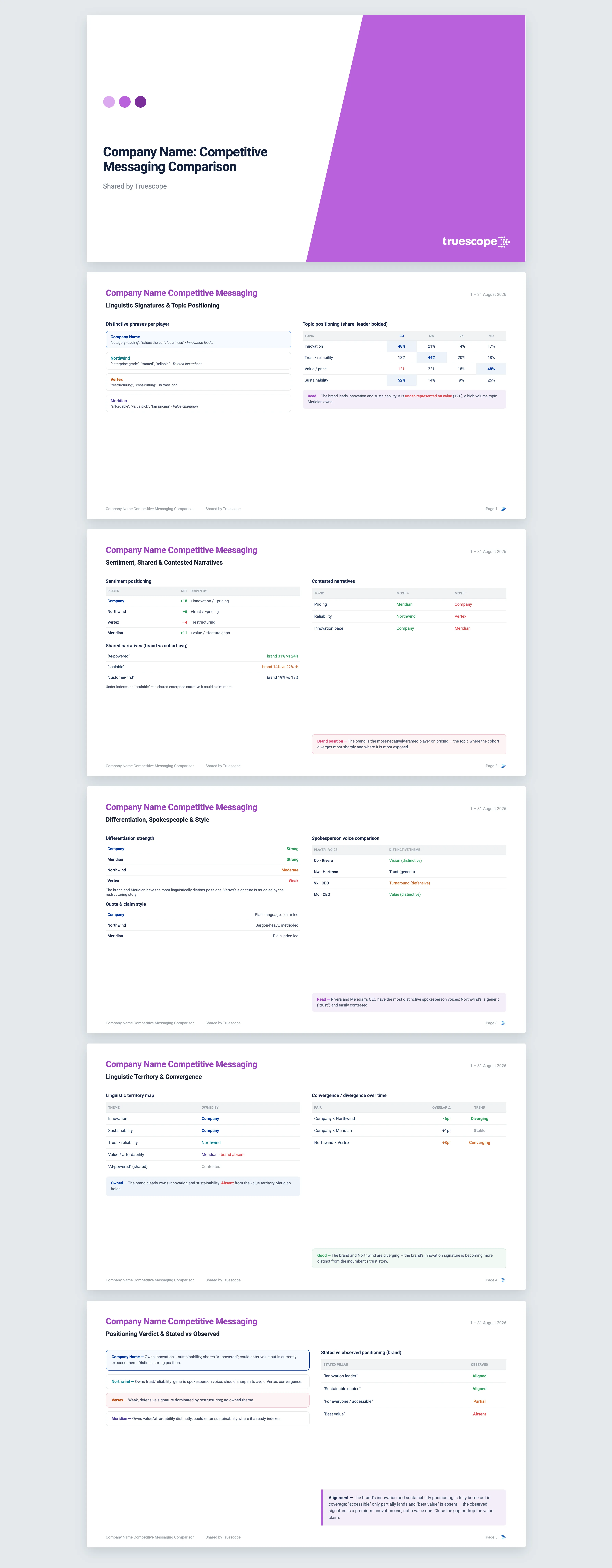
Share of voice tells you who is being talked about most. This template tells you what they are being talked about for. It reads the coverage of your brand and three to five named competitors and compares the language, topics and positioning each one occupies in the market. It maps the distinctive phrases that define each player, the topics they own or share, where the cohort's sentiment splits sharply, and how clearly each player stands apart from the field. The competitive picture in language often diverges from the picture in volume, and the language picture is the one you can act on.
The questions it answers
- What narrative is each competitor actually occupying, in the words coverage uses about them?
- Which topics do we own, which do we share with the field, and which does a rival own while we are absent?
- On which themes does the cohort's sentiment split, with one player framed positively and another negatively?
- Is our positioning linguistically distinctive, or are we hard to tell apart from the competition?
- Do our spokespeople have a recognisable voice in coverage, or a generic one?
What's in the report
The report gives each player a linguistic signature: the distinctive phrases that mark their positioning, with a short read on the narrative they occupy. Your brand is listed first throughout.
- A topic positioning heatmap showing each player's share and sentiment by topic, with cohort leaders highlighted and any topic where your brand is under-represented flagged.
- A sentiment positioning table naming the topics that drive each player's positive and negative coverage.
- Shared narratives, the themes the whole cohort is in, with any where your brand under-indexes called out.
- Contested narratives, the themes where sentiment splits between players, and where you sit on each.
- A differentiation strength score rating each player's position as strong, moderate or weak, so you can see who is linguistically distinct and who has positioning work to do.
- A spokesperson voice comparison, a quote and claim comparison covering stylistic patterns, and a linguistic territory map of who owns which theme.
Where you supply a prior period, the report adds a convergence-and-divergence view showing whether players' language is becoming more alike or more distinct over time. Where you supply your stated positioning, it compares what you intend against what coverage shows, and the gap is the finding. Every signature is grounded in cited coverage.
Who it's for
It serves brand and marketing leaders shaping competitive positioning, communications and corporate-affairs teams who need to know where rivals own the conversation, and strategy and insights professionals preparing a competitive read for executives or the board that goes beyond a volume chart.
How to use this template
This template runs inside Truescope Analyst, the AI media analyst in the Truescope platform. Point it at your own coverage, set the window, and Analyst returns the full report with every claim cited to source. You can also save your own analysis as a reusable template and run it on a schedule. Book a demo and we will run this one on your coverage.
Why Truescope Analyst
Comparing competitive positioning by hand means reading each rival's coverage, pulling out the recurring language, and trying to weigh it all on the same scale without bias. It is slow, and it rarely survives contact with the next quarter. An agency competitive audit is thorough but expensive and dated by the time it lands. General AI tools can contrast a few articles you paste in, but they cannot build a distinctive-phrase signature across each player's full coverage, score differentiation, or weight topics by the whole cohort. Competitive Messaging Comparison reasons across every player's coverage at once, surfaces who owns what, scores how distinct each one is, and cites the evidence, in minutes, inside your subscription, so you can rerun the read whenever the field shifts.
Frequently asked questions
How many competitors can I compare, and over what period?
You can compare your brand against three to five named competitors; more than five makes the language tables unreadable. It works across up to the last 13 months for coverage in your Truescope inbox, or the last 90 days for global data not yet matched to your workspace, and supplying a prior period unlocks the convergence-and-divergence view.
What if a competitor has very little coverage?
A player with thin coverage produces a noisy signature, because there is not enough language to draw a stable picture from. The comparison is most reliable when every player in the set has a reasonable depth of coverage in the period.
Does this tell me how a competitor wants to be seen?
No. It describes how each player is framed in coverage, not how they wish to be framed. Where you supply your own stated positioning, the gap between what you intend and what coverage actually shows is itself the strategic finding.
See how you can get more signals and insights from your media intelligence platform
See how you can get more signals and insights from your media intelligence platform


.svg)