This template is one of 70+ report templates that is available in Truescope Analyst, your AI media analyst teammate. Book a demo to use this template or to create your own reusable template.
You set the messages you wanted coverage to carry. Key Message Tracking tells you, with evidence, whether they actually landed, where, and in whose words.
What it does
Most measurement starts with the coverage and works backwards. This template starts with your intent. You give it the three to eight specific messages your brand set out to land, and it reads your coverage to see whether each one made it into print, broadcast and online, in what outlets, and with what fidelity to your original framing. It is top-down measurement: the messages you chose, scored against the coverage that resulted. Because it works from your messages, it needs them to be specific enough to detect in language. "Commitment to net zero by 2040" can be tracked; "innovation" cannot.
The questions it answers
- Which of our intended messages actually landed in coverage, and which never made it out the door?
- Are journalists using our exact words, paraphrasing us, or covering the topic while losing our framing entirely?
- Which outlets and journalists are carrying each message, and did any reach Tier 1?
- Where is our message being reframed or contradicted, and by whom?
- Which spokespeople successfully landed the messages they were tasked to carry?
What's in the report
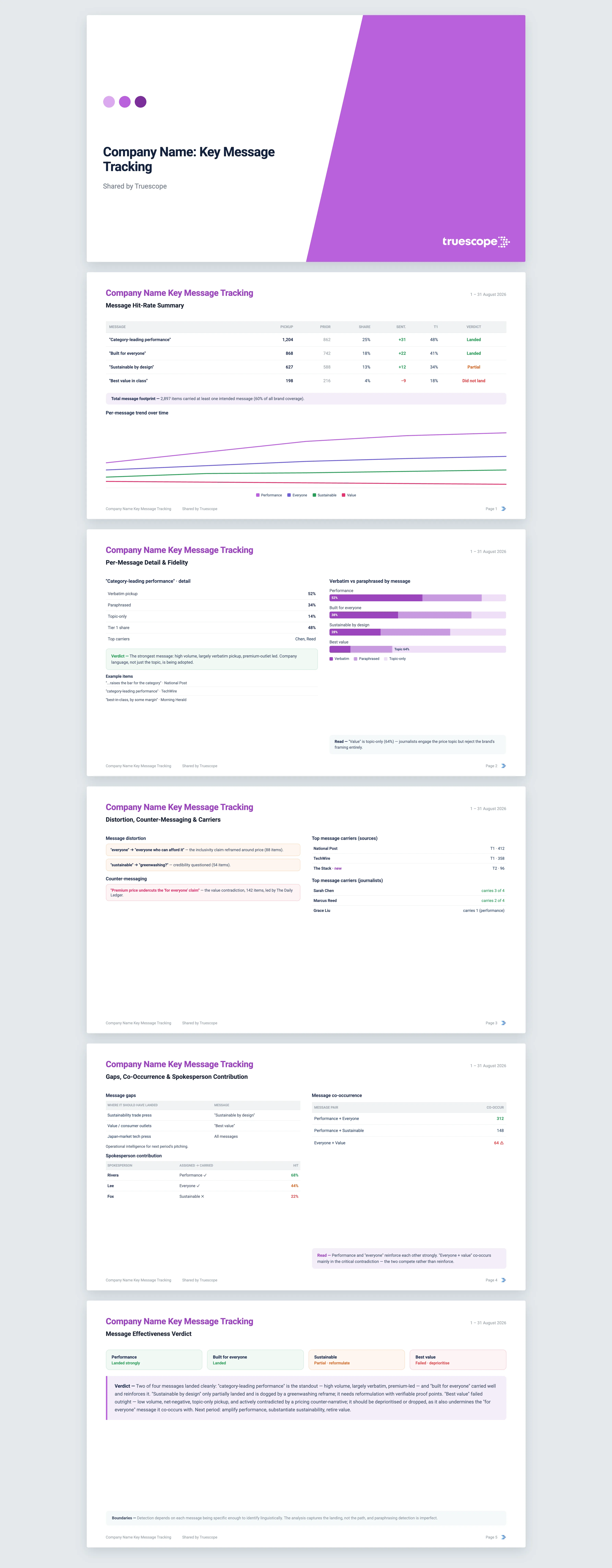
The report opens with a message hit-rate scoreboard: every message, with current and previous pickup, the change, its share of your total coverage, the sentiment of items carrying it, Tier 1 pickup, and a plain verdict of landing strongly, partially landing, or not landing. Each message then gets its own detailed breakdown.
- A message-presence-over-time chart with one line per message, showing which are gaining traction and which are flat or fading.
- A verbatim-versus-paraphrased split, so you can see whether your language is being adopted or just your topic.
- A message distortion section flagging coverage that picked up your theme but reframed it, plus any direct counter-messaging.
- Scoreboards of the sources and journalists carrying your messages, including new conduits established this period.
- A message gaps table naming outlets that covered the topic but carried none of your messages, which is direct input for your next pitching round.
- Co-occurrence of messages, and, where you supply spokesperson assignments, a per-spokesperson hit rate.
Findings compare the current window against the period immediately before it, and every count, quote and verdict is traceable back to the source coverage it came from.
Who it's for
It is built for communications and PR leads running a campaign or announcement who need to prove message cut-through, not just clip counts. It suits brand and corporate-affairs teams reporting message effectiveness to executives or the board, and spokesperson managers who want to know which voices landed their lines and which did not.
How to use this template
This template runs inside Truescope Analyst, the AI media analyst in the Truescope platform. Point it at your own coverage, set the window, and Analyst returns the full report with every claim cited to source. You can also save your own analysis as a reusable template and run it on a schedule. Book a demo and we will run this one on your coverage.
Why Truescope Analyst
Checking message pickup by hand means reading every clip and tallying which phrases survived, a job that takes days and rarely covers the full set of coverage. An agency can do it, but you wait for the deck and pay for the read. General AI tools can assess a few articles you paste in, but they cannot reason across your entire media dataset, and they invent confidence they have not earned. Key Message Tracking reads all of your coverage, separates verbatim adoption from paraphrase from lost framing, cites every example back to source, and produces the same disciplined scoreboard in minutes. It is built into your subscription, so anyone on the team can rerun it the moment a message is in market.
Frequently asked questions
How far back can it track my messages?
It covers up to the last 13 months for coverage already in your Truescope inbox, or the last 90 days for global data not yet matched to your workspace. Each run compares your current window against the equivalent period immediately before it.
What makes a message trackable?
A message has to be specific enough to detect in language. Concrete claims like "industry-leading customer satisfaction" or "AI safety leadership" can be matched reliably; abstract words like "leadership" or "innovation" produce loose detection and overstate your hit rate, so the template will ask you to sharpen them.
Can it tell me how a message got into coverage?
No. It captures the landing, not the path. It cannot tell whether a journalist picked your message up from a release, an interview or a social post; it shows you that the message appeared and where, not how it travelled there.
See how you can get more signals and insights from your media intelligence platform
See how you can get more signals and insights from your media intelligence platform


.svg)