Custom Analysis
Not every question fits a standard report. The Custom Analysis template is built for the one-off question that arises once or rarely, designing the analysis around what you are actually asking rather than forcing it into a fixed format.
What it does
Standard templates have predetermined sections because the questions they answer recur. Custom Analysis is for the question that does not recur: a specific, sometimes composite question that no off-the-shelf report addresses. The strategic question, in meta form, is what analysis structure best answers your particular question, drawing on the engine's capabilities flexibly.
The discipline is precision of framing. The analysis begins by interpreting your question sharply, breaking it into the sub-questions that actually need answering, and resisting the temptation to default to a familiar template format that would not serve it. A vague question produces a misleading answer no matter how good the analysis, so sharpening the question comes first. It works across coverage from up to the last 13 months in your Truescope inbox, or the last 90 days for global data not already matched to your workspace.
The questions it answers
By design, this template answers the questions the standard reports do not. Common shapes include:
- Comparative questions: how do two or more entities compare on a specific set of dimensions?
- Trajectory questions: how has a particular measure moved over time, and what drove the inflection points?
- Voice and actor questions: who is shaping a conversation, and how?
- Event-impact questions: how did coverage change before and after a specific moment?
- Cross-cutting questions: where does a pattern show up across many sub-categories at once?
What's in the report
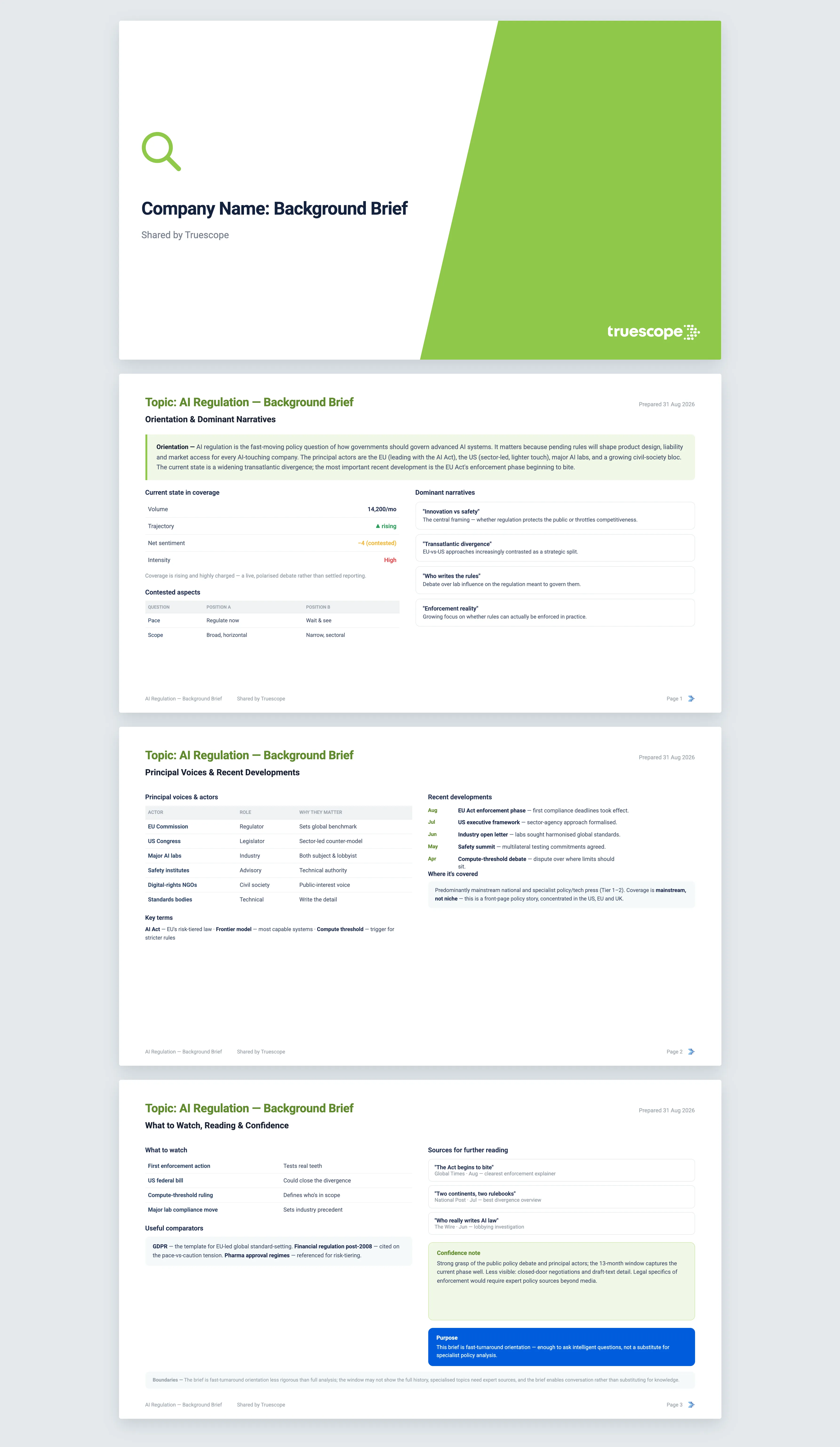
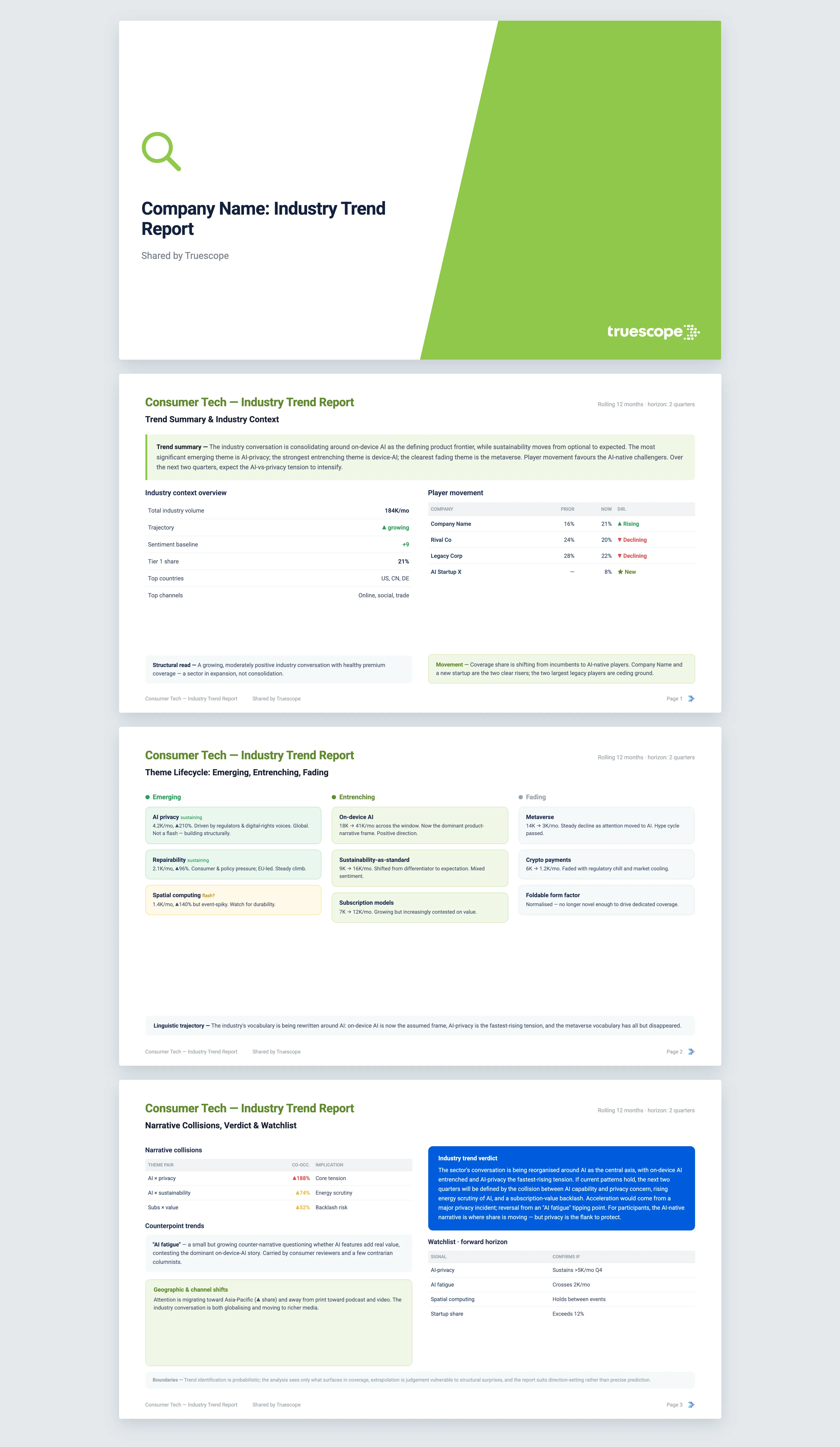
Because the structure is bespoke to your question, the report is built around it rather than a fixed outline. A typical analysis follows a clear progression.
- A question-framing section stating your original question and breaking it into the explicit sub-questions the analysis will address.
- An analytical-approach section setting out the data scope, the comparisons being made, any assumptions, and the planned steps, so you can judge whether the approach fits before reading the findings.
- Findings organised by sub-question, each with a direct answer, supporting evidence as charts, tables, or metrics chosen to fit that sub-question, any caveats, and a strength-of-evidence label.
- Cross-cutting observations: patterns that emerged but were not part of your original question, often the most valuable section because you did not know to ask.
- A confidence table rating each major finding and stating what would change it.
- Recommended next steps and a short note on whether the pattern could become a reusable standard template.
Charts are used only where they directly answer a sub-question, and every finding is cited back to source coverage.
Who it's for
This template is for analysts, communications and strategy leads, and decision-makers who have a sharp, non-standard question and need it answered with rigour. It fits the moment a stakeholder asks something specific, an unexpected concern surfaces, or a decision needs evidence that no recurring report happens to produce.
Why Truescope Analyst
The manual route to a bespoke answer is to brief an analyst, wait, and hope they framed the question the way you meant it. Iterating is slow and expensive, and the result reflects whatever subset of coverage one person could read. General AI tools will happily answer any question you type, but they reason from training data or a handful of links, they cannot run the comparisons and time-series your question needs across real coverage, and they offer no honest read on how strong the evidence actually is.
Truescope Analyst reasons across your full media dataset and designs the analysis around your specific question, deploying capabilities the standard templates rarely reach for, such as sentiment toward each named person or syndication-deduplicated reach, when they answer the question better. It states its approach up front, labels the confidence of every finding, and stays in the analyst's lane by describing what the data shows rather than prescribing what you should do. It delivers in minutes, not days, with every finding cited and traceable, and it is built into your subscription so the next unusual question is one command away.
Frequently asked questions
What if my question is vague?
The template's first responsibility is to push for a sharper version before any analysis runs. A precise question produces a useful answer; a vague one defaults to generic output, so reframing is treated as part of the work and sometimes the most valuable contribution.
What scope can I set?
You define the entities, topics, geographic or platform constraints, and the audience for the output, and the analysis is shaped to them. It draws on coverage from up to the last 13 months in your Truescope inbox, or the last 90 days for global data not yet matched to your workspace, matching the reporting detail to the period you choose.
Will it tell me what to do?
No. Custom Analysis stays disciplined about describing what the data shows and labelling how confident it is in each finding. It will name follow-up questions worth investigating, but the judgement about what action to take is left to you.