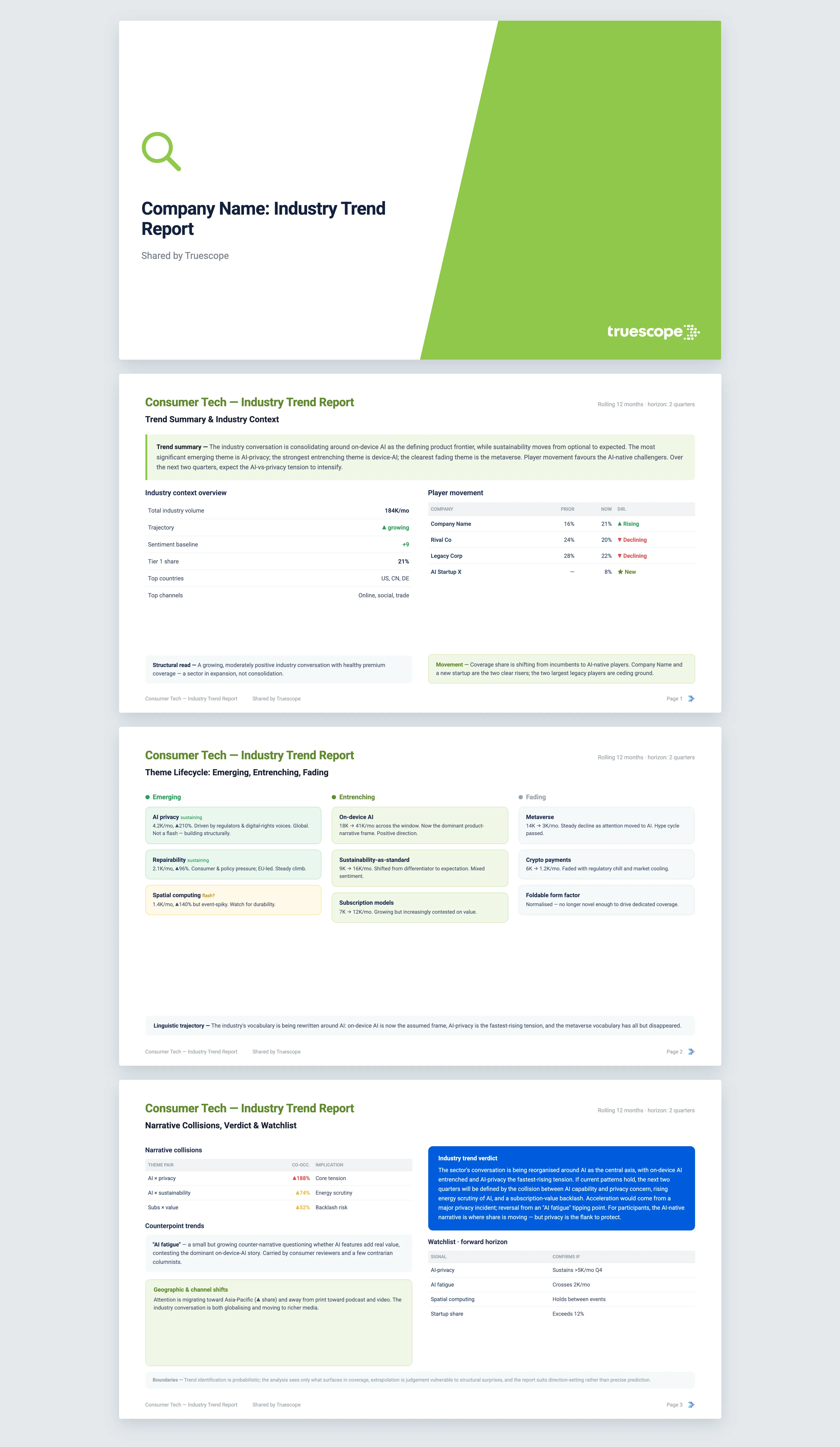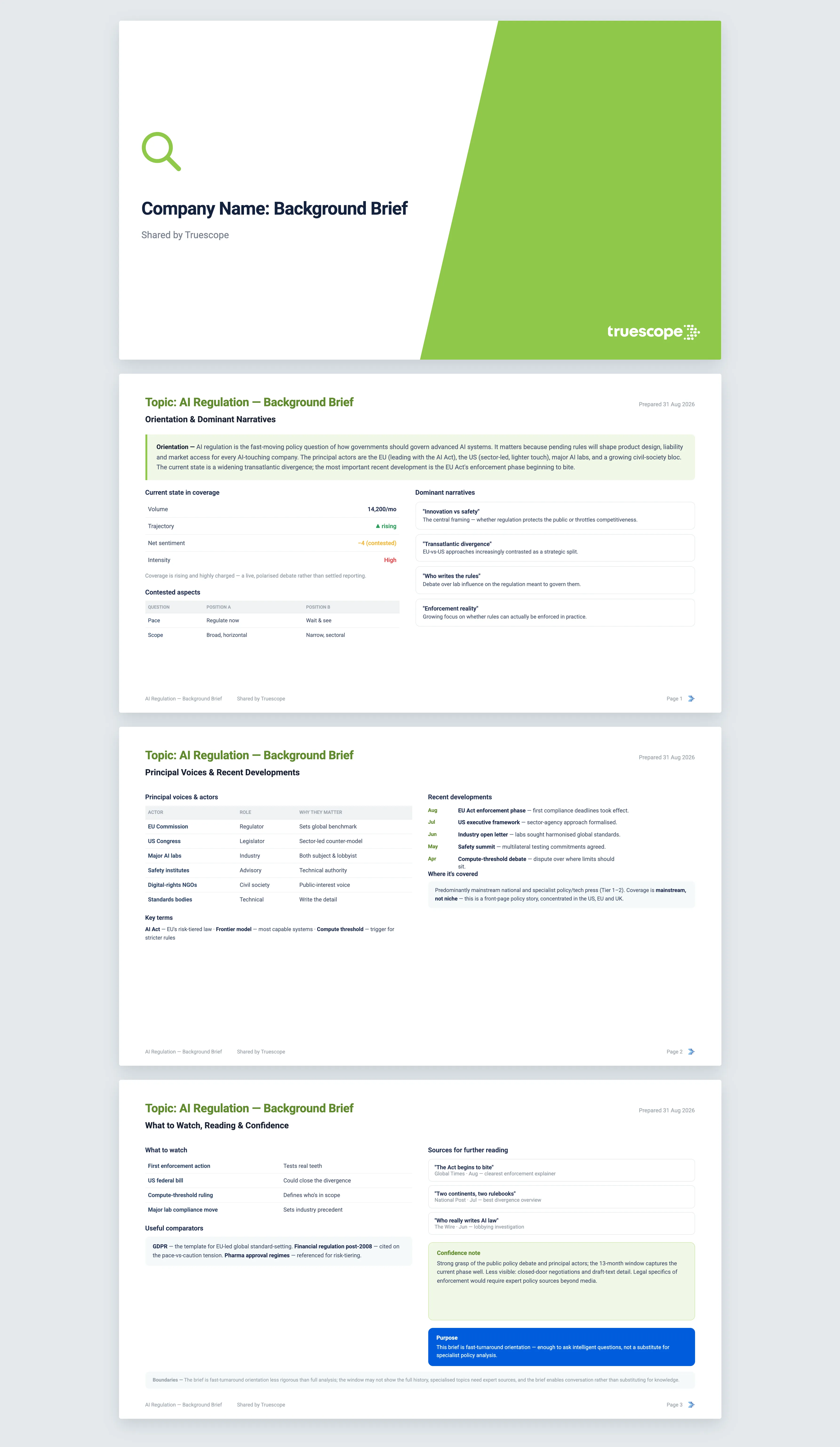
Background Brief
Walking into a meeting on a topic you do not know is a quiet risk. The Background Brief gives you fast, cited orientation on any unfamiliar company, person, issue, or event, so you arrive able to ask intelligent questions and follow the conversation.
What it does
Some subjects you need to understand quickly without becoming an expert. The Background Brief is the primer for exactly that moment. It answers a focused question: for an unfamiliar topic, entity, or situation, what is the orientation a reader needs to grasp the basics, the current state, the key voices, and the recent developments?
Concision is the whole discipline. Every section earns its place by directly contributing to orientation, and the brief is deliberately lean rather than exhaustive. It is judged by one test: does a reader emerge able to participate intelligently in a conversation about the subject? It draws on coverage from up to the last 13 months for material in your Truescope inbox, or the last 90 days for global data not already matched to your workspace.
The questions it answers
- What is this topic or entity, why does it matter, and who are the principal actors?
- What is the current state of coverage, and is attention rising, stable, or fading?
- What are the dominant narratives and framings shaping how the subject is discussed?
- What significant developments happened recently, and where is the topic being covered?
- Where is the conversation contested, and what terms or acronyms do I need to recognise?
What's in the report
The brief leads with a single orientation paragraph: read only that, and you can already ask sensible questions. It then moves through tightly scoped sections, each kept short on purpose.
- A short background-context note covering only the prior history needed to make sense of current coverage.
- A current-state snapshot with volume, trajectory, sentiment, and intensity.
- The three to five dominant narratives in current coverage, each explained in a sentence.
- A table of eight to twelve principal voices and actors, with why each one matters.
- A chronological list of the five to ten most significant recent developments.
- Where the topic is covered, by outlet and tier, plus its geographic and political dimensions.
- A contested-aspects section setting out where coverage genuinely disagrees, which is often the most useful part.
- A short glossary of key terms, a set of useful comparators, a what-to-watch list of signals, and three to five recommended articles for deeper reading.
It closes with an honest confidence note: what the analyst knows well from the data, what is inferred, and what would need deeper research. Findings are cited back to source coverage throughout.
Who it's for
This template suits anyone who needs to get up to speed fast: communications and PR professionals briefing an executive, public-affairs staff preparing for a stakeholder meeting, investor-relations teams sizing up an unfamiliar issue, or any analyst who needs context before a longer piece of work. It is the document you generate the day before the meeting, not the week-long deep dive.
Why Truescope Analyst
The manual version of this is an afternoon of searching, opening twenty tabs, and trying to work out which voices and narratives actually matter, with no easy way to tell whether you have the current picture or last year's. Ask a junior staffer to do it and you wait, then you cannot check their sources. General AI tools feel quick but they hallucinate names and dates, they cannot tell you whether attention is rising or fading right now, and they have no view of which outlets are actually covering the subject this week.
Truescope Analyst reasons across your full media dataset rather than a single article you paste in, so the principal voices, the dominant narratives, and the contested aspects come from real coverage, not guesswork. It delivers the brief in minutes, not days, with every finding cited and traceable to source. Because it is built into your subscription and available to anyone on the team, the same fast orientation is one command away whenever the next unfamiliar topic lands on your desk.
Frequently asked questions
What period does the brief cover?
It reaches up to the last 13 months for coverage already in your Truescope inbox, or the last 90 days for global data not yet matched to your workspace. The template leans towards recent coverage for emerging topics and a longer view for established entities, and it states the window it used.
Can I tailor it to my purpose?
Yes. You tell the brief what it is for, such as preparing for a meeting, supporting a decision, or setting up a longer analysis, and that intended use shapes which dimensions get the most emphasis.
How is this different from a full report?
The Background Brief is intentionally concise, two to four pages of orientation rather than an exhaustive analysis. It is built to enable an intelligent conversation, not to substitute for substantive subject-matter knowledge, and it says so plainly in its boundaries.