
Sentiment monitoring is the ongoing tracking of how positive, negative or neutral the coverage and conversation about a brand is, across media and social channels. It turns the question every board eventually asks, "how do people feel about us?", into a number you can track over time and a trend you can act on. Done well, it gives comms teams an early read on reputation, weeks before a problem shows up in sales, market research, or a survey.
Most guides on this topic treat it as a social media monitoring exercise. That is the gap we want to close. For a communications team, brand sentiment lives in broadcast bulletins, print, online news and podcasts as much as it does on social media. This guide covers what sentiment monitoring is, how sentiment analysis works underneath it, where the technology still falls short, and how to set it up so the output earns trust with your leadership.
What is sentiment monitoring?
Sentiment monitoring is the continuous measurement of the tone of what is being said about your brand. Each mention, whether a news article, a TV segment or a social post, is classified as positive, negative or neutral sentiment, and those classifications are tracked over time to show whether perception is improving or sliding.
It helps to separate two terms, such as customer sentiment analysis and monitoring, that get used interchangeably. Sentiment analysis is the act of judging the tone of a single piece of text or speech. Sentiment monitoring is doing that continuously, across every channel, and watching the trend. You run sentiment analysis on one article; you set up sentiment monitoring for the brand. In practice the work of monitoring depends on sentiment analysis running underneath it, at scale, on everything that mentions you.
The output is usually a sentiment score, sometimes called a brand sentiment score, a rolled-up measure of how positive or negative your coverage is over a period, often split by topic, channel or spokesperson. A score on its own means little. The value is in the movement, the comparison against a baseline, and the ability to drill from the score into the specific coverage driving it.
Sentiment also feeds the metrics comms leaders already report. Share of voice tells you how much of the conversation is yours; layering sentiment over share of voice tells you whether that conversation is helping or hurting. The two together are far more useful than either alone.
Why sentiment monitoring and customer sentiment matter for PR and communications
For a PR team, sentiment monitoring does three jobs that volume metrics cannot.
First, it is an early warning system. A rise in negative sentiment or a sudden drop in positive sentiment is often the first measurable sign that an issue is building, and it tends to move before call volumes, web traffic or sales. Catching a negative trend on day one rather than day five changes what you can do about it. Real-time sentiment monitoring is why brand sentiment sits at the centre of how communications teams spot a crisis early and decide whether to respond. A sharp move can be the first signal of a crisis before it breaks wide.
Second, it gives campaign work a quality measure, not just a count. A launch that earns 200 mentions looks like a win until you see that sentiment dipped because half of those mentions questioned the price. Tracking brand sentiment through a campaign tells you whether the coverage moved brand perception in the direction you wanted.
Third, it translates communications work into language the C-suite understands, linking effective brand sentiment monitoring to stronger customer experience and better customer satisfaction that supports loyalty and retention. A board does not want a clip count. It wants to know whether the organisation's brand reputation is stronger or weaker than last quarter and why. A clear brand sentiment trend, tied to specific events, is one of the few PR measures that travels well into a board paper. We do not dress this up as an advertising value equivalent; AVE has been displaced by AMEC's measurement framework, and sentiment is one of the outcome measures that replaced it. Turning coverage into that kind of insight is the same discipline behind good PR analytics.
How sentiment monitoring works, and where it breaks down
Under the hood, sentiment monitoring runs on natural language processing (NLP), opinion mining, machine learning, and artificial intelligence (AI). The software performs automated text analysis on articles or transcripts of audio and video, and modern sentiment analysis models use deep learning and other sentiment analysis algorithms to assign a tone to each mention. NLP lets a model go beyond single keywords and read natural language in context, while processing unstructured data at scale, so it can tell that "sick" is praise in one sentence and a complaint in another. AI and the rise of AI agents have made sentiment analysis faster and more accurate than the static lexicons and keyword-counting methods of a decade ago.
The core workflow moves from data collection (ingesting mentions across sources), to categorization (topic and channel tagging), and to scoring (assigning positive, negative, or neutral tone to each mention).
It is worth being honest about the limits, because no tool reads tone perfectly. Three things still trip up automated sentiment analysis:
- Sarcasm and irony. "Great, another outage" is negative, but the word "great" can fool a weak model, and phrases like "just what I needed" show how human language can reverse the literal meaning.
- Mixed sentiment. "The product is excellent but the service was slow" is positive about one thing and negative about another. Good tools utilize aspect-based sentiment analysis to score by topic; lesser ones flatten it to a single confused rating.
- Context and culture. Industry language, local idiom and the difference between Australian and American phrasing all change meaning, and a model trained on the wrong data will misread it.
This is why the better approach keeps a human in the loop. Automated sentiment analysis does the heavy lifting across thousands of mentions in real-time, and an analyst reviews and corrects the edge cases that matter, such as the coverage feeding a board report or a crisis call. Accuracy claims that ignore this are worth treating with caution. The honest position is that AI gets you most of the way, fast, with some platforms going further to offer emotion detection to classify specific emotions, like joy, anger, or frustration, rather than just positive or negative tone. Human judgement then closes the gap on mentions where being wrong is expensive.
What to monitor beyond social media
Here is where most sentiment monitoring advice falls short. It assumes sentiment analysis tools only need to read social sources, when they should cover far more than Twitter, Instagram and Facebook. For a communications team, that is a fraction of the picture.
Reputation is shaped across earned media, and sentiment monitoring needs to cover all of it:
- Broadcast television and radio, where a single evening bulletin can reach more people than a month of social posts, and where the tone of a presenter's framing matters as much as the words.
- Print and online news, where a journalist's angle sets the narrative that social conversation then amplifies.
- Podcasts, an earned channel that is growing fast and that most social listening tools miss entirely.
- Social media, which matters, but as one channel among several rather than the whole story.
A negative segment on national television and a wave of critical tweets are not the same risk, and a sentiment score that only sees the tweets will mislead you. This breadth is the heart of modern media monitoring across broadcast, online and social, and it is the main reason a PR team needs a media intelligence platform rather than a social-only tool. Broadcast sentiment, in particular, is where lighter tools fall down, because capturing and transcribing television and radio is hard. Better systems turn that raw volume into dashboards and insights your team can report from, rather than leaving analysts to stitch sources together manually.
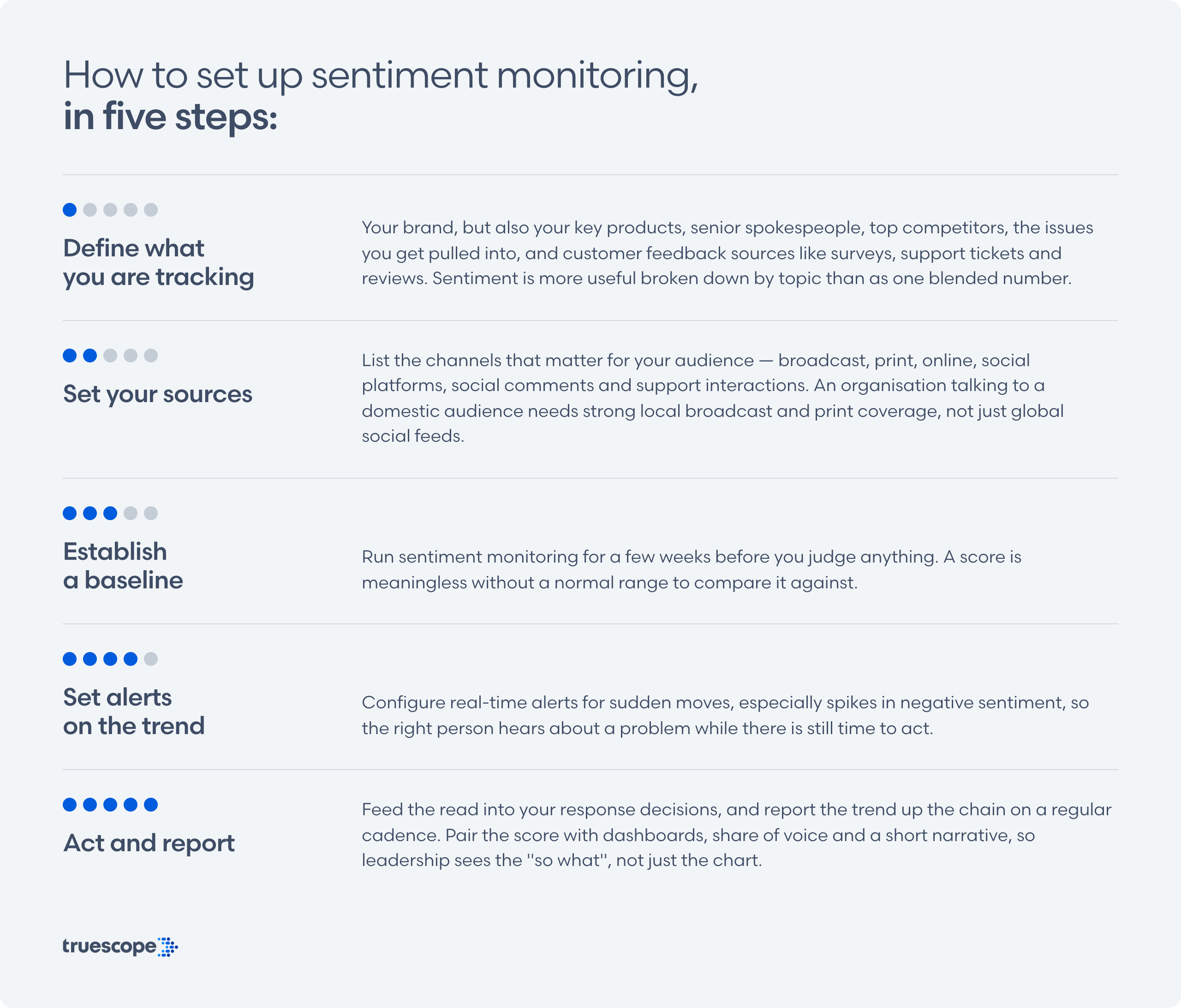
How to set up sentiment monitoring in five steps
You do not need a large team to start. You need a clear scope and a tool that covers your channels.
How to choose a sentiment monitoring tool
The market is crowded, and many tools are built for social media marketing rather than communications. You can buy an existing platform or build your own tool, but most run sentiment analysis well on social media and still cannot see the rest of your coverage. A few questions separate the tools that suit a PR team:
- Channel coverage. Does it capture broadcast and print media, or only social media and online? For a comms team this is the deciding factor, and it is where social listening tools and full media intelligence platforms differ most. It should also help you monitor brand mentions and social media mentions across channels, with competitor sentiment where relevant to brand health.
- Sentiment accuracy. Can the AI score sentiment by topic, handle mixed sentiment, and is there a way for an analyst to correct the sentiment analysis? Ask for the accuracy rate and how it is measured. Some platforms also expose sentiment scores on a 0 to 100 scale to indicate emotional polarity and roll that up into overall sentiment.
- Real-time alerting. How quickly does a spike in negative sentiment reach you, and how configurable are the alerts?
- Local depth. For an Australian or wider APAC programme, does it have real coverage of local media, or is it strong overseas and thin at home?
- Reporting. Can it produce something you can put in front of a board without a day of manual reformatting, while clearly tracking brand mentions?
The right tool for effective brand monitoring depends on the job. A consumer brand running social campaigns has different needs from a government department or a listed company managing reputation across broadcast and print. Match the tool to where your audience actually forms its opinion to gain a competitive edge while maintaining a positive brand image.
Frequently asked questions
What is the difference between sentiment monitoring and sentiment analysis?
Sentiment analysis is judging the tone of a single piece of text or speech as positive, negative or neutral. Sentiment monitoring is doing that continuously across all your channels and tracking how the result changes over time. Analysis is the technique; monitoring is the ongoing programme built on top of it.
Is sentiment analysis accurate?
It is accurate enough to be useful at scale, but not perfect. AI-driven sentiment analysis handles the bulk of mentions well and struggles with sarcasm, mixed sentiment and local context. The most reliable approach pairs AI with an analyst who reviews the high-stakes coverage, so you get speed across everything and precision where it counts.
What is a good sentiment score?
There is no universal benchmark, because a "good" score depends on your industry, your audience and your normal range. The figure that matters is the movement against your own baseline. A score holding steady through a difficult news cycle can be a strong result, while a high score that is sliding is a warning.
How do you monitor brand sentiment across broadcast and print?
You need a media intelligence platform that captures and transcribes television and radio and ingests print and online news, then runs sentiment analysis across all of it. Social listening tools alone will not see broadcast or print, which is where a large share of reputation is still made.
Closing
Sentiment monitoring is most valuable when it covers every channel your reputation lives on and when the output is honest about what the technology can and cannot read. Get those two things right and you have an early warning system, a campaign quality measure, and a brand reputation metric your board will trust.
See how Truescope tracks brand sentiment across broadcast, print, online and social here.
See how you can get more signals and insights from your media intelligence platform





See how you can get more signals and insights from your media intelligence platform


.svg)