

Most media monitoring platforms will tell you they do everything, but that’s not necessarily the case. Every tool has tradeoffs, and the tradeoffs that matter depend entirely on what your team actually needs to get done each day.
This buyer’s guide is designed to help you avoid that. It covers how to choose media monitoring tools by setting clear buying criteria, evaluating the features that actually matter, and asking the right questions about AI before you sign. We’ll also look at the leading real-time monitoring tools and how to decide which is right for you.
Setting your buying criteria: how to choose a media monitoring solution
Before you look at media intelligence, get clear on what you're trying to solve.
Long lists of flashy features are tempting. They're also misleading.
A tool with 50 capabilities you'll never touch is less useful than one with 20 that work together seamlessly.
Most communications teams are solving for one or more of these specific use cases:
- Brand reputation management. You need to know what's being said about your brand across news, broadcast, and social networks, and you need to know fast. This typically involves capabilities to track brand mentions and sentiment analysis.
- Campaign measurement. You need to prove the reach, sentiment, and impact of your earned media efforts to leadership.
- Competitive intelligence. You want to track competitors alongside your own brand and compare share of voice, sentiment, and media presence.
- Stakeholder communication. Your primary deliverable is a daily or weekly report that keeps executives, employees, or clients informed about relevant coverage.
- Crisis detection. You need real-time alerts when coverage spikes or sentiment shifts so you can respond before a story spirals.
Determine which use cases matter most to your team, and which are must-haves. This will help you determine which features, sources, and integrations are non-negotiable, which is what you want to prioritize when you come into every demo.
Must-have features in leading tools for 24/7 monitoring
Once your criteria are set, it’s time to start looking for the media monitoring tools that have the functionality you need. Asking the right questions can help you understand how features work, what sources you’ll have access to, and how a platform can work with your media intelligence workflows.
Here’s what to ask.
What media types does the platform actually cover?
This is the single most important factor, and it's the one most buyers always know to ask about. Here’s what to keep in mind:
- Online news sites are table stakes. Every platform covers them.
- Social media listening varies widely. Some platforms cover X, Facebook, and Instagram but miss TikTok,Bluesky or Telegram. Check whether social data is integrated with traditional media analytics or if it’s siloed in a separate module.
- Broadcast monitoring is where definitions sometimes diverge. Some vendors say "broadcast" when they mean they're tracking articles on broadcast network websites like CNN.com. Others define true broadcast monitoring as capturing actual over-the-air TV and radio segments. If broadcast matters to you, ask specifically: does the platform capture live segments, or just website content?
- Print monitoring also varies. Some platforms offer licensed full-text feeds. Fewer offer scanned images of actual newspaper and magazine pages. If your stakeholders need to see the physical clipping as it appeared in the paper, confirm this before you sign.
- Podcasts are increasingly important and increasingly inconsistent across platforms. Ask for specifics about what coverage is included here.
You can ask each vendor to confirm that specific sources that matter to you are included in your potential plan. Don’t forget to confirm which media types are included in your subscription compared to what will be available as add-ons for extra costs.
How does the platform use AI for media monitoring?
Every vendor will tell you they have AI. The question is what the AI actually does and whether it's working on your data or just browsing the web.
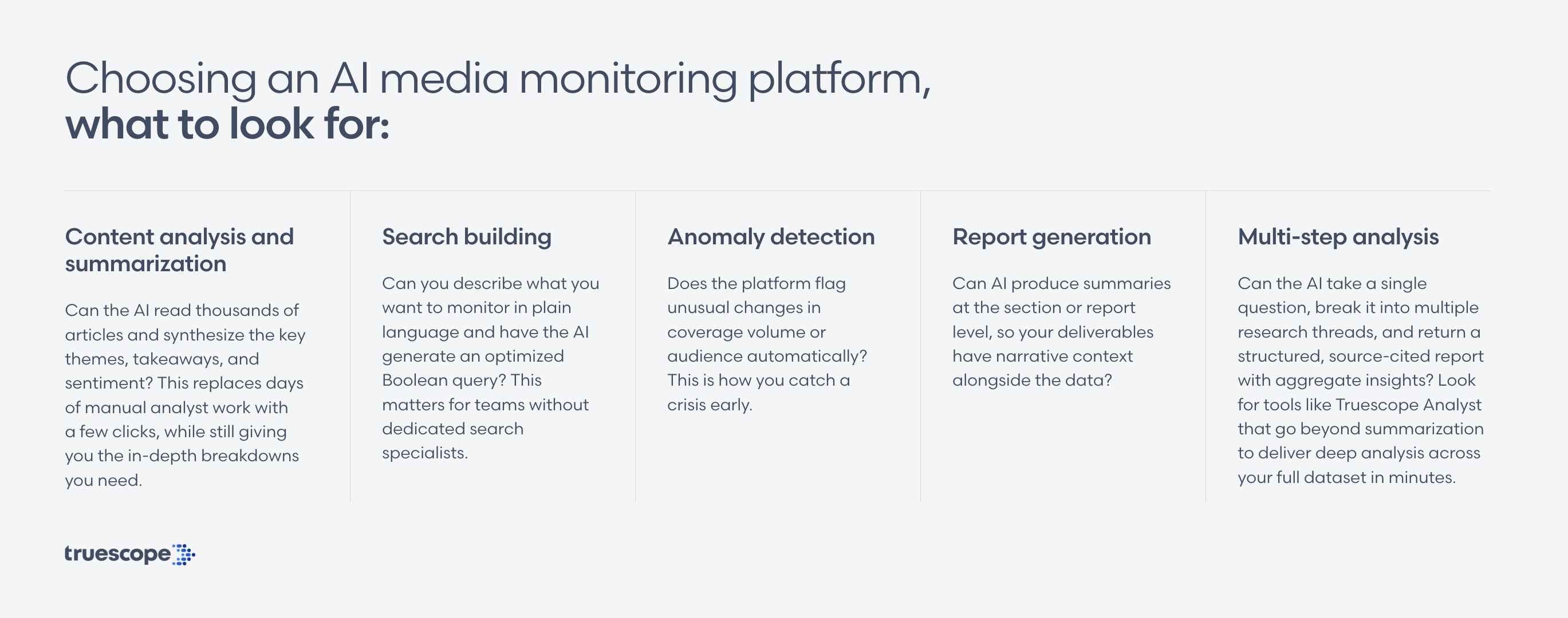
What to watch out for:
- AI that helps you navigate the platform. Think how to build a chart or how to refine a search, which is useful but limited — especially since the platform should be user-friendly and come with a dedicated account manager. This is fine, but the real value is AI that reads and analyzes your actual coverage.
- AI that queries the open web rather than your proprietary media dataset. If it's searching the internet, it's not giving you intelligence specific to your coverage.
Is the AI responsible? What to ask about data privacy
This one matters more than most buyers realize, and it's moving fast. AI in media monitoring raises real questions about data privacy, especially for government agencies, healthcare organizations, and other regulated industries and sectors.
In 2026, regulations like the EU AI Act and a growing patchwork of U.S. state laws are raising the bar on vendor accountability and data handling. A vendor that can clearly articulate its AI practices today is less likely to create compliance problems for you later.
Before you commit, ask:
- Is my data used to train AI models? If your queries and reports are feeding a shared model, your proprietary intelligence could influence outputs for other users. Look for an explicit guarantee that your data stays yours.
- Where is the AI processing my data? Understand whether data stays within your workspace or gets sent to third-party providers without enterprise-grade encryption.
- What data does the AI analyze? The most valuable media monitoring AI works against a proprietary repository of licensed, curated content, not the open web.
How good is the reporting and can you automate it?
For most communications and PR teams, the report practically is the product. It's how you demonstrate value, keep stakeholders informed, and justify the budget. Evaluate on these criteria:
- Automation. Can reports run on a schedule, pull in the right results, and land in stakeholder inboxes without manual work? And what about having options to set up different types of reports, like industry trend reports for key team members?
- Customization. Can you brand reports with your logo, adjust layouts, and tailor content by audience?
- Format flexibility. Look for exports to PDF, PowerPoint, Word, and CSV. Different stakeholders want different formats.
- AI integration. Can AI-generated summaries be included in reports automatically? Do AI assistants offer insights, or help automate key tasks?
- Unified view. Can reporting combine online, social, broadcast, and print in a single view? Or are you stitching together data from separate modules?
- Charts. Can you add easy-to-interpret charts to help stakeholders understand your data at a glance?
If you’re unsure, you can ask to see a specific example during a demo. For example, you could ask to see a report about a current campaign, with data sourced from TikTok, print, and broadcast. Seeing the workflow will help you determine if the platform is right for you.
Does the platform fit your daily workflow?
This is the one that bites you six months after signing, if not sooner. The platform you choose is one your team will use every morning, often before their first coffee.
Complexity costs time, reduces functionality, and ultimately results in team members who don’t use it as frequently as they could.
These are the questions to ask:
- How intuitive is the platform? If a demo feels heavy, daily use will be worse. If a platform isn’t easy to use, it will cause frustration and unnecessary friction that can hurt both initial adoption and ongoing usability.
- Are searches and results unlimited? Some platforms cap these, which forces upgrades as your monitoring needs grow. This can become expensive overtime as you incorporate a platform more into your daily workflow.
- Does it integrate where your team already works? Look for distribution to email, Slack, and Microsoft Teams, plus an API for teams that need data in their own systems where their teams work
- How long does onboarding take? Ask whether training is included or costs extra, and what ongoing support looks like after the initial onboarding process.
What does customer support actually look like after the sale?
This is arguably the most underrated factor in the buying process for monitoring solutions. Buyers spend weeks evaluating features and minutes evaluating support. Then they sign, and the experience changes.
Before you commit, ask:
- Will I have a dedicated account manager, or will I be routed to a ticket queue? At the minimum, companies should offer clear incident response times and support in their SLA.
- What's my account manager's background? Someone who's worked in public relations or communications will understand your needs differently than a general support agent, because they’ll truly understand how you want to use the platform.
- What are the contract and renewal terms? Auto-renewal clauses with narrow cancellation windows (60-90 days) are common in this space and can lock you in. Read the fine print.
It’s important to understand what happens after the deal is closed and onboarding is complete. Absolutely ask the company about what their support promises are, but this is also where you want to turn to review sites like G2. No company will say they’re going to offer sub-par customer support, but their past clients will let you know.
The best media monitoring tools for brands compared
Not every platform is built for the same buyer. Here's where the major players focus, based on publicly available product information and verified user reviews.
Truescope
Truescope is purpose-built for media monitoring and intelligence. It covers all major media types, including online news, social media, podcasts, true over-the-air broadcast TV and radio, and scanned print newspaper clippings. Every client gets a dedicated account manager with PR or communications experience, and pricing is custom-built to the features you need.
Key features:
- Native AI Assistant and Analyst that reads, summarizes, and analyzes thousands of articles in seconds
- Plain-language Search Assistant that builds Boolean queries without technical expertise, including related terms and translated keywords
- Scanned print newspaper clippings and true over-the-air broadcast capture
- Automated, brandable reporting with AI-generated summaries that can include sentiment analysis
- Unlimited searches, results, and report templates for quick and actionable insights
- Fully customizable dashboards and reporting so you can track the metrics that matter to you
- Dedicated account manager with PR/comms background
- Reports & Alerts can be delivered to Slack & Teams
- API access
Best for: Communications and brand monitoring teams that need comprehensive media coverage that includes broadcast monitoring, fast reporting, and a support team that acts as a true extension of their department.
Want to see how it works? Book your demo with Truescope today.
Meltwater
Meltwater offers broad media coverage with strong enterprise social analytics through its Explore+ platform. Its suite goes beyond monitoring to include social media management, influencer discovery, and a media contact database.
The tradeoff is complexity. Users on platforms G2 and TrustRadius frequently cite report limitations, steep learning curves, and aggressive contract renewal practices.
Key features:
- Enterprise social listening and analytics (Explore+)
- Social media monitoring and management
- Influencer discovery and outreach
- Built-in media contact database
- AI-powered answers, executive briefings, and coverage reports
- LLM brand monitoring (GenAI Lens)
Best for: Large enterprises with boolean search experience that need social media management, influencer tools, and media contacts bundled alongside monitoring.
Considering Meltwater? See how Meltwater compares to Truescope.
Cision
Cision’s core strength is its media contact database and ownership of PR Newswire, which makes it the default choice for teams that need media outreach and press release distribution alongside monitoring. Cision also offers broadcast monitoring through its partnership with TVEyes and social listening through its ownership of Brandwatch.
The most significant challenge here is fragmentation. Because the company has grown through acquisitions, its product suite can feel like a cobbled-together collection of separate tools rather than a unified platform, and some different modules don't communicate well. There are also multiple reviews citing slow or unhelpful customer support.
Key features:
- PR Newswire press release distribution
- Broadcast monitoring
- Social listening via Brandwatch
- Media outreach and journalist relationship tracking
- Campaign measurement and analytics
Best for: Teams whose primary workflow includes journalist outreach and press release distribution, and who want those tools under the same roof as monitoring.
Muck Rack
Muck Rack is popular with PR agencies for journalist discovery, media list building, and relationship management. Its monitoring capabilities have expanded in recent years, but remain less comprehensive than dedicated monitoring platforms.
Key features:
- Journalist discovery and media list building
- Pitch tracking and outreach management
- Coverage alerts and notifications tied to journalist relationships
- PR reporting and campaign attribution
Best for: PR agencies and in-house teams whose primary need is journalist outreach and media relations, with monitoring as a secondary function.
Common mistakes when choosing media monitoring software
These four mistakes cost communications teams time, money, and credibility. Every one of them is avoidable.
- Buying based on the demo, not the workflow. Ask for a walkthrough of your actual daily tasks, not just the feature highlights. This will help you understand how user-friendly the platform is and how well-suited it is for your specific use cases.
- Not verifying source coverage before signing. Ask your vendor to confirm the specific publications, broadcast markets, and social platforms that matter to you. Get it in writing.
- Undervaluing customer support. A great platform with poor support is a bad investment. The team behind the tool matters as much as the tool itself.
- Ignoring AI data privacy. Ask how the vendor handles your data, whether it's used for training, and what controls exist. Not all AI is built the same.
Choosing the right media monitoring platform for your team
The best media monitoring tool for brands is the one that matches your actual needs. Ultimately, the right media types, the right AI, reporting that makes your team look good, a workflow that respects your time, and a support team that's invested in your success.
Most teams don't need every feature on the market; it just becomes more noise that you need to filter out. You need the right features for the use cases you care about that work together cleanly, backed by people who understand the work. That's the bar.
Truescope was built to meet it. Custom pricing scoped to exactly what you need, unlimited searches and results, AI that reads your actual coverage, and a dedicated account manager who's done the work you're doing now.
Looking for comprehensive coverage in a user-friendly platform? Book a demo with Truescope to see how it fits your workflow.
See how you can get more signals and insights from your media intelligence platform




See how you can get more signals and insights from your media intelligence platform


.svg)