Supply Chain Risk Monitor
Catch disruption before it reaches your operations. The Supply Chain Risk Monitor scans coverage of your named suppliers, your supply geographies, and your supply-chain themes, and flags the risk signals forming around them.
What it does
Supply-chain problems often show up in the media before they become operational disruption. A strike, a port closure, or a supplier's financial trouble is reported well before it hits a delivery schedule. This template watches your specific suppliers and geographies for disruption-pattern language, things like shortage, bottleneck, force majeure, and supplier failure, and connects each signal to your own exposure. Without that supplier and geographic specificity, supply-chain coverage is just generic news. With it, you get an early-warning read on operational resilience.
The questions it answers
- Which of my named suppliers is carrying the most risk right now, and how severe is it?
- Which supply geography is most disrupted by strikes, disasters, port issues, or instability?
- What disruption patterns are recurring across my suppliers, and where are they concentrated?
- Are peer companies in my industry reporting similar supplier problems, suggesting I face the same exposure?
- What contract expirations, weather seasons, and regulatory deadlines should I be watching?
What's in the report
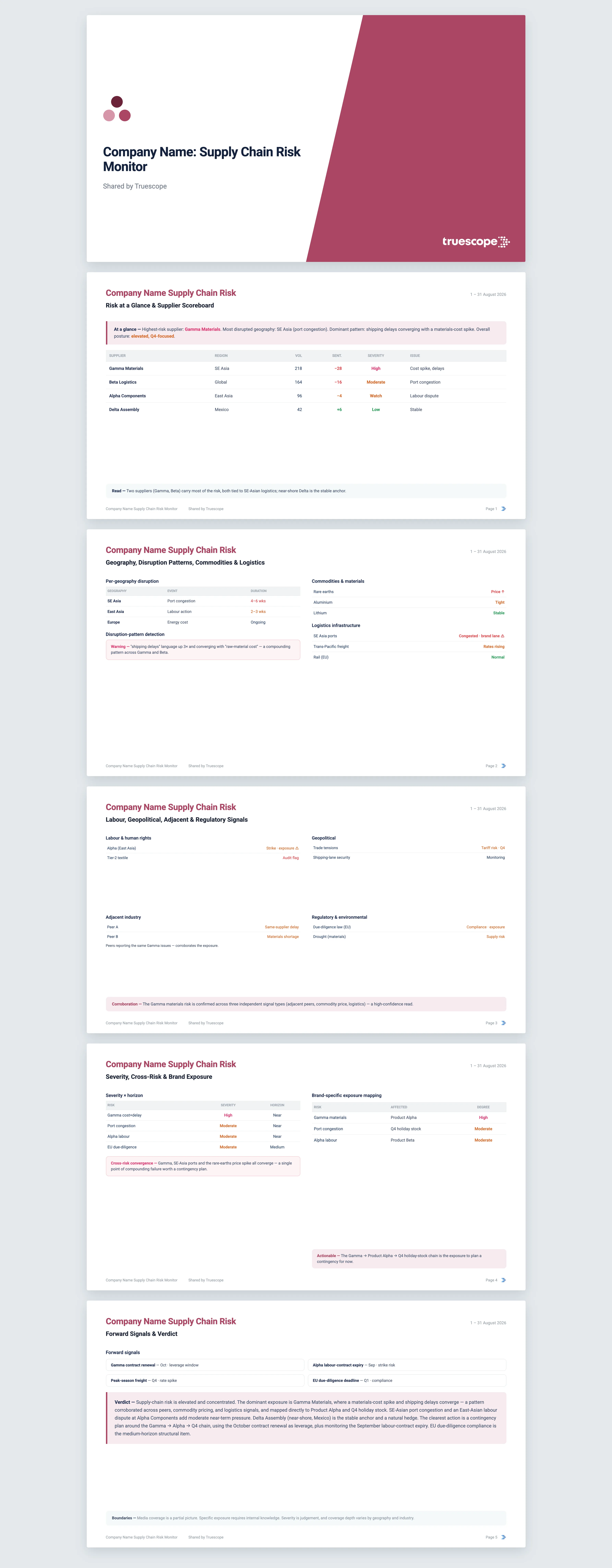
The report opens with a risk picture at a glance, naming your highest-risk supplier, your most disrupted geography, and the dominant disruption pattern. From there it gets specific.
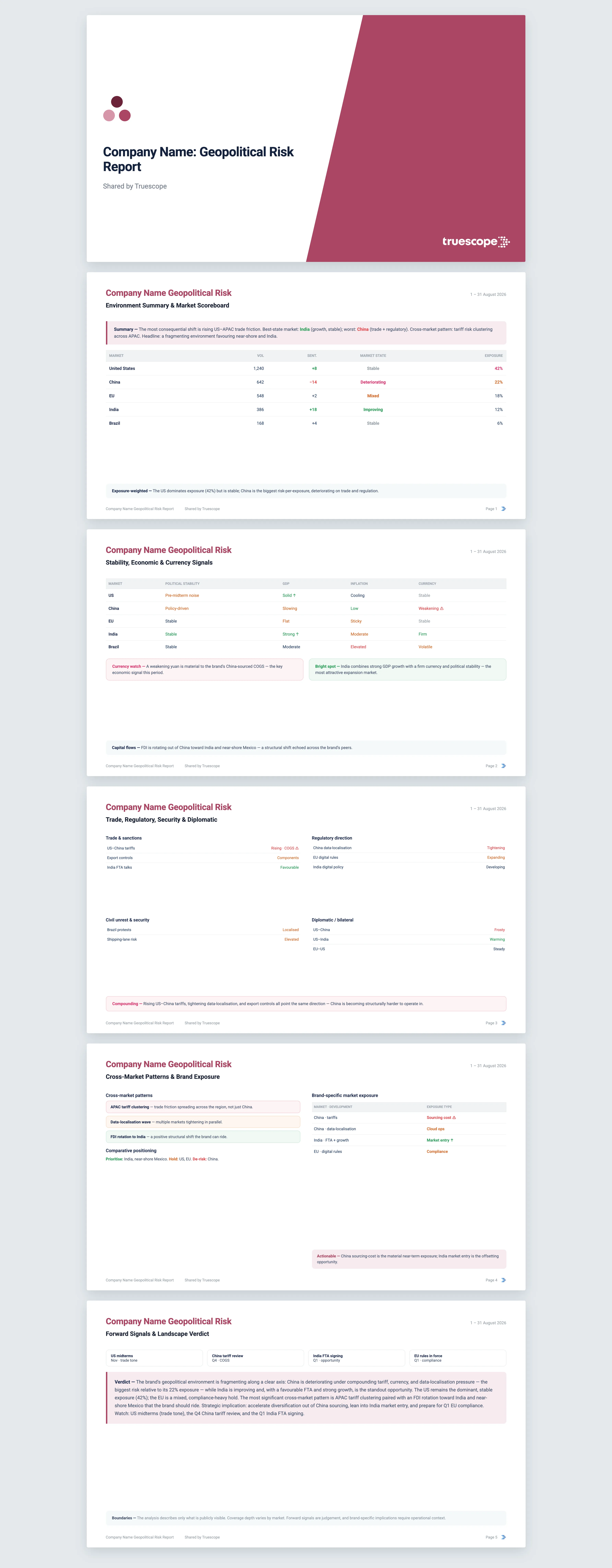
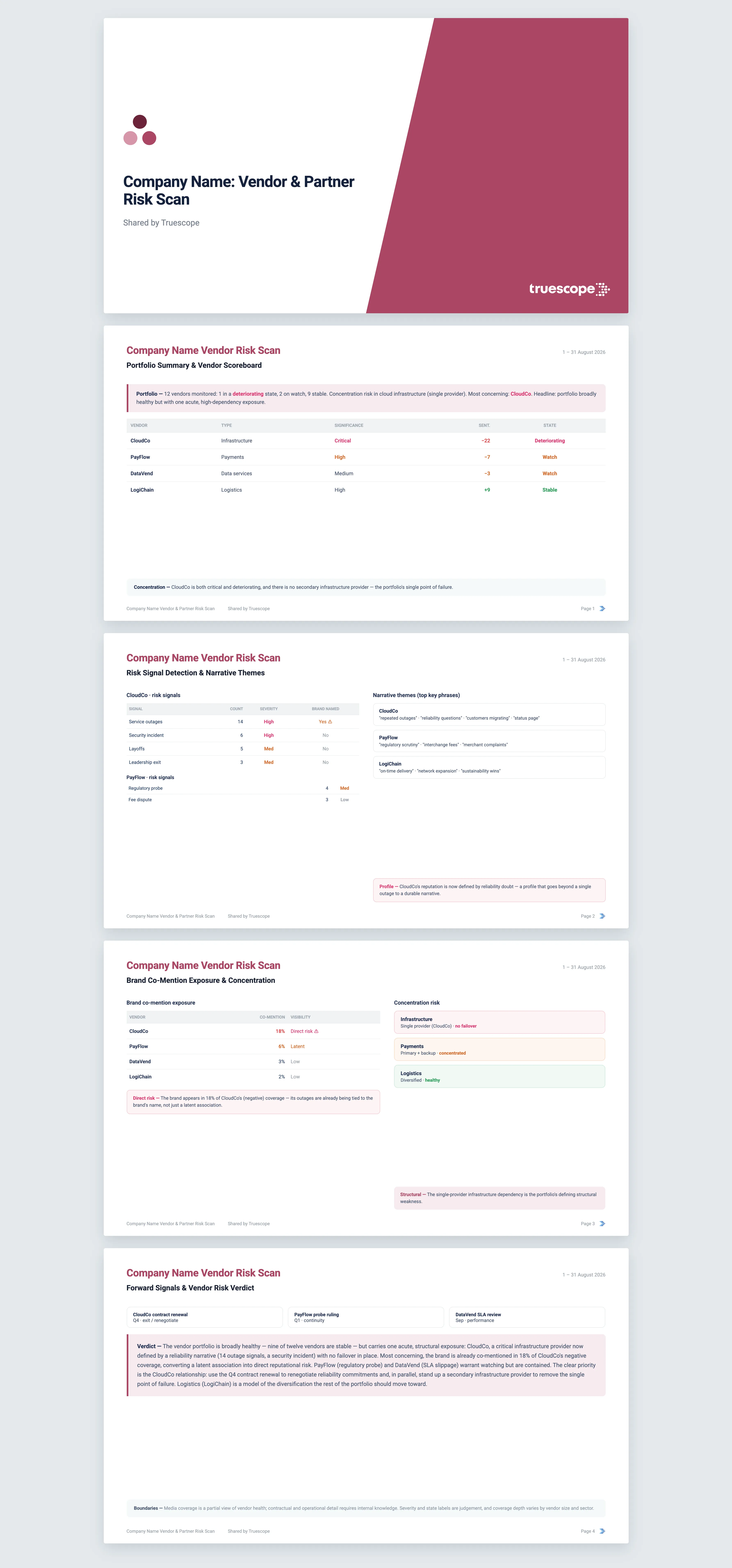
- A per-supplier scoreboard with volume, sentiment, detected incidents, and a severity rating from Critical down to Low.
- Per-geography disruption signals with event timing, scope, and the supply categories likely affected.
- A disruption-pattern table showing which warning phrases are appearing, their trajectory, and the suppliers and geographies involved.
- Commodity, logistics, regulatory, labour, geopolitical, and sustainability signal views.
- Adjacent industry signals, so you can see when several peers report the same supplier issue.
- A severity-and-horizon matrix marking each risk as immediate, weeks-out, or months-out, plus explicit mapping of which of your products or operations each risk affects.
Volume is benchmarked against the prior period, and every finding is cited back to the source coverage behind it.
Who it's for
This is for procurement and supply-chain leaders, operational risk and resilience teams, and the communications and corporate affairs people who need to anticipate the reputational fallout of a supplier's troubles. It suits anyone responsible for keeping goods moving and for warning executives or the board before a disruption becomes a crisis.
Why Truescope Analyst
The traditional way to monitor supplier risk is a patchwork: a buyer who happens to read trade press, a quarterly risk review, and a scramble of phone calls once something has already broken. By then the disruption is operational, not a signal. General AI tools cannot help here either, because they have no view of your supplier list, your geographies, or your live coverage, and they cannot rank one supplier's risk against another's. Truescope Analyst reads your whole media dataset against the suppliers and themes you name, detects disruption language as it appears, rates severity, and maps it to your specific exposure, in minutes. It is built into your subscription, available to the whole team, and every signal is traceable back to the article that raised it.
Frequently asked questions
What do I need to provide to run it?
A named supplier list is required, with identifying terms for each one, since the analysis is only as good as the names it watches. You also set your supply geographies, the supply-chain themes you care about, and any risks you are already tracking.
What time period does it cover?
It covers up to the last 13 months for coverage already in your Truescope inbox, or the last 90 days for global data not yet matched to your workspace. For active monitoring a tighter recent window is usually most useful, while the longer window helps you see a slow-building pattern.
Does it predict which disruptions will actually happen?
No. Severity is a judgement based on the signals visible in coverage. Some flagged risks will not materialise, and some real disruptions will not have left a detectable trace, so the monitor is an early-warning input rather than a forecast.